


TL;DR:
- Effective vocabulary instruction involves engaging activities, thematic grouping, and regular review to promote long-term retention. Incorporating games, personal writing, and morphological understanding enhances students’ connection to words beyond simple memorization. Consistency and purposeful routines are key to transforming vocabulary learning into lasting skills.
Vocabulary lessons are one of the places where student engagement either takes off or falls completely flat. You plan a lesson, introduce ten new words, and by Thursday half the class has forgotten them. This classroom vocabulary activities guide exists to fix that. You will find practical, ready-to-use strategies that move beyond memorization drills and actually stick with students. From setting up your physical space to running games and tracking progress, every section gives you something you can apply the next day.
Table of Contents
- Key takeaways
- Setting up your classroom for vocabulary success
- Active vocabulary games and kinetic learning
- Creative vocabulary exercises for deeper connections
- Reviewing, reinforcing, and measuring progress
- My honest take on vocabulary teaching
- Bring vocabulary practice beyond the classroom
- FAQ
Key takeaways
| Point | Details |
|---|---|
| Start small each week | Selecting 5 to 10 words weekly gives students the depth of practice needed for real retention. |
| Active games beat passive drills | Interactive vocabulary activities like scavenger hunts and movement-based tasks improve recall far better than definitions alone. |
| Group words by theme, not alphabet | Thematic and morphological grouping helps students build connections between words rather than memorizing isolated items. |
| Short routines beat long sessions | Brief daily vocabulary practice maintains engagement and retention better than one long weekly session. |
| Creative writing and discussion cement words | Using new vocabulary in authentic speaking and writing contexts locks words into long-term memory. |
Setting up your classroom for vocabulary success
Good vocabulary instruction starts before any activity begins. The way you organize your words, your walls, and your students’ notebooks shapes every lesson that follows.
How many words to introduce each week
Selecting 5 to 10 new words each week gives you enough material to build variety without overwhelming students. More than that, and practice time gets too thin. With a focused set, you can revisit the same words through games, writing, and discussion across multiple days, which is exactly what builds lasting vocabulary recall.
Word walls that actually do something
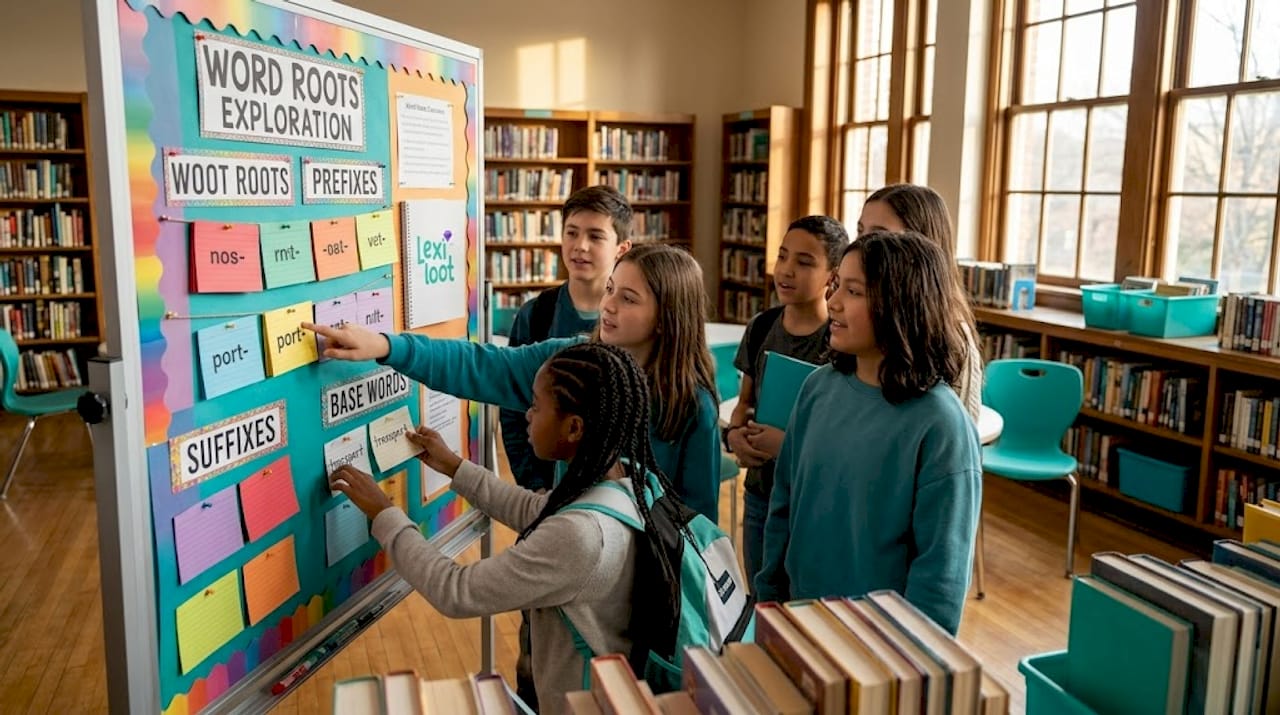
A word wall is only as useful as the thinking behind it. Rather than listing words alphabetically, group words by roots, categories or themes so students see relationships. Pair each word with a small image or a simple student-drawn sketch. Visual aids in word walls improve memory retention significantly, and when students help build the wall, their sense of ownership over the vocabulary grows too.
Vocabulary journals as a personal tool
Give each student a dedicated vocabulary notebook rather than loose worksheets. Students write the word, its meaning in their own words, a sentence, and a quick sketch. This combination of writing, defining, and visualizing hits multiple learning channels at once. It also creates a personal reference students actually use.
Here is a quick reference table for materials you will want to have ready:
| Material | Purpose |
|---|---|
| Index cards | Flashcard games and word sorting activities |
| Student notebooks | Vocabulary journals for personal word connections |
| Markers and chart paper | Word wall construction and category displays |
| Print or digital dictionaries | Scavenger hunts and definition verification |
| Sticky notes | Quick peer review and word-of-the-day sharing |
Pro Tip: When grouping words, try a morphological approach. Cluster words that share a root, like “port” in transport, export, and import. Students who learn one root unlock the meaning of dozens of related words.
Active vocabulary games and kinetic learning
Knowing a word and feeling a word are two different things. The activities in this section connect vocabulary to movement, competition, and discovery, which wakes up attention and creates the kind of repeated exposure that transfers words to long-term memory.
Four games to run this week
-
Dictionary Scavenger Hunt. Give teams a list of 8 to 10 clues that describe words without naming them. Students race to find each word using print or digital dictionaries. This teaches dictionary navigation skills while reinforcing vocabulary in context. Keep it to 15 minutes to maintain energy.
-
A to Z List Game. Call out a category, such as “animals that live in the ocean” or “words related to weather.” Students have 60 seconds to write as many words as they can that fit. The game fosters friendly competition and focus while building category thinking and spelling fluency.
-
Total Physical Response (TPR) Commands. Assign an action to each vocabulary word. “Migrate” might mean walking slowly to one side of the room. “Erode” might mean crouching down slowly. Combining multiple vocabulary words into single commands reinforces meaning through movement and helps kinesthetic learners connect sound to sense.
-
The Letters Game. Choose a 9-letter word from your weekly set and scramble it on the board. Students have 60 seconds to make as many smaller words as they can from those letters. This game spotlights word structure and morphology, showing students how prefixes and suffixes work in practice rather than in theory.
Keeping games focused and on schedule
The biggest mistake teachers make with vocabulary games is letting them run too long. When a game stretches past 15 to 20 minutes, it stops feeling like a challenge and starts feeling like a free period. Set a visible timer, keep point totals clear, and always debrief for two minutes after each game. Ask students: which word was hardest to remember and why? That reflection is where the real learning locks in.
Pro Tip: Rotate game formats across the week. Use a physical movement activity on Monday to introduce words, a competitive game on Wednesday to practice them, and a quick journal entry on Friday to consolidate. This rhythm matches how the brain revisits and strengthens new knowledge.
Creative vocabulary exercises for deeper connections
Games get words into students’ heads. Creative exercises get words into students’ voices and writing. This is where vocabulary becomes truly usable.
Vocabulary journals with personal connections
Earlier we set up vocabulary journals as a material. Now use them actively. Twice a week, give students a five-minute writing prompt that requires them to use three words from the current week’s list in a short paragraph. The prompt should be personal: “Describe a time you felt really determined” or “Write about a place that feels tranquil to you.” Students retain words best when exposed in multiple contexts, and personal writing is one of the most authentic contexts available.
Word association maps
Draw a circle on the board with the target word inside it. Ask students to call out anything the word makes them think of: other words, images, feelings, or memories. Write every response around the circle. This builds a web of mental connections that gives the brain more retrieval paths. When students try to recall the word on a test or in conversation, they have many more threads to pull on.
Here are four ways to deepen this activity for different grade levels:
- Grades 3 to 5: Keep association maps visual. Students draw their connections rather than writing them, then share with a partner.
- Grades 6 to 8: Ask students to sort their associations into categories: synonym, antonym, example, and non-example.
- Grades 9 and up: Have students write a short argument using only the words on the association map, defending a position using precise vocabulary.
- All grades: Display completed maps on the word wall alongside the original word so students can revisit the connections throughout the week.
Discussion and debate circles
Structured discussion forces students to use vocabulary in real time. Assign each student a word from the week’s list and ask them to use it at least twice during a five-minute class debate or discussion. Topics work best when they are mildly provocative for the age group. “Should schools have longer recesses?” gives students a real reason to reach for words like “beneficial,” “concentration,” and “demonstrate.”
Pro Tip: Teaching word parts like prefixes and suffixes reduces reliance on whole-word memorization and gives struggling readers a decoding strategy that works across all subjects, not just language arts. Weave one prefix or suffix into each week’s vocabulary set.
Reviewing, reinforcing, and measuring progress
Introducing vocabulary is only half the work. How you review it determines how much students actually keep.
Scheduling reviews with spaced repetition
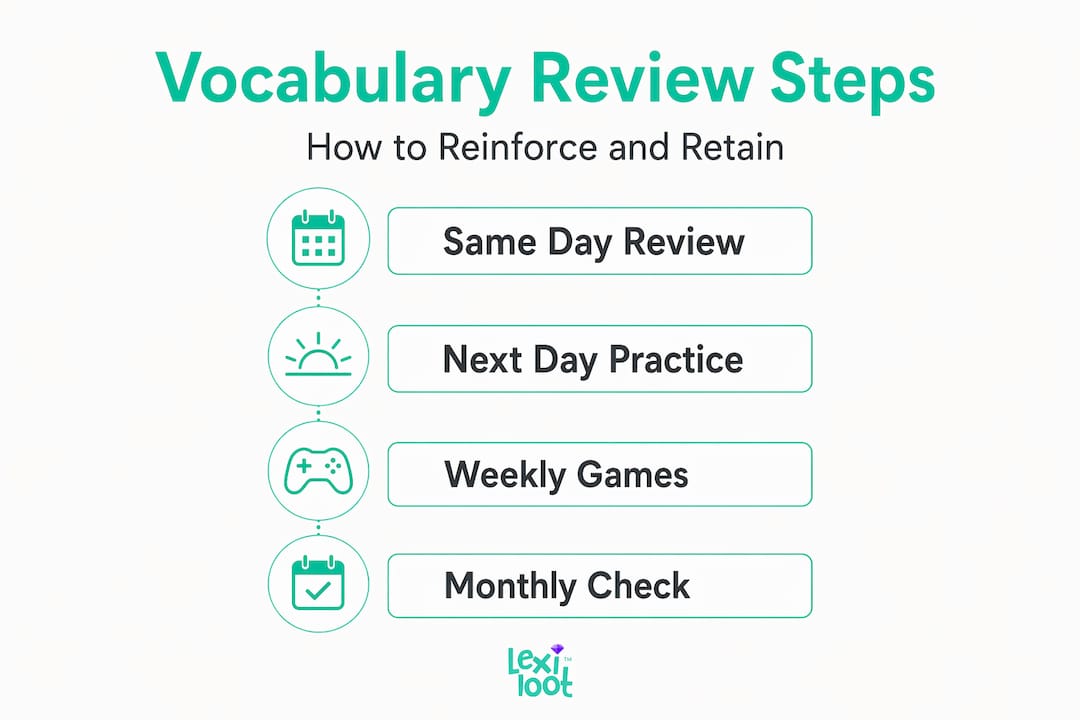
Spaced repetition means revisiting words at increasing intervals. Review new words the same day you introduce them, again two days later, then again a week after that. This pattern matches the way memory consolidates information. Short daily activities like 5-minute trivia cards are sustainable and effective. One long review session each Friday is far less useful than brief, consistent daily check-ins spread across the week.
Multi-sensory review techniques
Effective review touches more than one sense. Here are five techniques that layer input types:
- Say it, write it, draw it. Students say a word aloud, write it from memory, then draw a quick image representing it.
- Peer quizzing. Pairs take turns holding up index cards and asking for definitions or example sentences.
- Mnemonic creation. Students invent a silly sentence or mental image to anchor a difficult word. The sillier the mnemonic, the better it sticks.
- Word sorts. Give students a stack of index cards with this week’s words and ask them to sort into categories of their own choosing. The decision-making process builds understanding.
- Observation logs. Ask students to note every time they encounter a target word outside class, whether in a book, on a screen, or in conversation.
Simple, low-prep assessment methods
You do not need formal tests to measure vocabulary growth. The table below outlines three quick methods that fit into any lesson:
| Method | Time needed | What it measures |
|---|---|---|
| 2-sentence quick write | 5 minutes | Word usage in context |
| Peer vocabulary check | 10 minutes | Definition and example fluency |
| Observation during discussion | Ongoing | Natural vocabulary recall |
For students who need additional support, allow them to use their vocabulary journal during quick writes. For advanced learners, require them to use two or more target words in a single sentence that shows the relationship between the words.
My honest take on vocabulary teaching
I’ve spent a lot of time working through what actually makes vocabulary instruction stick, and the honest answer is simpler than most teaching guides suggest. The biggest mistake I’ve seen is treating vocabulary games as a reward for finishing real work. Well-planned vocabulary games are not a break from learning. They are the mechanism that transfers short-term word exposure into long-term memory. When teachers treat games as filler, they skip the most powerful repetition tool they have.
I’ve also learned that morphology instruction is consistently underused at the elementary level. Teachers often hold it back for older students, but every grade benefits. The moment a student understands that “un” reverses a word’s meaning, they can decode hundreds of words they have never seen before.
My honest advice: pick two or three activities from this guide and run them consistently for four weeks before adding more. Consistency beats variety when it comes to engaging vocabulary exercises. You are not building a show. You are building a habit.
— Philipp
Bring vocabulary practice beyond the classroom
Teachers who build strong classroom vocabulary routines often look for ways to extend that practice into students’ independent time. Lexiloot is built for exactly that.
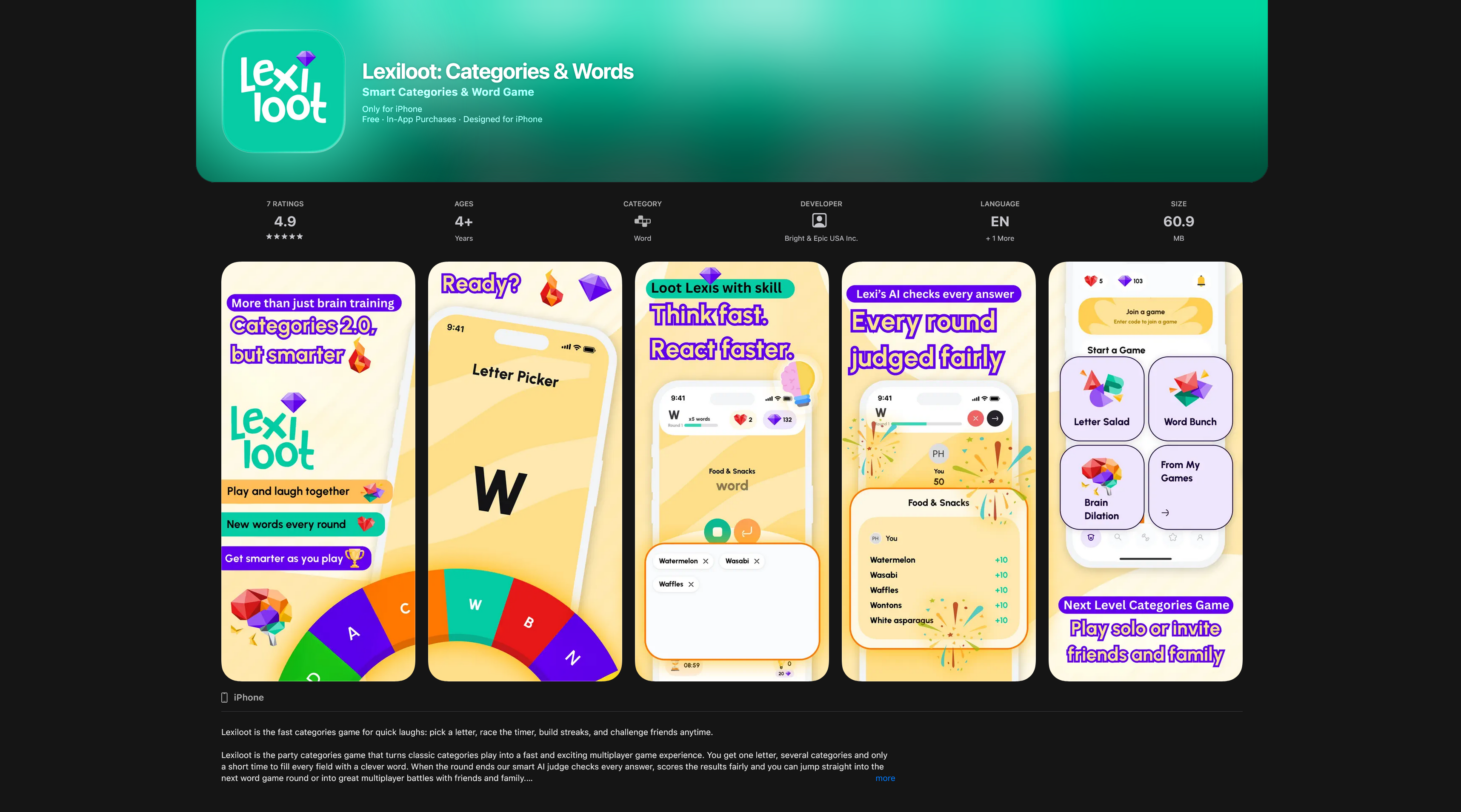
Lexiloot is an iOS categories game that combines word games, vocabulary building, and category-based challenges in one app. Students can practice the same category thinking and vocabulary recall they develop in class through multiplayer competitions and word puzzles they actually want to play. It supports the kind of mobile vocabulary learning that reinforces what you teach without adding work to your plate. You can also explore Lexiloot’s educational game strategies to see how game-based practice maps to real vocabulary outcomes. It is a natural next step after the activities in this guide.
FAQ
How many vocabulary words should I teach per week?
Research supports 5 to 10 words weekly as the right range. This gives students enough time for deep practice through games, writing, and discussion without spreading review too thin.
What is the best way to organize vocabulary instruction?
Group words thematically or by shared word roots rather than alphabetically. Students build stronger connections between words when they can see patterns, which improves both recall and reading comprehension.
How do vocabulary games support long-term retention?
Vocabulary games provide repeated exposure in a context that keeps students engaged. Engagement drives repetition, and repetition is what moves words from short-term awareness into long-term memory.
How can I quickly assess vocabulary progress without formal tests?
Quick writes, peer quizzing with index cards, and observation during class discussions all give you usable data in under ten minutes. Tracking how students use words in conversation is often more revealing than a written quiz.
What vocabulary activities work for diverse learners?
TPR activities and word association maps work across ability levels because they allow multiple response types, movement, drawing, and speaking. For struggling readers, teaching word parts provides an independent decoding strategy that reduces reliance on memorization alone.

