


TL;DR:
- In 2026, mobile gaming dominates revenue, shaping a reshaped industry driven by partnerships and monetization shifts. Co-development becomes a standard strategy to manage rising costs and investor expectations, while hardware shortages push prices higher and accelerate engine migrations like Godot. The industry remains economically concentrated and culturally challenged, with ongoing workforce overwork and limited diversity impacting creative output.
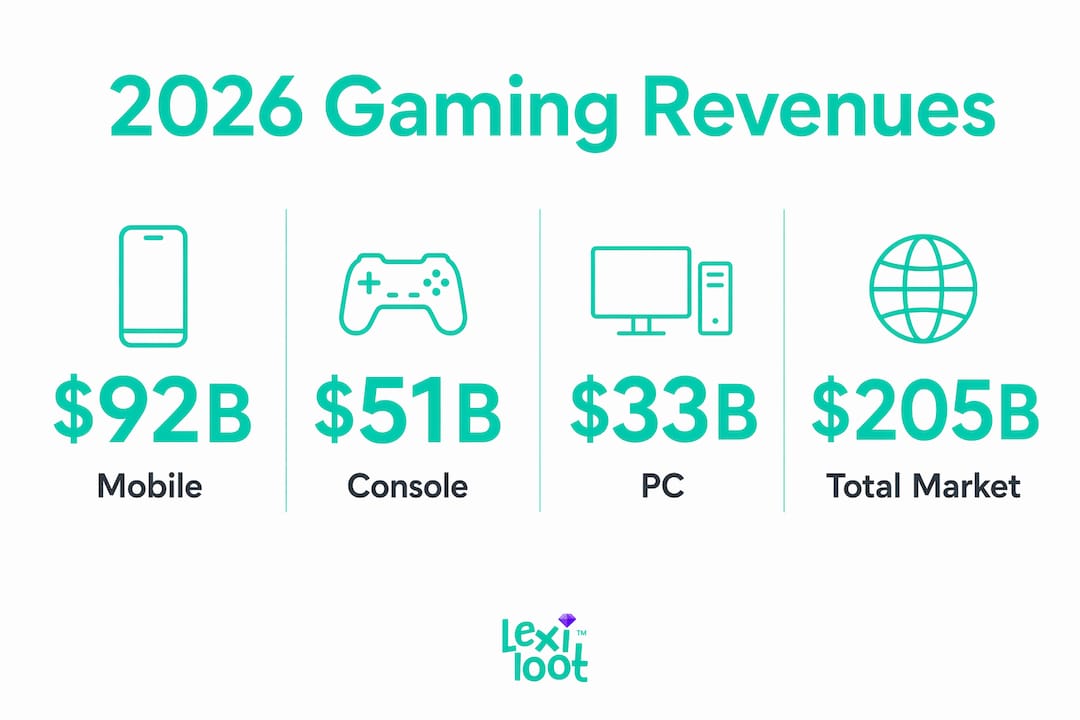
Gaming trends in 2026 are defined by rising mobile revenues, co-development partnerships, and a hardware market reshaped by global memory shortages. The global gaming industry is on track to reach $205 billion in revenue, with mobile alone accounting for $92 billion. Whether you follow the industry as a player, analyst, or developer, the forces shaping games this year are more interconnected than ever before. Sensor Tower, GDC, and Nvidia are all pointing to the same conclusion: the future of gaming belongs to studios and platforms that adapt fast.
What are the major market forces driving gaming in 2026?
The global gaming market is not just growing. It is restructuring. Mobile dominates at $92 billion, console sits at $51 billion, and PC holds $43 billion, reflecting a clear shift in where players spend their time and money.

Mobile in-app purchase revenue reached $81.75 billion in 2025 with only 1.3% year-over-year growth, while total game downloads fell 7.2% to 50.41 billion. That combination tells a specific story: players are spending more per session but downloading fewer new titles. Engagement is deepening, not widening.
| Platform | 2026 Revenue | Key Trend |
|---|---|---|
| Mobile | $92 billion | IAP growth, download decline |
| Console | $51 billion | Hardware price pressure |
| PC | $43 billion | Engine migration, indie growth |
| Global Total | $205 billion | Modest but stable growth |
Console and PC markets remain significant, but neither is growing at mobile’s pace. Console faces hardware cost headwinds, while PC benefits from a surge in indie development. For analysts, the takeaway is that platform diversification is no longer optional. Publishers who rely on a single platform are increasingly exposed to volatility.
Pro Tip: If you track gaming stocks or studio performance, watch mobile IAP revenue per download as a leading indicator. When downloads fall but revenue holds, it signals stronger player loyalty and better monetization design.
How is co-development changing game production?
Co-development is the industry term for cross-company partnerships where studios share talent, tools, and production costs on a single project. According to the GDC 2026 Trends Report, co-development maturity is accelerating as rising costs and funding difficulties force studios to pool resources rather than build in isolation.
The shift matters for several reasons:
- Investor expectations have changed. Funding now typically requires a working prototype before capital is committed, pushing studios toward partnerships that share early-stage costs.
- AAA studios benefit from specialist partners. Rather than hiring full internal teams for every discipline, large studios contract specialized co-development partners for art, QA, or narrative design.
- Indie studios gain access to infrastructure. Smaller teams can attach to co-development arrangements that give them publishing support, marketing reach, and technical resources they could not afford alone.
- Cross-company collaboration reduces single-point failure. When one studio faces a funding gap, a co-development partner can absorb some of the load without the project collapsing entirely.
The GDC report frames this as a maturation of the industry rather than a crisis response. Studios that treat co-development as a permanent operating model, not a temporary fix, are better positioned to weather funding cycles. For indie developers especially, building a network of co-development relationships is now as important as building the game itself.
What emerging technologies and hardware trends are shaping gaming in 2026?
The technology side of gaming innovations in 2026 is defined by two competing forces: AI making development faster, and hardware shortages making it more expensive.
Here is how those forces are playing out in practice:
-
Generative AI handles administrative load. The GDC 2026 Trends Report shows AI is primarily used for brainstorming, task management, and administrative efficiency rather than creative generation. This is especially valuable for neurodivergent and senior professionals, who report that AI tools reduce cognitive load on repetitive tasks and free attention for design work.
-
Memory shortages have ended cheap hardware. A global shortage of high-bandwidth memory has forced Valve and Nintendo to raise MSRP on their hardware to protect margins. The Epiction 2026 report describes this as the end of the low-cost consumer hardware era, which means players should expect higher entry prices for new devices through at least the near term.
-
Engine migration is accelerating in indie development. The indie market shift to Godot is gaining real momentum. Developers cite zero-license risk and faster iteration cycles as the primary reasons for moving away from Unity. Godot’s open-source model removes the financial unpredictability that Unity’s pricing changes introduced in 2023 and 2024.
-
Hardware price hikes are reshaping player expectations. When the cost of a new console or handheld rises, players hold onto existing hardware longer and shift spending toward software and subscriptions. This indirectly benefits mobile and browser-based platforms, which require no new hardware investment.
Pro Tip: If you are an indie developer evaluating engines, Godot’s zero-license model is not just a cost saving. It removes a category of business risk entirely. You will never face a mid-project pricing change from the engine provider.
How are monetization strategies evolving in mobile and other gaming sectors?
Monetization in 2026 is moving away from pure platform dependency and toward direct relationships between publishers and players. The two biggest shifts are dual monetization in mobile and the growth of direct-to-consumer models enabled by recent legal changes.
Key developments shaping this area:
- Dual monetization combines ads and in-app purchases. Mobile publishers are no longer choosing between ad revenue and IAP. They are running both simultaneously, targeting different player segments within the same game.
- D2C payments are now legally viable in more markets. Legislative changes have opened pathways for publishers to accept payments directly, bypassing traditional platform storefronts.
- The financial case for D2C is strong. D2C monetization can generate an additional $250,000 per $1 million in revenue compared to traditional platform sales. That margin difference is significant enough to justify the technical investment in building direct payment infrastructure.
- Player experience improves with D2C done well. The most effective D2C implementations add value through rewards like daily streaks and loyalty bonuses rather than simply offering discounts. Frictionless checkout is non-negotiable. A clunky payment flow eliminates the conversion advantage entirely.
| Monetization Model | Revenue Advantage | Player Benefit |
|---|---|---|
| Platform storefront | Broad reach, built-in trust | Familiar checkout experience |
| Direct-to-consumer | Up to 25% higher margin | Rewards, streaks, loyalty perks |
| Dual (ads + IAP) | Maximizes revenue per user | Free access with optional upgrades |
The shift toward D2C also reflects a broader trend in word game trends 2026 and educational gaming, where pay-once models and ad-free upgrades align naturally with what families and educators want from a mobile experience.
What cultural and workforce dynamics are influencing the gaming industry in 2026?
The people building games in 2026 are under significant pressure. The game workforce is 64% under 35 and 66% male, a demographic profile that has remained largely unchanged for years. That lack of diversity has real consequences for the kinds of games that get made and the players who feel represented in them.
Crunch culture remains one of the industry’s most persistent problems. 87% of gaming employees report working overtime, driven by both self-imposed pressure and project deadlines. That figure means crunch is not an exception in game development. It is the norm. The health and retention costs of sustained overwork are well documented, yet structural change has been slow.
“The gaming workforce is young, male-dominated, and overworked. Until the industry addresses all three of those realities together, the cultural products it creates will reflect those limitations.”
Layoffs have hit AAA studios harder than indie teams in 2026, partly because large studios carry higher fixed costs and are more exposed to investor pressure. Indie developers, operating leaner by necessity, have shown more resilience. Anti-DEI policy shifts in some markets have added additional pressure on marginalized workers, who report higher uncertainty about job security and workplace inclusion. For analysts watching the industry, workforce health is a leading indicator of creative output quality. Studios that invest in sustainable working conditions consistently produce more consistent work over time.
Key takeaways
Gaming trends in 2026 are shaped by mobile revenue growth, co-development partnerships, AI-assisted production, hardware cost increases, and monetization shifts toward direct-to-consumer models.
| Point | Details |
|---|---|
| Mobile leads revenue | Mobile gaming generates $92B, with IAP growth outpacing download volume. |
| Co-development is standard | Studios partner across companies to share costs and meet investor prototype demands. |
| AI aids productivity | Generative AI handles administrative tasks, reducing cognitive load for developers. |
| Hardware costs are rising | Memory shortages have pushed Valve and Nintendo to increase device pricing. |
| D2C monetization pays off | Direct-to-consumer models can add $250K per $1M compared to platform storefronts. |
My read on where gaming is actually headed
The data from Sensor Tower, GDC, and Epiction all point in the same direction, but the interpretation most analysts miss is this: the gaming industry is not growing uniformly. It is concentrating. Revenue is rising, but it is flowing to fewer titles, fewer platforms, and fewer studios with the right co-development networks in place.
What I find genuinely interesting about 2026 is the Godot migration. Engine choice used to be a technical decision. Now it is a business risk decision. The studios moving to Godot are not doing it because it is technically superior in every dimension. They are doing it because they cannot afford the uncertainty of a proprietary engine changing its pricing model mid-project. That is a rational, mature response to a real business threat, and it signals that indie developers are thinking more like operators than ever before.
The cultural workforce data is harder to sit with. An industry where 87% of workers report overtime and nearly 20% have been personally affected by layoffs is not a healthy creative environment. The best games come from teams with enough stability to take creative risks. That is not a soft observation. It is a production quality argument.
For players and educators watching these trends, the most practical implication is that mobile gaming is where the most monetization experimentation is happening. The D2C shift, dual monetization, and pay-once models are all being tested in mobile first. What works there will spread to other platforms within two to three years. Paying attention to mobile vocabulary learning and educational gaming now gives you a clear view of where engagement design is heading.
— Philipp
Explore educational gaming with Lexiloot
The gaming trends shaping 2026 are not just for hardcore players or industry insiders. They matter for anyone who uses games to learn, teach, or build skills.
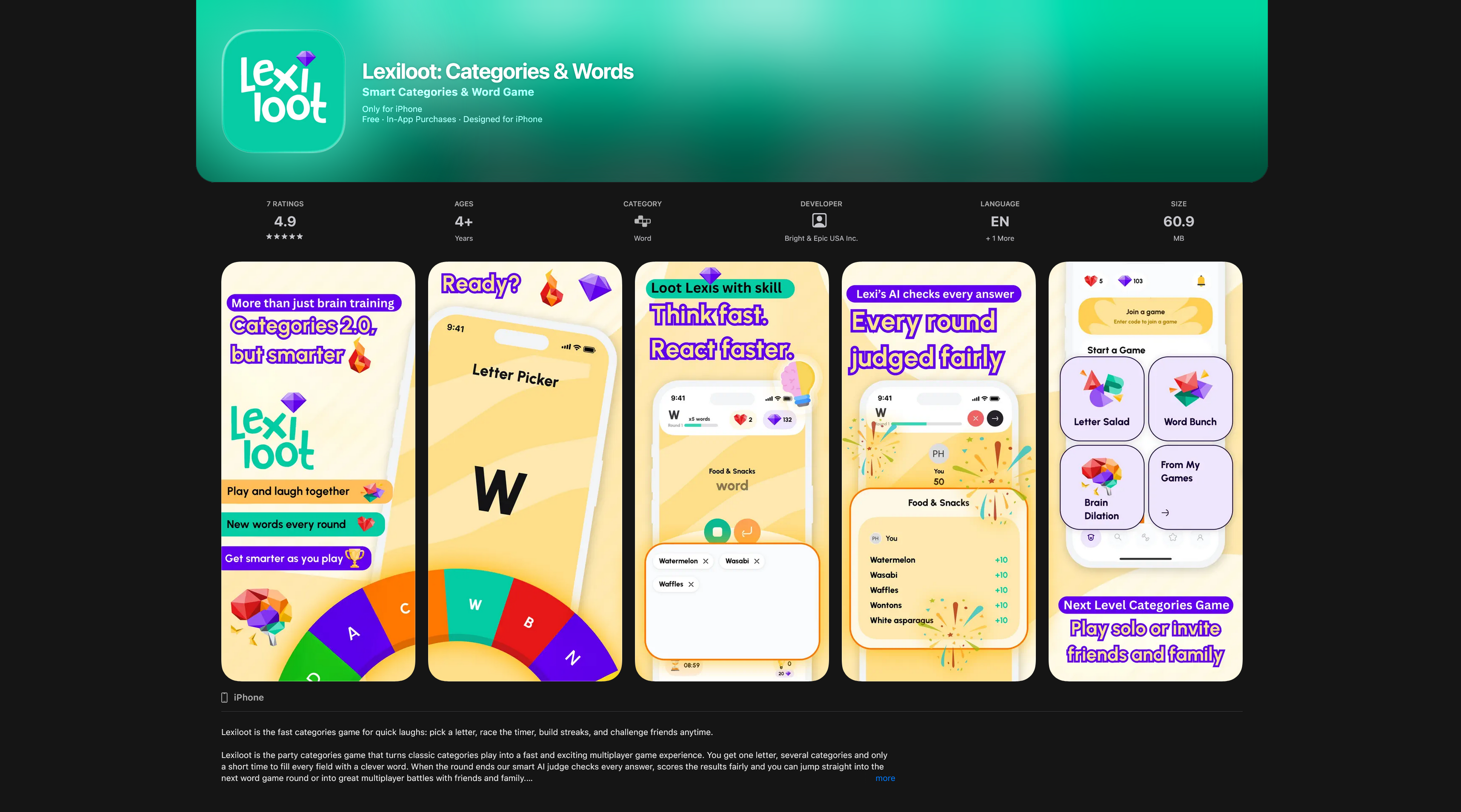
Lexiloot sits at the intersection of mobile gaming growth and educational value. As mobile platforms deepen engagement and shift toward pay-once models, Lexiloot offers exactly that: a word game and categories challenge app with no subscription, ad-free premium play, and multiplayer modes that work for families, classrooms, and independent learners. If you want to see how games support real learning outcomes, Lexiloot is built on that evidence. Download it on iOS and put the vocabulary-building and cognitive training trends of 2026 to work for you.
FAQ
What is the global gaming market size in 2026?
The global gaming market is projected to reach $205 billion in 2026, with mobile accounting for $92 billion, console $51 billion, and PC $43 billion.
Why are gaming hardware prices rising in 2026?
A global shortage of high-bandwidth memory has forced hardware makers including Valve and Nintendo to raise MSRP to protect margins, effectively ending the era of low-cost consumer gaming devices.
What is co-development in the gaming industry?
Co-development refers to cross-company partnerships where studios share talent, tools, and production costs on a single project, a model growing in 2026 due to rising development costs and investor demands for working prototypes before funding.
How does direct-to-consumer monetization benefit game publishers?
D2C monetization can generate an additional $250,000 per $1 million in revenue compared to traditional platform storefronts, while also improving player retention through loyalty rewards and frictionless checkout experiences.
Is crunch culture still a problem in gaming in 2026?
Yes. According to the State of the Game Industry 2026, 87% of gaming employees report working overtime, confirming that crunch culture remains a structural norm rather than an exception across the industry.

