


TL;DR:
- Cognitive training can reduce dementia risk by up to 29% over 20 years.
- Fun, social word games effectively challenge and strengthen memory, vocabulary, and focus.
- Consistent, enjoyable mental exercises combine with lifestyle habits for best long-term brain health.
Cognitive training can cut your dementia risk by 25 to 29% over 10 to 20 years, according to long-term research. That’s not a small number. And here’s the part most people miss: you don’t need boring drills or clinical programs to get there. Fun, social activities like word games and vocabulary challenges can give your brain a genuine workout while keeping you engaged enough to actually stick with it. This guide breaks down what brain training really means, what the science says, and how you can make cognitive exercise something you look forward to every day.
Table of Contents
- What does it mean to train your brain?
- The science-backed benefits of training your brain
- Why word games are powerful tools for brain and vocabulary growth
- Common pitfalls and the real limits of brain training
- Our take: Training your brain should be fun, social, and surprisingly simple
- Ready to boost your brain? Try engaging word games
- Frequently asked questions
Key Takeaways
| Point | Details |
|---|---|
| Brain training cuts dementia risk | Consistent cognitive training can reduce your risk of dementia by up to 25 percent. |
| Games boost vocabulary and focus | Word and puzzle games enhance vocabulary, memory, and mental agility for all ages. |
| Expect realistic results | Gains are moderate and task-specific—regular practice matters more than magic solutions. |
| Social play multiplies benefits | Training with friends or family increases motivation, consistency, and cognitive outcomes. |
What does it mean to train your brain?
Brain training is the practice of regularly challenging your mind with structured activities designed to strengthen specific cognitive skills. Think of it like going to the gym, but instead of building muscle, you’re building mental capacity. The core skills targeted include working memory (your ability to hold and use information in the moment), processing speed (how fast your brain handles incoming data), and attention control.
Neuroplasticity is the brain’s ability to form new connections and reorganize itself in response to learning and experience. It’s not a fixed trait. Your brain stays adaptable throughout life, which means cognitive training at any age can produce real changes. This is the biological foundation behind why consistent mental exercise works.
There are several common misconceptions worth clearing up:
- Brain training is only for older adults. False. Young people, students, and working professionals all benefit from regular cognitive exercise.
- It’s just playing games with no real effect. False. Structured, progressively challenging activities produce measurable brain changes.
- You need expensive software or clinical tools. False. Well-designed word games and category puzzles can deliver meaningful cognitive benefits.
- Results happen overnight. False. Consistency over weeks and months drives real gains.
Here’s a quick look at what happens in your brain when you train regularly:
| Brain process | What it does | How training helps |
|---|---|---|
| Neuroplasticity | Forms new neural pathways | Strengthens connections with repeated challenge |
| Acetylcholine release | Supports memory and learning | Increases by 2.3% with intensive training |
| Working memory | Holds active information | Improves with adaptive tasks |
| Processing speed | Handles information quickly | Responds well to timed challenges |
Understanding the right brain training terms helps you choose activities that target the right skills. The key takeaway is that the brain responds to challenge and repetition, much like any other system in your body.
Pro Tip: Variety and progressive difficulty matter more than time spent. Ten focused minutes on a challenging word puzzle beats an hour of easy repetition.
Now that you know brain training isn’t just hype, let’s break down what it actually involves.
The science-backed benefits of training your brain
Understanding what brain training is, it’s time to see what the science really says about its impact.
The evidence is encouraging. Brain training games improve cognitive functioning, working memory, and processing speed in healthy individuals, with statistically significant effects across multiple studies. This isn’t one isolated study. Meta-analyses pooling data from dozens of trials consistently show real, measurable improvements.
The cognitive domains that respond best to training include:
- Working memory: Your ability to remember and use information in real time, like following multi-step directions or solving problems on the fly.
- Processing speed: How quickly your brain can interpret and respond to information, which affects reading, decision-making, and reaction time.
- Focus and sustained attention: The ability to stay on task without losing concentration, which improves with regular practice on engaging challenges.
- Vocabulary recall: Actively using and retrieving words strengthens the neural pathways linked to language and communication.
“Meta-analyses show moderate cognitive gains from training (Hedges’ g=0.451), alongside measurable neural changes in trained individuals.”
To put that effect size in perspective, a Hedges’ g of 0.451 is considered a moderate effect in psychology research. It’s not a miracle cure, but it’s a meaningful, real improvement.
Here’s how different training approaches compare:
| Training type | Cognitive benefit | Engagement level | Transfer to daily life |
|---|---|---|---|
| Adaptive speed games | High (processing speed, memory) | High | Moderate to strong |
| Social word games | High (vocabulary, recall, focus) | Very high | Strong |
| Traditional puzzles (e.g., sudoku) | Moderate (logic, pattern) | Moderate | Limited |
| Rote memorization tasks | Low to moderate | Low | Weak |
The vocabulary and cognition boost from word games stands out in this comparison. Social, adaptive games keep engagement high, which means you practice more consistently. And consistency is what drives real results. If you want to boost vocabulary and brainpower, the research points clearly toward game-based, socially engaging formats.
Set realistic expectations. Cognitive training produces moderate, skill-specific improvements. It won’t turn you into a genius, but it will sharpen the skills you use every day.
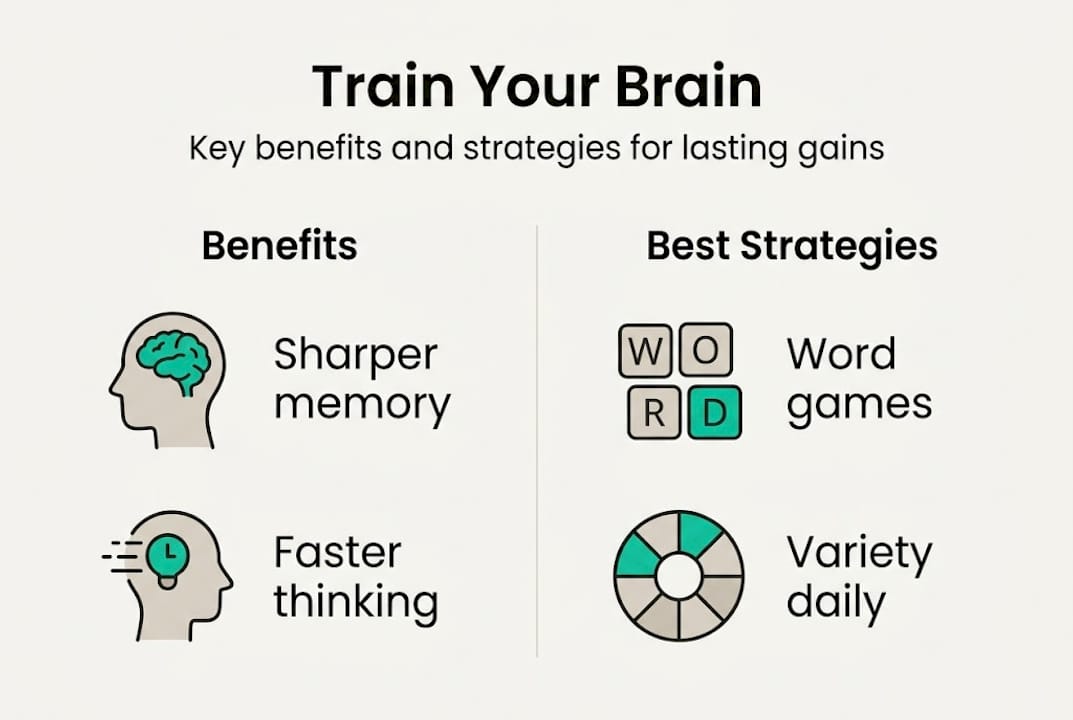
Why word games are powerful tools for brain and vocabulary growth
Cognitive games are powerful on their own, but let’s see why word games truly stand out.

Word games do something that generic brain training apps often miss: they combine challenge, social interaction, and genuine enjoyment in one activity. When you’re laughing with friends over a category puzzle or racing to recall vocabulary under pressure, your brain is fully engaged. That emotional engagement isn’t a bonus. It’s actually what makes the training stick.
Word games enhance vocabulary, memory, focus, and may even delay cognitive decline. Here’s a step-by-step look at what happens during a typical vocabulary game session:
- Attention activates. The game presents a challenge, like naming items in a category within a time limit. Your brain immediately focuses.
- Memory retrieval begins. Your brain scans what it already knows, pulling words from long-term storage into working memory.
- Processing speed engages. You’re working against time or competition, which pushes your brain to retrieve and evaluate words faster.
- Vocabulary expands. You encounter new words from other players or game prompts, and the emotional context of the game helps lock them into memory.
- Social reinforcement occurs. Competing, laughing, or collaborating with others creates positive associations that motivate you to play again.
When choosing a word game for cognitive training, look for these qualities:
- Progressive difficulty that grows as your skills improve
- Category-based challenges that build category thinking and word association
- Multiplayer or social features that add motivation and accountability
- Variety in game modes to prevent boredom and keep the brain adapting
Pro Tip: Playing word games with others, whether family, friends, or online competitors, significantly increases how often you’ll return to practice. Social play turns a solo habit into a shared routine.
Exploring modern word puzzles is a great way to find formats that match your skill level and interests. There are also many word puzzle varieties worth trying to keep your sessions fresh and your brain challenged.
Enjoyment equals consistency. And consistency is what produces lasting cognitive and vocabulary growth.
Common pitfalls and the real limits of brain training
Before you get started, it’s important to understand both the real benefits and the common mistakes to avoid.
Brain training has genuine value, but it also has real limits. One of the most important concepts here is the difference between near transfer and far transfer. Near transfer means you get better at the specific task you practice. Far transfer means those improvements carry over to unrelated real-world skills. Near transfer is well-supported. Far transfer is not.
Many studies show limited far transfer, with improvements often task-specific and no consistent broad IQ or real-life gains. Similarly, adaptive cognitive training induces neuroplasticity, but transfer to real-world skills remains debated, with near transfer common and far transfer inconsistent.
Common pitfalls to watch out for:
- Overestimating benefits. Expecting brain training to dramatically boost your IQ or eliminate cognitive decline sets you up for disappointment.
- Inconsistent practice. Sporadic sessions produce little lasting change. Short, daily practice beats occasional marathon sessions.
- Ignoring physical health. Exercise, sleep, and nutrition all support cognitive function. Brain training works best as part of a broader healthy lifestyle.
- Choosing passive activities. Watching educational videos or doing very easy puzzles doesn’t push your brain hard enough to stimulate real change.
- Skipping social engagement. Isolated training misses the motivational and cognitive benefits of social play.
Here’s a realistic picture of what brain training can and can’t do:
| Outcome | Realistic expectation | Exaggerated claim |
|---|---|---|
| Working memory | Moderate improvement over weeks | Dramatic IQ boost |
| Processing speed | Measurable gains with adaptive tasks | Instant mental sharpness |
| Vocabulary recall | Steady growth with regular word games | Fluency in weeks |
| Dementia prevention | Reduced risk, not elimination | Complete protection |
| Real-world transfer | Near transfer likely, far transfer limited | Total life improvement |
The best approach combines brain training with physical activity, quality sleep, social connection, and varied mental challenges. Learning how to teach word games in group settings is one practical way to add social and cognitive value at the same time.
Our take: Training your brain should be fun, social, and surprisingly simple
After learning what the research and experts say, consider this perspective.
We’ve seen a lot of people start cognitive training programs with the best intentions and quit within two weeks. Not because the science is wrong, but because the approach was joyless. Dry apps with repetitive tasks and no social element feel like homework. And nobody sticks with homework for years.
The real secret to lifelong cognitive gains isn’t the most scientifically optimized program. It’s the one you actually keep doing. Enjoyment is not a nice-to-have feature. It’s the mechanism that drives consistency, and consistency is what produces neuroplasticity over time.
Social, game-based contexts deliver something that solo drills can’t: accountability, laughter, and genuine motivation to return. When you compete with a friend or challenge your family, you’re not just training your brain. You’re building a habit reinforced by human connection.
We believe family word games and community-based play are among the most underrated cognitive tools available. Playful competition and shared vocabulary challenges beat rigid training regimens every time, because they’re sustainable. Keep it fun, keep it social, and your brain will thank you for decades.
Ready to boost your brain? Try engaging word games
Inspired to level up your own brain training? Here’s how to start engaging and reaping real-world benefits.
Lexiloot brings together everything the research supports: adaptive word challenges, category-based thinking games, and social multiplayer competitions, all in one place. Whether you want to sharpen your vocabulary recall, challenge a friend, or explore new word puzzle formats, the app makes it easy to build a consistent, enjoyable practice.
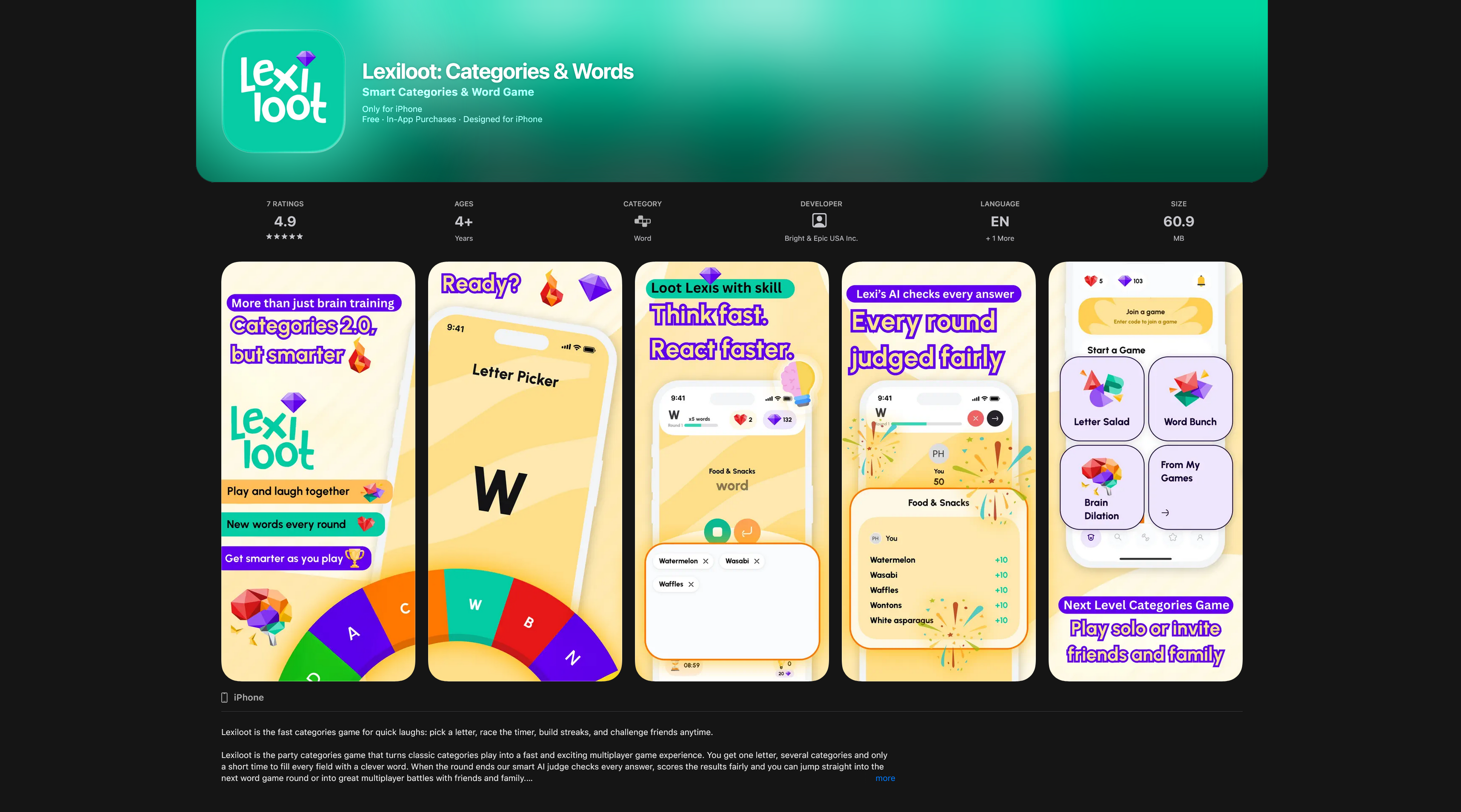
You can explore guides on how to boost brainpower with word games and discover practical word game strategies that help you improve your scores and your cognitive skills at the same time. Ready to make brain training a part of your daily routine? Discover Lexiloot and start playing today.
Frequently asked questions
Can brain training games really make me smarter?
Brain training games can improve specific skills like memory and processing speed, but broad IQ gains are not consistently supported by research. Think of it as sharpening targeted skills rather than a general intelligence upgrade.
How often should I play word or brain games for best results?
Most research supports daily sessions of 20 to 30 minutes. Intensive daily training over 10 weeks has been shown to produce measurable brain chemical changes in older adults.
What are the best types of games to train your brain?
Adaptive speed-of-processing games show the strongest long-term benefits, while social word games add vocabulary and memory benefits with higher engagement.
Will brain training stop dementia or Alzheimer’s?
Cognitive training can reduce dementia risk by about 25 to 29%, but it cannot eliminate dementia or cure Alzheimer’s disease. It’s a meaningful protective factor, not a guarantee.

