


Many parents and educators believe vocabulary learning must be a tedious chore involving flashcards and repetitive drills. This misconception keeps children disengaged and struggling to retain new words. Research shows that gamified learning boosts vocabulary skills by increasing motivation and retention far beyond traditional methods. When vocabulary practice transforms into an exciting game with challenges, rewards, and social competition, children naturally spend more time learning and remember words longer. This article explains how gamification turns vocabulary building into an enjoyable experience that simultaneously enhances cognitive abilities, providing practical strategies for parents and educators to implement at home and in classrooms.
Table of Contents
- What Is Gamified Vocabulary Learning And Why Does It Matter?
- How Gamification Enhances Children’s Vocabulary Development And Cognitive Skills
- Comparing Gamified Vocabulary Tools And Traditional Methods
- Practical Ways To Gamify Vocabulary Learning At Home And School
- Explore Lexiloot’s Gamified Vocabulary Learning Tools
- Frequently Asked Questions About Gamified Vocabulary Learning
Key takeaways
| Point | Details |
|---|---|
| Gamification increases engagement | Game elements like points and levels motivate children to practice vocabulary more frequently and enthusiastically. |
| Memory retention improves significantly | Repeated exposure through fun challenges helps children remember new words better than traditional drills. |
| Cognitive skills develop alongside vocabulary | Gamified learning simultaneously builds problem solving, attention, and creative thinking abilities. |
| Multiple proven tools exist | Parents and educators can choose from various digital platforms and physical games suited to different ages and learning styles. |
What is gamified vocabulary learning and why does it matter?
Gamification in education means applying game design elements to learning activities to boost motivation and engagement. Instead of memorizing word lists through repetition, children earn points for correct answers, unlock new levels as they progress, complete timed challenges, and receive immediate feedback on their performance. These elements tap into natural human desires for achievement, competition, and mastery.
Traditional vocabulary drills often fail because they lack emotional engagement and contextual meaning. Children view flashcards and worksheets as boring obligations rather than exciting opportunities. The brain requires emotional connection and repeated exposure in varied contexts to move words from short term to long term memory. Defining brain training terms for vocabulary games shows how gamified approaches create these essential conditions naturally.
Game elements used in vocabulary learning include progression systems where children advance through increasingly difficult levels, reward mechanisms that provide virtual badges or unlockable content, competitive leaderboards that encourage friendly rivalry, and adaptive difficulty that adjusts to each child’s skill level. This personalization ensures children remain challenged without becoming frustrated or bored.
The cognitive benefits extend beyond vocabulary acquisition. Games require children to make quick decisions, recognize patterns, categorize information, and apply strategic thinking. These mental exercises strengthen neural pathways associated with language processing and executive function. Children develop metacognitive skills as they learn to monitor their own progress and adjust strategies.
Pro Tip: Schedule three 10 minute game sessions daily rather than one 30 minute block to maximize retention through spaced repetition while maintaining high engagement levels.
Adaptive games automatically adjust difficulty based on performance, ensuring optimal challenge levels. If a child consistently answers correctly, the game introduces more complex words or faster time limits. Conversely, struggling learners receive additional practice with foundational vocabulary before advancing. This personalization makes gamified learning effective for diverse ability levels within the same classroom or family.
How gamification enhances children’s vocabulary development and cognitive skills
Motivation drives practice frequency, and practice frequency determines learning outcomes. When children find vocabulary games enjoyable, they voluntarily spend more time playing, resulting in exponentially greater word exposure than forced study sessions. This intrinsic motivation creates a positive feedback loop where success breeds confidence, which encourages continued practice.
Immediate feedback mechanisms in games help memory consolidation by reinforcing correct associations and correcting errors instantly. Traditional methods often delay feedback until a teacher grades assignments, allowing misconceptions to solidify. Games provide real time correction, preventing incorrect learning patterns from forming. Children see consequences of their choices immediately, strengthening neural connections between words and meanings.
Studies demonstrate that word game trends 2026 show a 25% boost in learning outcomes compared to traditional vocabulary instruction methods.
Cognitive benefits extend across multiple domains. Categorization games require children to identify relationships between words, strengthening analytical thinking. Word puzzles develop spatial reasoning and pattern recognition. Timed challenges improve processing speed and attention control. Multiplayer competitions build social cognition as children predict opponents’ strategies and adapt their own approaches.
The cognitive improvement process through gamification follows these steps:
- Initial exposure occurs in a low stress, enjoyable context that reduces anxiety and opens neural pathways for learning.
- Repeated practice through varied game formats reinforces memory while preventing boredom from monotonous repetition.
- Progressive difficulty challenges the brain to stretch beyond current capabilities, promoting neuroplasticity and skill development.
- Social elements activate mirror neurons and collaborative learning, deepening understanding through peer interaction.
- Achievement systems provide dopamine rewards that strengthen motivation circuits and positive associations with learning.
Creativity flourishes in open ended vocabulary games where children invent stories, create word combinations, or design their own challenges. This generative practice moves beyond passive recognition to active production, the highest level of language mastery. Children who regularly engage with gamified vocabulary tools show increased willingness to experiment with new words in speaking and writing.
Problem solving skills develop as children strategize about which words to play, how to maximize points, or ways to outsmart opponents. These metacognitive processes transfer to academic subjects beyond language arts, improving overall learning capacity.

Comparing gamified vocabulary tools and traditional methods
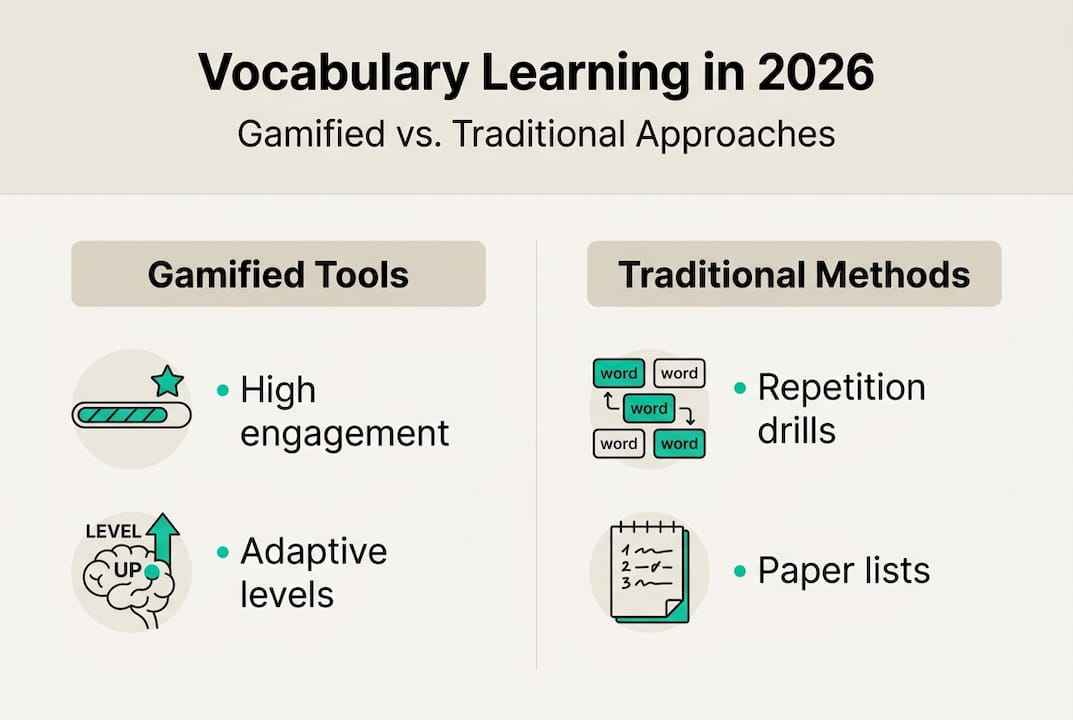
Understanding the strengths and limitations of different approaches helps parents and educators make informed choices. Types of word games for fun and skill building in 2026 vary significantly in their features and appropriate applications.
| Feature | Gamified Tools | Traditional Methods |
|---|---|---|
| Engagement Level | High through rewards and competition | Low without external motivation |
| Adaptability | Automatic adjustment to skill level | Manual differentiation required |
| Feedback Speed | Immediate correction and reinforcement | Delayed until teacher review |
| Skill Building | Vocabulary plus cognitive abilities | Primarily vocabulary focus |
| Progress Tracking | Automated data and visual dashboards | Manual record keeping |
Gamified vocabulary tools excel at maintaining consistent engagement over extended periods. Children voluntarily return to games repeatedly, accumulating practice hours that would be difficult to achieve through assigned worksheets. The entertainment value reduces the perception of effort, allowing longer productive sessions without mental fatigue.
Traditional methods retain value in specific contexts. Direct instruction provides efficient introduction of new concepts and explicit explanation of nuanced meanings. Structured worksheets allow teachers to assess specific learning objectives systematically. Some children prefer quiet, independent study over stimulating game environments.
Appropriate scenarios for gamified approaches include:
- Daily practice and review to maintain vocabulary retention
- Differentiated instruction for mixed ability classrooms
- Home learning where parental supervision is limited
- Motivation building for reluctant learners
- Social learning opportunities through multiplayer modes
Traditional drills work best for:
- Initial introduction of complex vocabulary requiring detailed explanation
- Formal assessment of specific learning standards
- Students who thrive in structured, predictable environments
- Situations without access to digital devices
Pro Tip: Combine both approaches by using games for daily practice and retention while reserving traditional methods for introducing new vocabulary themes and conducting formal assessments.
The most effective vocabulary programs integrate multiple modalities. Games provide engaging practice, direct instruction offers clear explanations, reading exposes children to words in authentic contexts, and writing activities require active production. This comprehensive approach addresses different learning styles and reinforces vocabulary through varied neural pathways.
Practical ways to gamify vocabulary learning at home and school
Implementing gamified vocabulary learning requires minimal resources and planning. Parents can start immediately with simple activities, while educators can integrate games into existing curriculum frameworks.
Recommended vocabulary games and apps for children include:
- Category based challenges where players name items within themes under time pressure
- Word building puzzles that combine letters to form increasingly complex vocabulary
- Multiplayer competitions allowing family members or classmates to compete on leaderboards
- Story creation games requiring use of target vocabulary words in creative narratives
- Digital platforms offering adaptive difficulty and comprehensive progress tracking
Integrating games into daily routines follows these steps:
- Establish consistent play times such as after breakfast or before bedtime to build habitual practice.
- Start with 10 minute sessions and gradually increase duration as children’s attention spans develop.
- Rotate between different game types to maintain novelty and address various cognitive skills.
- Participate alongside children initially to model strategies and build enthusiasm.
- Gradually transition to independent play as children become comfortable with game mechanics.
- Review progress weekly to celebrate achievements and adjust difficulty settings appropriately.
Setting goals transforms casual play into purposeful learning. Help children establish specific targets like learning 20 new words weekly or reaching a certain level within a month. Track progress visually using charts or digital dashboards that display cumulative achievements. Celebrate milestones with meaningful rewards that reinforce the value of vocabulary development.
Pro Tip: Adjust difficulty by selecting age appropriate word lists, modifying time limits, or enabling hint features to ensure games remain challenging but achievable for each child’s current ability level.
Social play amplifies learning benefits through peer interaction and friendly competition. Successful implementation includes using category games that allow multiple players to collaborate or compete. Children learn from observing others’ strategies, explaining their own thinking, and negotiating word meanings during gameplay discussions.
Classroom integration works seamlessly with station rotations where small groups cycle through different vocabulary games while the teacher provides targeted instruction to individuals. Digital platforms enable teachers to assign specific word lists aligned with curriculum standards and monitor each student’s progress through automated reporting. Games serve as both practice tools and formative assessments.
Family game nights transform vocabulary practice into quality bonding time. Parents playing alongside children demonstrate that learning continues throughout life while naturally modeling advanced vocabulary use. Siblings of different ages can play cooperatively or with handicaps that level the playing field. Learning how to play categories for fun and vocabulary growth provides excellent starting points for families new to vocabulary games.
Explore Lexiloot’s gamified vocabulary learning tools
Lexiloot specializes in creating engaging vocabulary games that combine education with entertainment. The platform offers multiple game modes including category challenges for kids and classrooms that build rapid recall and categorical thinking skills. Players compete individually or in teams, making it perfect for both home and school environments.
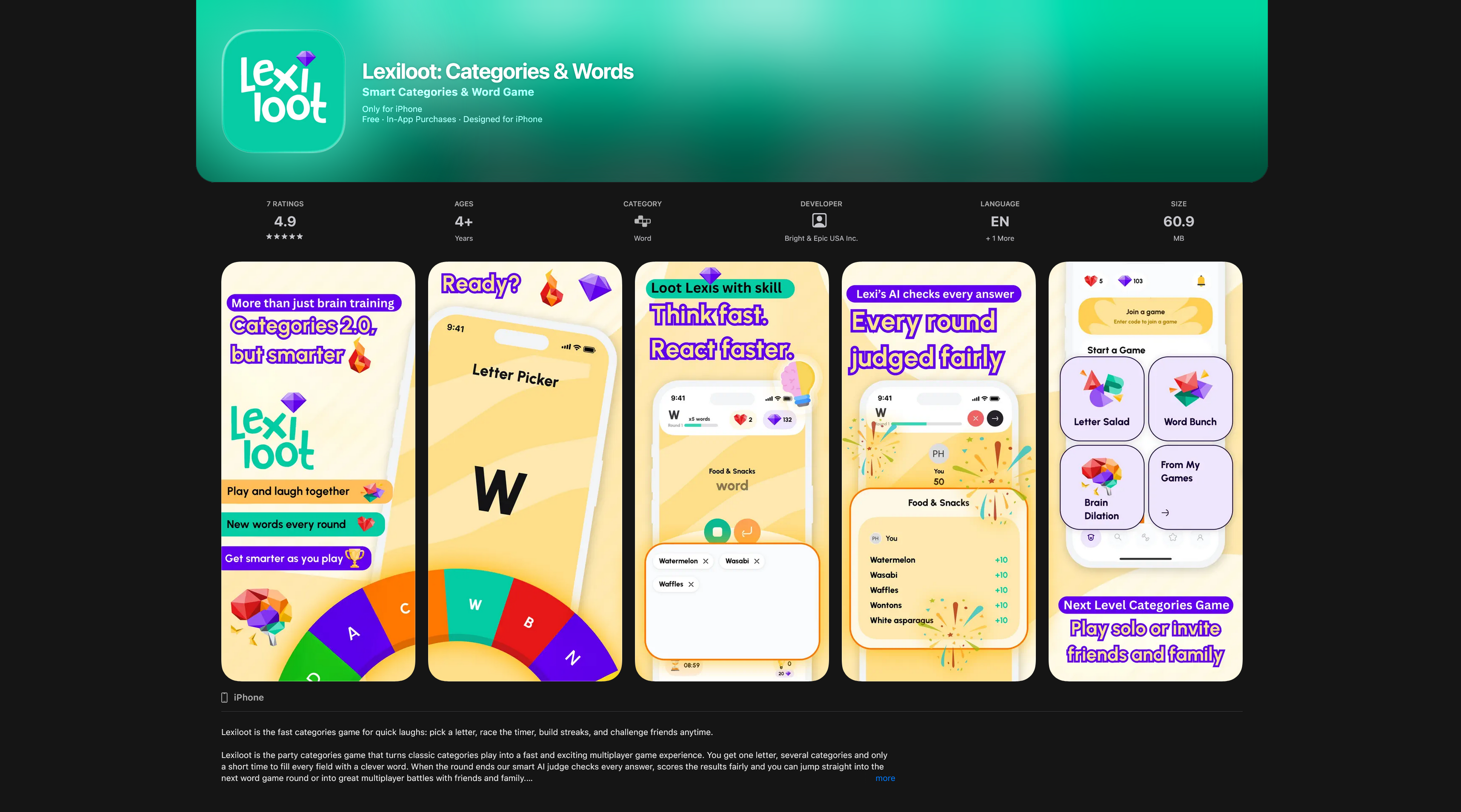
The app features adaptive difficulty that grows with each player’s abilities, ensuring continuous challenge without frustration. Premium options provide ad free gameplay and access to advanced brain training modes using a pay once model rather than recurring subscriptions. Social features enable families to host friendly competitions and track progress on leaderboards. Master category games online for fun brain training while building vocabulary that transfers to academic success. Educators can create custom word puzzles for families and classrooms aligned with specific learning objectives. Explore Lexiloot today to transform vocabulary learning into an activity children request rather than resist.
Frequently asked questions about gamified vocabulary learning
What age groups benefit most from gamified vocabulary learning?
Children ages 5 through 14 show the strongest benefits from gamified vocabulary approaches, though learners of all ages can gain advantages. Elementary students develop foundational word recognition and categorization skills through simple games. Middle schoolers tackle more complex vocabulary while building cognitive abilities like strategic thinking and pattern recognition. The key is selecting age appropriate games with suitable difficulty levels and themes.
Are gamified methods effective for children with learning difficulties?
Gameified vocabulary tools often work exceptionally well for children with learning differences because they provide immediate feedback, allow self paced progress, and reduce anxiety associated with traditional classroom assessment. The multisensory nature of games engages multiple learning pathways simultaneously. Adaptive difficulty prevents frustration by ensuring tasks remain achievable. However, games should complement rather than replace specialized interventions designed by learning specialists.
How much daily time should be spent on vocabulary games?
Research suggests 15 to 30 minutes daily provides optimal benefits without causing mental fatigue or diminishing returns. Shorter sessions of 10 minutes work well for younger children with limited attention spans. Breaking practice into multiple brief sessions throughout the day often proves more effective than single long sessions. Consistency matters more than duration, so daily 10 minute games outperform occasional hour long sessions.
Can gamified learning replace traditional study methods?
Gamified vocabulary learning works best as part of a comprehensive approach rather than a complete replacement. Games excel at motivation, practice, and retention but may not provide the explicit instruction and contextual depth that reading and direct teaching offer. The ideal program combines gamified practice with traditional reading, writing activities, and teacher led instruction to address vocabulary learning from multiple angles.
What are some recommended vocabulary games to start with?
Category games where players rapidly name items within themes provide excellent starting points for all ages. Word building puzzles that combine letters into increasingly complex words develop spelling alongside vocabulary. Digital platforms offering adaptive difficulty and progress tracking help maintain long term engagement. Multiplayer options add social motivation through friendly competition. Choose games aligned with your child’s interests, whether animals, sports, science, or general knowledge themes.

