


If you’ve heard the term ‘category challenge’ thrown around in mobile gaming circles, you might picture complex puzzles or boring vocabulary drills. The reality is much more exciting. Category challenges are fast, fun games where you race against time to name items in specific categories, like animals starting with B or movies from the 1990s. They’re designed to sharpen your brain while keeping you entertained, making them perfect for casual players who want to boost their vocabulary and cognitive skills without feeling like they’re studying. This guide breaks down exactly what category challenges are, why they work so well for brain training, and how you can start playing today.
Table of Contents
- What Is A Category Challenge? An Overview
- How Category Challenges Improve Vocabulary And Cognitive Skills
- Popular Category Challenge Game Formats And How To Play
- Integrating Category Challenges Into Your Daily Mobile Gaming Routine
- Explore Category Challenges And Level Up Your Vocabulary With Lexiloot
- Frequently Asked Questions
Key takeaways
| Point | Details |
|---|---|
| Category challenges combine fun and learning | Players name items in specific categories under time pressure, building vocabulary and recall speed naturally |
| Brain training meets mobile gaming | These games improve working memory, mental flexibility, and cognitive processing through engaging gameplay |
| Multiple formats suit different players | Choose from solo mobile apps, multiplayer battles, or casual party games depending on your preference |
| Easy to start, hard to master | Simple rules make category challenges accessible for beginners while offering depth for experienced players |
| Daily play builds lasting skills | Regular short sessions enhance vocabulary retention and keep your brain sharp with minimal time commitment |
What is a category challenge? An overview
A category challenge involves naming items within given categories under time pressure to boost recall and vocabulary. The basic mechanic is simple: you receive a category like ‘fruits’ or ‘countries’ along with a letter like M, then race to list as many valid answers as possible before time runs out. Think mangoes, melons, and Malta for those examples.
These games differ from traditional word puzzles in important ways. While crosswords test your ability to solve clues and anagrams challenge letter rearrangement, category challenges focus on quick retrieval from your existing knowledge base. You’re not solving a mystery but rather accessing information stored in your brain as fast as possible.
The format translates perfectly to mobile devices. Key features include:
- Rounds typically last 60 to 90 seconds, fitting easily into short breaks
- Touch-based interfaces make typing answers quick and intuitive
- Visual feedback shows your progress and score in real time
- Difficulty scales automatically based on your performance
Many players confuse category challenges with games like Scattergories, and while they share DNA, modern category games online for fun and brain training add layers of cognitive benefits. Digital versions track your improvement over time, introduce increasingly complex categories, and often include multiplayer modes where you compete against friends or strangers. The social element adds motivation while the educational component works quietly in the background, expanding your vocabulary without feeling like homework.
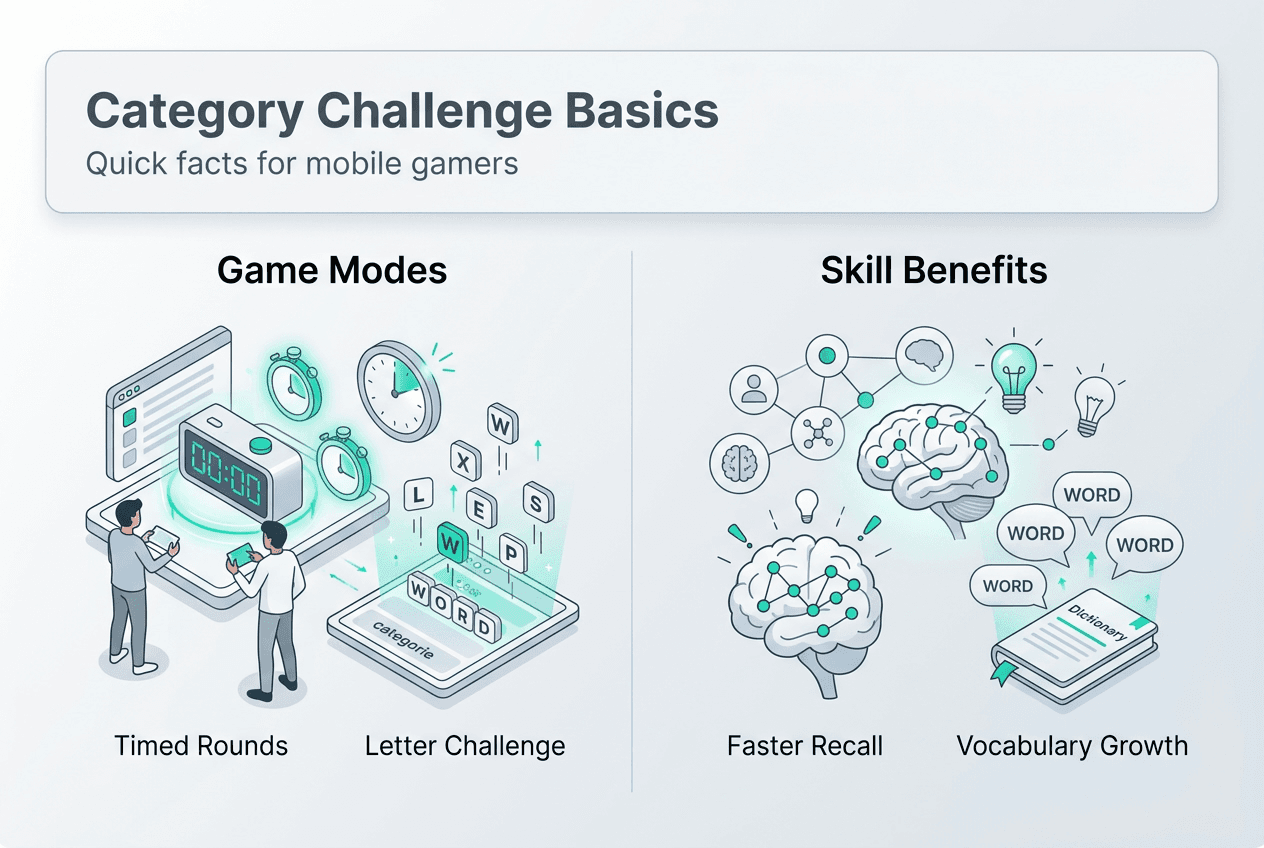
How category challenges improve vocabulary and cognitive skills
Playing category challenges helps expand vocabulary and improve cognitive recall speed through repetitive, engaging play. When you scramble to think of cities starting with P under time pressure, your brain activates multiple neural pathways simultaneously. You’re not just remembering words but also categorizing information, filtering irrelevant options, and making quick decisions about which answers to prioritize.
The vocabulary benefits work on two levels. First, you reinforce words you already know by retrieving them quickly and repeatedly. This strengthens the neural connections associated with those terms, making them easier to recall in conversation or writing. Second, you encounter new words when reviewing other players’ answers or when the game introduces advanced categories. Seeing ‘persimmon’ listed under fruits starting with P might be your first exposure to that term, and the context helps it stick.
Cognitive improvements extend beyond vocabulary:
- Working memory gets a workout as you hold the category and letter in mind while generating answers
- Processing speed increases because you must think and type simultaneously under time constraints
- Mental flexibility improves as you switch between different categories and adjust strategies
- Pattern recognition strengthens when you notice common word structures or category relationships
Research on brain training terms for vocabulary games shows that regular players develop better executive function, the mental skill set that helps you plan, focus, and juggle multiple tasks. This translates to real-world benefits like improved problem solving at work or better multitasking in daily life.
The beauty of category challenges lies in their low-pressure approach to casual brain gaming and cognition. You’re having fun competing for high scores, but your brain is simultaneously building stronger pathways for language processing and information retrieval. The game format disguises the learning process so effectively that most players focus on the entertainment value while reaping cognitive rewards.
Pro Tip: Choose categories slightly outside your comfort zone to maximize learning. If you’re strong in geography, try music genres or scientific terms to expose yourself to new vocabulary domains.
Popular category challenge game formats and how to play
Various category challenge formats exist, such as timed rounds, letter-based categories, and multiplayer modes enhancing engagement. Understanding the different styles helps you pick the right format for your skill level and gaming preferences.
Here’s a comparison of the three main formats:
| Format | Best For | Key Features | Time Commitment |
|---|---|---|---|
| Classic (Paper/Verbal) | Party settings, family game night | No technology needed, highly social, flexible rules | 15-30 minutes per round |
| Mobile App | Solo play, daily brain training | Automated scoring, progress tracking, matchmaking | 2-5 minutes per session |
| Classroom/Educational | Group learning, structured practice | Teacher controls, curriculum integration, team modes | 10-20 minutes per activity |
To play a standard category challenge, follow these steps:
- Select or receive a category (examples: animals, foods, movies, cities)
- Choose a random letter, typically by spinning a virtual wheel or rolling a die
- Start the timer, usually set between 60 and 120 seconds
- List as many items fitting both the category and starting letter as possible
- Score points for each valid, unique answer
- Compare results with other players if in multiplayer mode
Mobile versions streamline this process. You tap to start, type answers rapidly, and the app validates responses instantly. Some games add twists like bonus categories worth double points or power-ups that extend your timer. The categories game for kids and classrooms often includes visual hints or simplified categories to accommodate younger players.

For game night enthusiasts, check out categories game ideas for game night to discover creative category combinations that challenge even experienced players. Advanced variations might require answers to meet multiple criteria, like naming movies from the 1980s starring actors whose names start with T.
Pro Tip: Start with broad categories like ‘foods’ or ‘animals’ to build confidence, then progress to niche topics like ‘jazz musicians’ or ‘programming languages’ as your skills improve. This gradual difficulty increase keeps the game engaging without overwhelming you.
Integrating category challenges into your daily mobile gaming routine
Regular short sessions of category challenge games enhance retention and keep players motivated. The key to maximizing benefits is consistency rather than marathon sessions. Even five minutes daily builds stronger vocabulary and cognitive skills than sporadic hour-long binges.
Here’s how to weave category challenges into your existing routine:
- Morning brain warm-up: Play two or three rounds while drinking coffee to activate your mind before work or school
- Commute companion: Turn waiting time on public transit into productive brain training instead of mindless scrolling
- Midday mental break: Use category challenges as a refreshing alternative to social media when you need a quick mental reset
- Evening wind-down: Play a few relaxing rounds before bed to engage your brain without the stimulation of action games
The mobile format of playing categories game on your phone makes integration seamless. You don’t need to carve out dedicated gaming time or sit at a computer. Pull out your phone whenever you have two minutes free and knock out a quick round.
Mixing categories prevents boredom and maximizes vocabulary exposure. If you play the same categories repeatedly, you’ll memorize standard answers and stop learning. Rotate through diverse topics like geography, entertainment, science, food, and history to challenge different areas of your knowledge. Many apps include daily challenges that automatically vary categories, removing the decision-making burden.
Category challenges also work brilliantly for stress relief. Unlike competitive shooters or puzzle games with failure states, category challenges let you succeed at your own level. You’re competing against yourself and the clock rather than facing punishing difficulty spikes. This makes them perfect for unwinding after stressful situations while still keeping your brain engaged.
For longer sessions, try the free categories game online for road trips format. These extended versions work great for family car rides or flights, turning travel time into fun group learning experiences.
Pro Tip: Track your most challenging categories in a note app and dedicate extra practice time to those areas. If you struggle with ‘historical figures’ or ‘chemical elements,’ spend a few minutes researching those topics between gaming sessions. You’ll notice improvement within days and feel more confident tackling diverse categories.
Explore category challenges and level up your vocabulary with Lexiloot
Ready to experience the brain-boosting fun of category challenges firsthand? Lexiloot offers mobile-optimized category games designed specifically for players who want engaging vocabulary practice without the grind of traditional study methods.
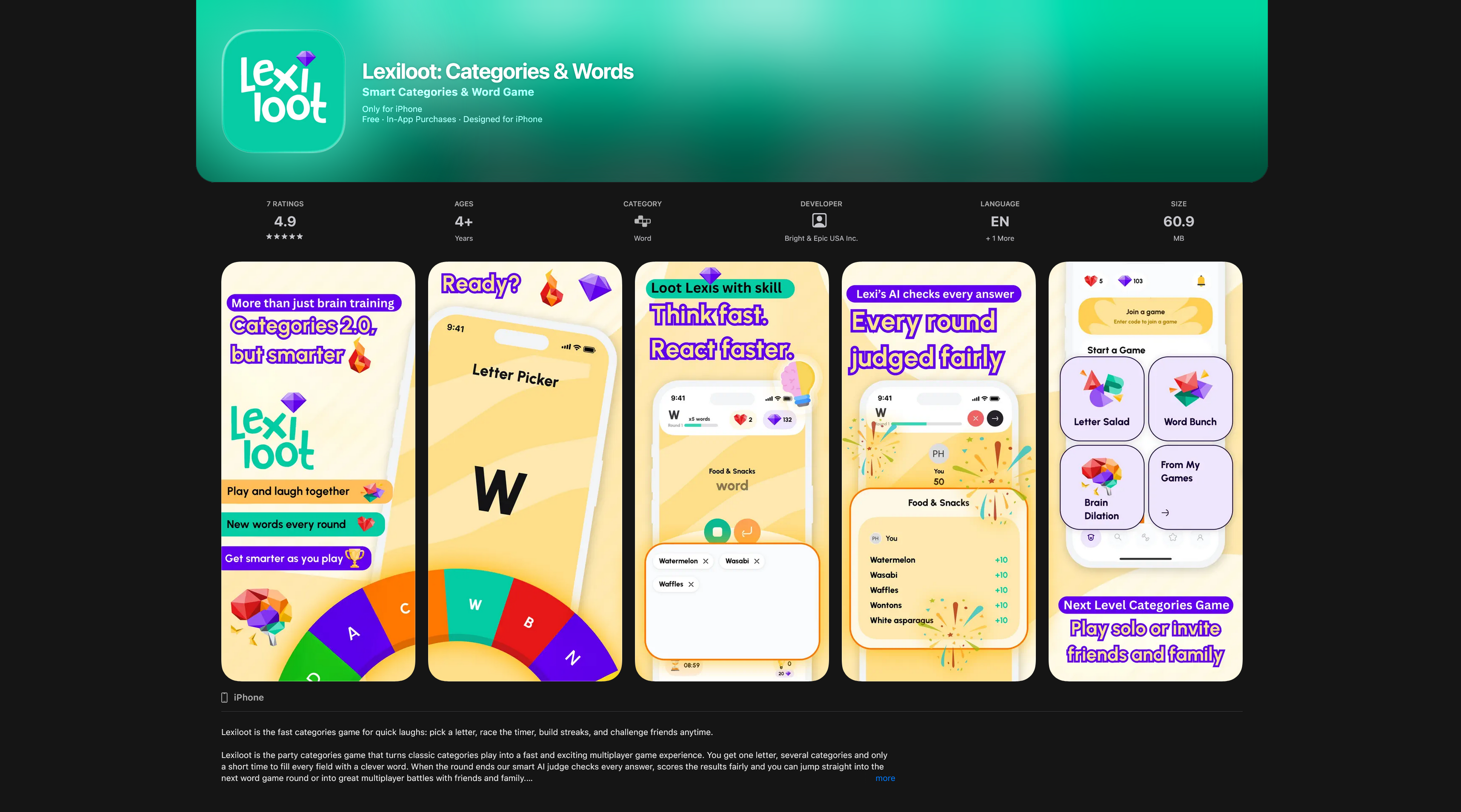
Our platform includes multiple game modes tailored to different skill levels and time commitments. Whether you’re looking for quick daily brain training or extended multiplayer battles with friends, Lexiloot delivers the perfect balance of education and entertainment. The categories game for kids and classrooms makes learning fun for younger players, while advanced modes challenge even the most experienced word game enthusiasts. Start with our master category games online guide to discover strategies that accelerate your improvement, or jump straight into the free categories game online for road trips for instant multiplayer fun. Download Lexiloot today and transform your mobile gaming time into valuable vocabulary building.
Frequently asked questions
What exactly is a category challenge game?
A category challenge game asks players to name items belonging to a specific category that start with a chosen letter, all within a time limit. For example, you might need to list fruits starting with M in 60 seconds. The format combines speed, knowledge recall, and vocabulary skills into an engaging mobile gaming experience suitable for all ages.
How do category challenges help improve vocabulary?
Category challenges strengthen vocabulary through active recall practice, forcing your brain to retrieve words quickly under time pressure. This repetition reinforces existing knowledge while exposing you to new terms when you review other players’ answers or encounter unfamiliar categories. The engaging format makes vocabulary building feel like play rather than study, leading to better retention and more consistent practice habits.
Can beginners easily join category challenges?
Absolutely. Category challenges feature simple rules that anyone can understand in seconds: name items in a category starting with a letter before time runs out. Most mobile apps include tutorial modes and adjustable difficulty settings that let beginners start with easy categories like ‘animals’ or ‘colors’ before progressing to more challenging topics. The friendly community and lack of harsh penalties for wrong answers create a welcoming environment for new players.
Where can I play category challenges on mobile?
You can find category challenge games on both iOS and Android app stores, with options ranging from free ad-supported versions to premium paid apps. The categories game mobile app from Lexiloot offers a comprehensive experience with multiple game modes, social features, and progress tracking. Many apps let you play solo against the clock or compete with friends in real-time multiplayer matches, giving you flexibility based on your mood and available time.

