


Casual brain gaming has exploded in popularity, with games like WordBrain attracting over 40 million players worldwide. These aren’t just time killers. Word puzzle games actively enhance vocabulary, sharpen pattern recognition, and improve cognitive function through engaging gameplay. Unlike traditional brain training apps that feel like homework, casual brain games blend entertainment with mental challenges, making cognitive improvement accessible and fun. Whether you’re a student looking to expand your vocabulary or a busy professional seeking quick mental workouts, casual brain gaming offers scientifically backed benefits wrapped in enjoyable puzzle solving.
Table of Contents
- Understanding Casual Brain Gaming And Its Appeal
- Cognitive Benefits Of Word Puzzles In Casual Brain Games
- How Adaptive Challenges And Social Features Enhance Engagement
- Notable Casual Brain Games And Their Educational Impact
- Discover More Fun Brain Games With Lexiloot
- Frequently Asked Questions
Key takeaways
| Point | Details |
|---|---|
| Entertainment meets education | Casual brain games combine engaging word puzzles with measurable cognitive training benefits |
| Vocabulary growth | Regular gameplay improves word recall and pattern recognition skills through progressive challenges |
| Adaptive difficulty | Smart algorithms adjust puzzle complexity to match your skill level, maintaining optimal engagement |
| Social motivation | Multiplayer features and leaderboards increase retention rates by 30% compared to solo play |
Understanding casual brain gaming and its appeal
Casual brain gaming refers to accessible, non-competitive mental challenges designed for quick sessions and broad appeal. Unlike hardcore strategy games requiring hours of commitment, these games let you jump in for five minutes or fifty. WordBrain exemplifies this approach, combining word search mechanics with logic puzzles where you find hidden words in specific order.
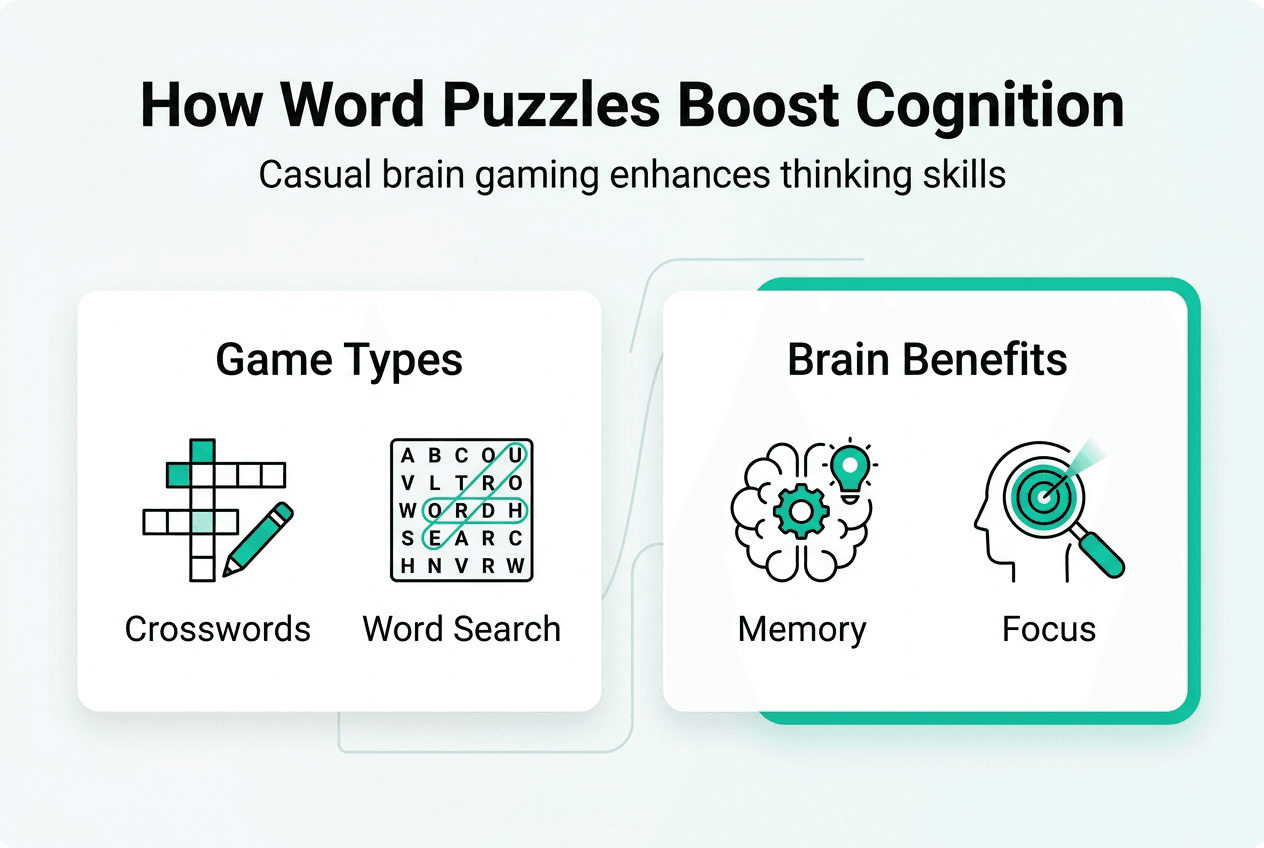
The appeal lies in low barriers to entry. You don’t need gaming experience or special knowledge to start. The core mechanics revolve around vocabulary recall, pattern recognition, and progressive difficulty that grows with your skills. Word puzzle games use familiar formats like crosswords, anagrams, and letter grids, making them instantly recognizable yet endlessly varied.
Common gameplay elements include:
- Timed challenges that create urgency without overwhelming pressure
- Letter grid manipulation requiring spatial reasoning
- Vocabulary databases spanning thousands of words across difficulty levels
- Achievement systems rewarding consistent play and skill improvement
These games succeed because they tap into our natural love of problem solving while providing clear progress markers. Each solved puzzle delivers a dopamine hit, encouraging continued play. The best casual brain games balance accessibility with depth, offering simple rules but complex strategic possibilities.
Pro Tip: Choose games with adaptive difficulty systems for brain training that automatically adjust challenge levels based on your performance, ensuring you stay in the optimal learning zone where puzzles feel achievable but not trivial.
Cognitive benefits of word puzzles in casual brain games
Word puzzle games deliver measurable cognitive improvements backed by scientific research. Studies show regular players experience a 15% improvement in vocabulary recall after six months of consistent gameplay. Pattern recognition skills sharpen as your brain learns to spot letter combinations and word structures faster.

The cognitive benefits extend beyond vocabulary. Research demonstrates that crossword puzzle training serves as effective cognitive enhancement for people at risk for Alzheimer’s disease, offering a low cost, home based intervention. Word games activate multiple brain regions simultaneously, strengthening neural pathways responsible for language processing, memory, and executive function.
Specific game formats target different cognitive abilities. Word N-Back training improves verbal working memory, directly enhancing reading comprehension and language learning capacity. This type of working memory training translates to real world benefits like faster vocabulary acquisition and improved communication skills.
| Cognitive Skill | Improvement Rate | Game Mechanism |
|---|---|---|
| Vocabulary recall | 15% after 6 months | Repeated word exposure and retrieval practice |
| Pattern recognition | 20% faster processing | Letter grid analysis and word structure identification |
| Working memory | Measurable gains in 4 weeks | Sequential word recall and manipulation tasks |
| Processing speed | 12% improvement | Timed challenges requiring quick decision making |
Practical applications include:
- Enhanced reading comprehension through expanded vocabulary
- Faster language learning due to improved word retention
- Better verbal communication from increased word accessibility
- Stronger mental agility supporting multitasking and problem solving
The key is consistent engagement. Playing for 15 to 20 minutes daily produces better results than occasional marathon sessions. Your brain needs regular stimulation to build and maintain cognitive improvements. Games with diverse word databases maximize learning by exposing you to varied vocabulary rather than recycling the same words.
Pro Tip: Combine different word game types to target multiple cognitive skills simultaneously. Mix traditional word puzzles with category based challenges for comprehensive brain training. You can even explore physical puzzle options to complement digital gameplay.
How adaptive challenges and social features enhance engagement
Adaptive difficulty represents the secret sauce keeping casual brain gamers engaged long term. Smart algorithms dynamically adjust puzzle complexity based on your performance, ensuring challenges remain in the sweet spot between too easy and impossibly hard. When you’re crushing puzzles, the game introduces more complex vocabulary or tighter time limits. Struggling? It scales back slightly, maintaining momentum without frustration.
This approach dramatically outperforms fixed difficulty models. Traditional puzzle books offer the same challenge to everyone, causing beginners to quit in frustration while experts get bored. Adaptive systems personalize the experience, keeping your brain in the optimal learning zone where neural growth happens. Neuroscientists call this the Goldilocks principle: challenges must be just right to activate brain circuits effectively.
| Feature | Adaptive Difficulty | Fixed Difficulty |
|---|---|---|
| Player retention | 65% after 3 months | 35% after 3 months |
| Skill improvement | Consistent upward trajectory | Plateaus quickly |
| Frustration levels | Low, balanced challenge | High for beginners, low for experts |
| Engagement quality | Sustained focus and flow states | Sporadic interest |
Social features amplify engagement even further. Social interaction in word games boosts retention by approximately 30% compared to solo play. Sharing scores, competing with friends, and climbing leaderboards transform solitary puzzle solving into social experiences. These mechanics tap into fundamental human motivations: achievement, competition, and belonging.
Social interaction benefits include:
- Increased motivation through friendly competition and visible progress comparisons
- Built in accountability when friends expect you to maintain streaks or beat their scores
- Enhanced enjoyment from shared experiences and collaborative problem solving
- Stronger community connections through common interests and mutual encouragement
The combination of adaptive difficulty and social features creates a powerful engagement loop. Personalized challenges keep gameplay fresh and appropriately difficult, while social elements provide external motivation and emotional rewards. This dual approach explains why modern casual brain games achieve retention rates far exceeding traditional puzzle formats.
Multiplayer modes and leaderboards work best when they’re optional rather than mandatory. Some players prefer solitary mental workouts, while others thrive on competition. The most successful games accommodate both preferences, letting you choose your engagement style. Current word game trends in 2026 emphasize this flexibility, offering robust solo experiences alongside vibrant social ecosystems.
Notable casual brain games and their educational impact
Several casual brain games have achieved mainstream success while delivering genuine educational benefits. WordBrain leads the pack with its elegant design and massive user base. The game presents letter grids where you swipe to form words, with each puzzle requiring specific word lengths in particular order. This constraint based approach exercises both vocabulary and logical reasoning.
Popular casual brain games include:
- WordBrain: Over 40 million downloads, featuring thousands of puzzles across 15 difficulty levels with progressive vocabulary complexity
- Word Crush: Thematic puzzles organized by categories, combining word search with trivia knowledge
- Wordscapes: Crossword style gameplay with relaxing visuals, emphasizing stress free cognitive engagement
- Category Games: Educational focus on grouping words by themes, particularly effective in classroom settings
Educational institutions increasingly incorporate these games into learning programs. Teachers use category based word games to reinforce vocabulary lessons, while language learning centers employ them for supplemental practice. The gamification transforms what could be tedious memorization into engaging challenges students actually want to complete.
How schools integrate casual brain games:
- Vocabulary building: Assign specific puzzle sets matching current lesson themes or difficulty levels
- Homework alternatives: Replace traditional worksheets with game based challenges tracking student progress
- Classroom competitions: Organize team based tournaments fostering collaboration and healthy competition
- Assessment tools: Monitor student performance through game analytics revealing vocabulary gaps
- Differentiated instruction: Use adaptive difficulty to provide appropriate challenges for varied skill levels
The educational impact extends beyond vocabulary acquisition. Pattern recognition skills developed through word puzzles transfer to mathematical reasoning and scientific thinking. Working memory improvements enhance overall academic performance across subjects. Students develop persistence and problem solving strategies applicable to non gaming contexts.
Category games prove especially valuable for younger learners developing organizational thinking skills. These games require players to identify relationships between words, strengthening conceptual understanding and semantic memory. The format naturally supports curriculum topics from science classifications to historical periods.
Game design features supporting educational use include progress tracking, customizable difficulty, offline play for classroom environments without reliable internet, and content filters ensuring age appropriate vocabulary. Premium versions often add teacher dashboards showing student performance metrics and identifying areas needing additional support.
Casual brain games succeed educationally because they disguise learning as entertainment. Students engage willingly, spending more time practicing vocabulary than they would with traditional methods. The immediate feedback and reward systems maintain motivation, while the progressive difficulty ensures continuous skill development. For educators seeking engaging classroom activities, these games offer research backed tools requiring minimal preparation. You can explore various mobile gaming genres to find formats matching specific learning objectives.
Discover more fun brain games with Lexiloot
Ready to experience the cognitive benefits of casual brain gaming firsthand? Lexiloot combines engaging word puzzles with category challenges designed for both entertainment and skill building. Our games adapt to your level, ensuring you’re always appropriately challenged whether you’re building vocabulary or sharpening pattern recognition.
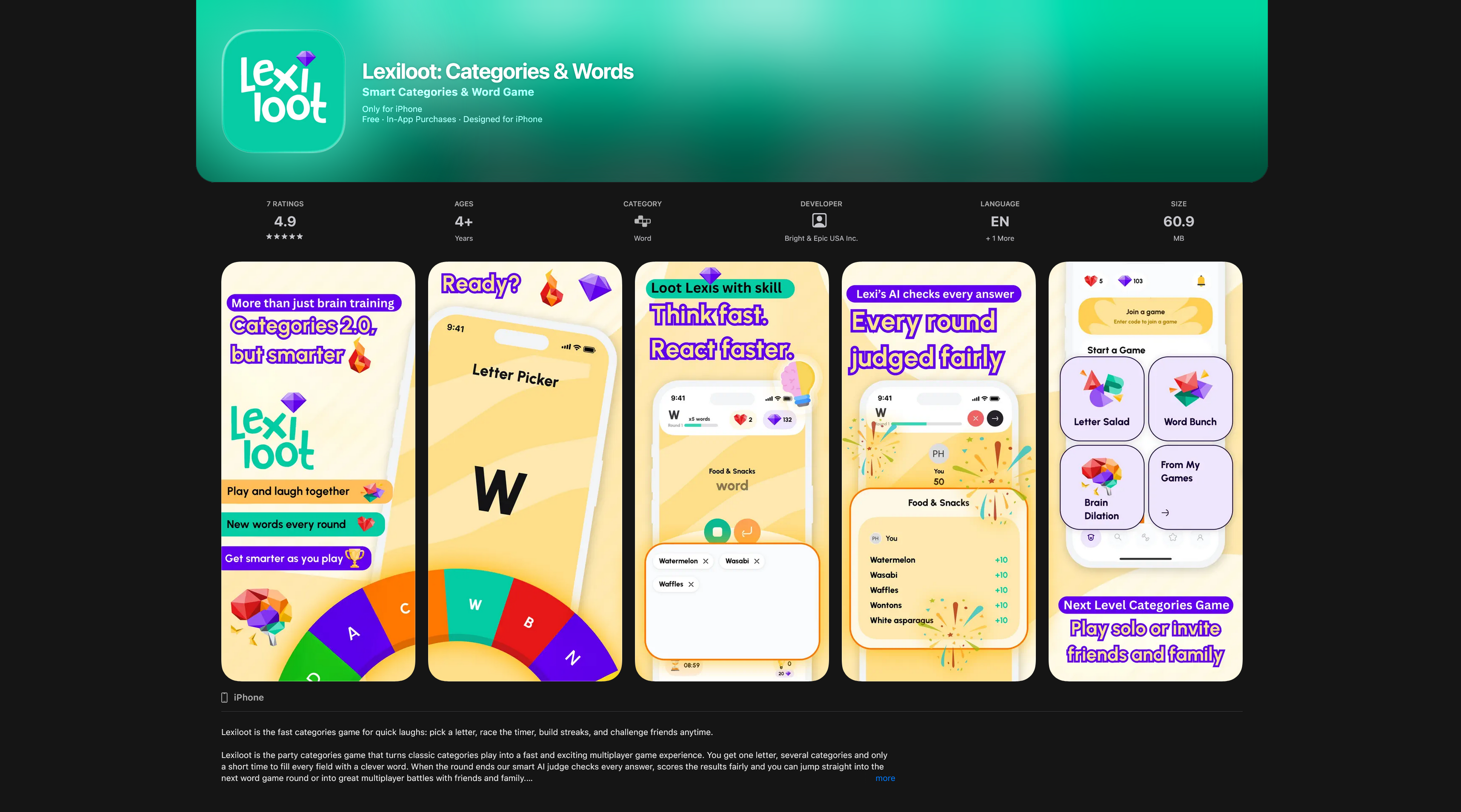
Explore diverse game modes from quick word puzzles perfect for commutes to deeper category challenges ideal for focused brain training sessions. Social features let you compete with friends, track progress on leaderboards, and share achievements. Premium options unlock advanced vocabulary databases and ad free gameplay without recurring subscriptions.
Lexiloot works equally well for solo mental workouts and family game nights. Teachers use our category games in classrooms to reinforce learning, while casual players enjoy stress free cognitive stimulation. Master category games that challenge your thinking, or explore various word game types to find your perfect match.
Pro Tip: Balance single player practice with social challenges for comprehensive brain training that builds skills while staying fun and engaging.
Frequently asked questions
What exactly is casual brain gaming?
Casual brain gaming refers to accessible puzzle games combining entertainment with cognitive training through word challenges, pattern recognition, and vocabulary building. These games require no special skills to start but offer deepening complexity as you improve.
How do word puzzles improve cognitive function?
Word puzzles activate multiple brain regions simultaneously, strengthening neural pathways for language processing, memory, and problem solving. Regular play produces measurable improvements in vocabulary recall, processing speed, and working memory within weeks.
Can casual brain games help prevent cognitive decline?
Research shows crossword and word puzzle training can slow cognitive decline in at risk populations, serving as low cost intervention tools. While not a cure, consistent mental stimulation supports brain health and may delay age related memory issues.
What makes adaptive difficulty important in brain games?
Adaptive difficulty keeps challenges in the optimal learning zone where your brain grows without frustration or boredom. Games automatically adjust complexity based on performance, ensuring sustained engagement and continuous skill development.
Which casual brain games are best for vocabulary building?
WordBrain excels for pure vocabulary expansion with progressive difficulty across thousands of puzzles. Category based games strengthen semantic relationships and conceptual thinking. Combining multiple game types produces the most comprehensive vocabulary growth.
How much time should I spend on brain games daily?
Fifteen to twenty minutes daily produces better cognitive results than occasional long sessions. Consistent engagement allows your brain to consolidate learning and build lasting neural pathways supporting vocabulary and memory improvements.
Recommended
- Defining brain training terms for vocabulary games
- Word game trends 2026: fun learning with 25% boost
- Master category games online for fun and brain training
- How wooden puzzles reduce cortisol 20% for mindfulness
- Understanding Memory: The Science Behind Mobile Games – playablemaker.com Understanding Memory: The Science Behind Mobile Games

