


TL;DR:
- True vocabulary trainers use spaced repetition, retrieval, and adaptive learning to improve long-term retention.
- Most word games focus on pattern recognition and spelling, offering indirect benefits rather than targeted vocabulary growth.
- Combining structured trainers with engaging games enhances vocabulary mastery and sustained motivation.
Vocabulary trainer: how games grow word skills fast
Most people assume that playing any word game will sharpen their vocabulary. You finish a round of Wordle, ace a crossword, and feel smarter for it. But here’s the reality: those games are entertaining and genuinely useful for some skills, yet they are not vocabulary trainers. There is a meaningful difference between games that happen to use words and tools specifically built to grow the words you know, understand, and remember. This article breaks down exactly what separates the two, what science says about effective vocabulary learning, and how you can make smarter choices about the tools you use whether you are learning solo, with kids, or as a family.
Table of Contents
- What defines a vocabulary trainer?
- How vocabulary trainers differ from pure word games
- The science behind memorization: SRS, retrieval, and error correction
- Choosing and using vocabulary trainers: Features, flexibility, and games
- A fresh perspective: Why most people underestimate vocabulary trainers
- Further your vocabulary journey with Lexiloot
- Frequently asked questions
Key Takeaways
| Point | Details |
|---|---|
| Trainers vs games | Vocabulary trainers use science-backed methods for recall, while word games focus on indirect skills. |
| Evidence-based learning | Retrieval practice and spaced repetition boost word retention by up to 25% vs traditional methods. |
| Customizable, social tools | Modern trainers provide offline access, lesson customization, and multiplayer options for families. |
| Practical next steps | Mix vocabulary trainers and fun games to maximize learning and engagement for all ages. |
What defines a vocabulary trainer?
A vocabulary trainer is not just any app or game that involves words. It is a learning tool built around specific psychological strategies designed to help you store, recall, and use new words over time. The goal is not just exposure. It is lasting retention.
The most important features that define a true vocabulary trainer include:
- Spaced repetition system (SRS): Words are reviewed at calculated intervals based on how well you know them. Words you struggle with come back sooner; words you know well return later. This mirrors how memory consolidates naturally over time.
- Retrieval practice: Instead of just showing you a word and its definition, a trainer asks you to actively recall it. This forces your brain to work, which makes the memory stronger.
- Adaptive learning: The system adjusts to your performance. If you are doing well with one word group, the trainer moves on. If you are struggling, it slows down and repeats.
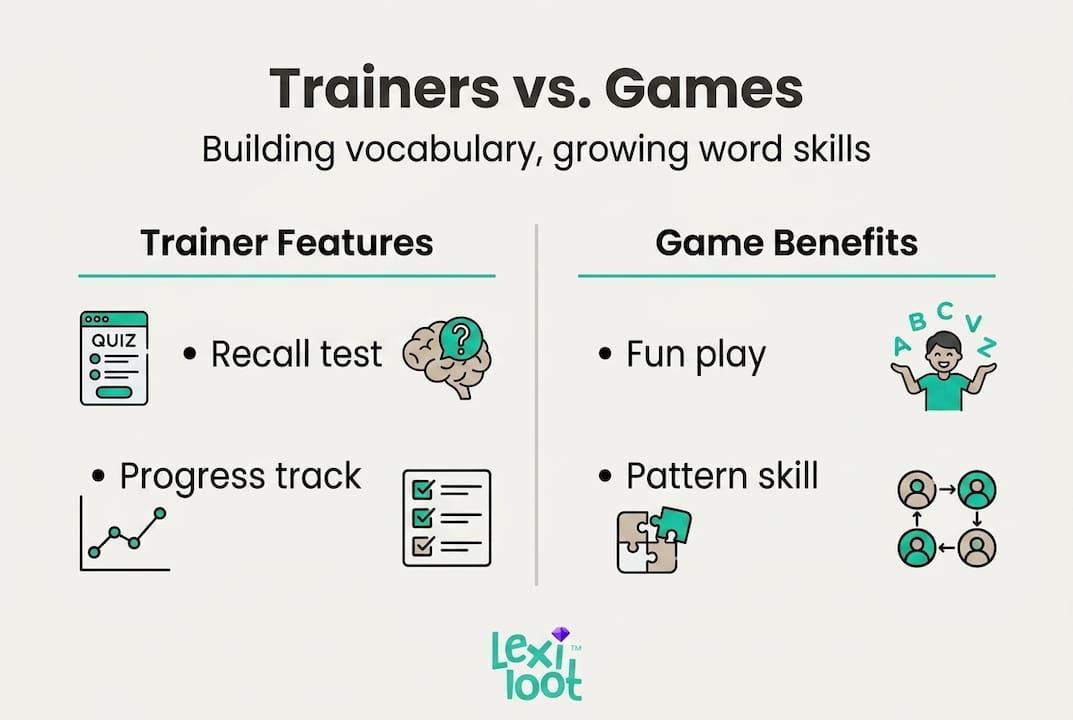
- Progress tracking: Good trainers show you how many words you have learned, which ones need review, and how your recall accuracy changes over sessions.
- Contextual usage: Many trainers show words in sentences or grouped by theme, helping you understand meaning in context rather than in isolation.
These are not random design choices. They are grounded in decades of cognitive science research. A landmark study by Roediger and Karpicke found that students using retrieval-based practice recalled 61% of material after one week, compared to just 40% for those who simply reread content. A separate competition studying vocabulary learning methods found that the winning approach combining mnemonics, retrieval, and adaptive SRS led to 27 out of 80 words recalled after one week versus significantly fewer in the control group.
Understanding what brain training terms like SRS and retrieval practice actually mean helps you choose smarter tools. These mechanisms are the engine under the hood of every effective vocabulary trainer.
Pro Tip: When evaluating a vocabulary trainer, look specifically for adaptive review cycles. If the app shows you every word at the same frequency, it is not using SRS, and your learning will be less efficient as a result. Look for apps that adjust based on your actual performance.
Vocabulary trainers also support something that goes beyond memorization. They build reading comprehension by helping learners understand words in context, which strengthens overall language processing and reading fluency over time.
How vocabulary trainers differ from pure word games
Now that you know what vocabulary trainers are, let’s see how they compare to the playful word games you already know and love.
Word games like Wordle, anagram solvers, and word scrambles are genuinely fun. They sharpen pattern recognition, improve spelling fluency, and give your brain a satisfying puzzle to solve. There is real cognitive value there. But most of them do not focus on helping you remember new words or understand their meanings.

Here is a direct comparison:
| Feature | Vocabulary trainer | Pure word game |
|---|---|---|
| Primary focus | Retention and recall | Pattern recognition and spelling |
| Learning method | SRS, retrieval, error correction | Trial and error, pattern matching |
| Progress tracking | Yes, detailed and adaptive | Rarely, or score-based only |
| New word acquisition | Core goal | Incidental, not guaranteed |
| Contextual understanding | Usually included | Usually absent |
| Long-term memory impact | High, by design | Moderate, as a side effect |
Pure word games build indirect skills. When you unscramble letters, your brain practices morphology, the ability to recognize word shapes and structures. When you guess a hidden five-letter word, you are practicing systematic elimination and phonics. These are real benefits. But they are byproducts of the game, not intentional learning outcomes.
Vocabulary trainers work in the opposite direction. The learning outcome comes first, and the activity is built around achieving it. Every quiz, every flashcard, every adaptive challenge is engineered to push specific words deeper into your long-term memory.
Research published in the Cognitive Research Journal reinforces this contrast. The study found that pure games build indirect skills like morphology and pattern matching but lack the targeted retention that dedicated trainers offer. Interestingly, the research also showed that pretesting and guessing, even with zero prior knowledge, can boost learning through error correction, which is a feature more commonly found in trainer-style apps than in casual word games.
Effective learning comes from targeted retrieval. Most word games are built for fun first. Trainers are built for memory first. Both have a place in your routine, but only one is designed to grow your vocabulary intentionally.
This distinction matters especially for families and educators. If your goal is for kids to genuinely expand their vocabulary, gamified learning through structured trainers is more reliable than hoping entertainment-first games will do the job. That said, mixing both types, which we explore in later sections, produces strong engagement and solid results.
If you are teaching word games in a classroom or family setting, understanding teaching word games effectively helps you choose the right format for the right goal. Games for fun reinforce enthusiasm. Trainers lock in the vocabulary.
The science behind memorization: SRS, retrieval, and error correction
To understand why vocabulary trainers work so consistently, you need to look at the psychological principles driving them. Three mechanisms do most of the heavy lifting: spaced repetition, retrieval practice, and error correction through pretesting.
Spaced repetition works by timing your reviews strategically. Instead of cramming all your new words in one sitting, SRS spreads reviews over days or weeks. The spacing matches the natural curve of forgetting. You review a word just before your brain would lose it, which reinforces the memory and extends how long you retain it. This feels counterintuitive because spacing reviews out means less frequent practice, but research consistently shows it outperforms massed practice.
Retrieval practice is the act of pulling information out of memory rather than looking it up. Every time your brain successfully retrieves a word, the memory trace strengthens. This is sometimes called the testing effect, and it is one of the most replicated findings in cognitive psychology. It is why answering a quiz question helps you remember better than rereading a definition ever could.
Error correction through pretesting is less well known but equally powerful. When you guess a word’s meaning before knowing the answer, even incorrectly, your brain becomes primed to receive and encode the correct information. The error creates a gap your mind actively wants to fill. This mechanism is why some Duolingo-style guessing features actually accelerate learning.
Here is what the research numbers look like:
| Method | Recall after 1 week | Accuracy after 3 to 4 rounds |
|---|---|---|
| Retrieval practice | 61% | 74% |
| Rereading or restudy | 40% | 52% |
| SRS plus mnemonics | 27 out of 80 words | Significantly above control |
| Traditional methods | Baseline | 25% lower than retrieval methods |
Data from MDPI Behavioral Sciences confirms that retrieval practice increases in accuracy as rounds increase. Moving from 3 to 4 learning rounds improved accuracy from 50% to 74% with retrieval practice, compared to only 35% to 52% with restudy methods. Across proficiency levels, retrieval-based approaches led to 25% better word memorization compared to traditional learning methods.
Three essential memory-boosting steps you can apply right now:
- Review words at spaced intervals. Use a trainer that schedules reviews automatically, or manually space out your flashcard sessions over days, not hours.
- Test yourself before checking answers. Actively guess meaning before revealing it. The attempt, right or wrong, deepens memory encoding.
- Focus on words just outside your comfort zone. Your brain retains new information more effectively when it is slightly challenging. Words you already know well waste review time.
Understanding how vocabulary and brainpower interact helps you apply these principles beyond just language learning. Strong vocabulary recall is linked to faster reading, better comprehension, and even improved problem-solving skills.
Choosing and using vocabulary trainers: Features, flexibility, and games
You have learned how trainers work. Now let’s talk about how to pick the best one for your goals, whether you are learning solo, helping kids at home, or looking for something the whole family can enjoy.
Not all vocabulary trainers are equal. The difference between a truly effective trainer and a mediocre one often comes down to a handful of key features:
- Customizable lessons: Can you add your own word lists? Can you focus on a specific subject area, grade level, or theme? Customization lets the tool serve your actual learning goals rather than a generic curriculum.
- Offline capability: A good trainer should work without an internet connection. Learning happens in cars, waiting rooms, and classrooms without reliable Wi-Fi. Offline access removes that barrier.
- Multi-language support: For families with bilingual learners or classrooms with diverse students, support for 20 or more languages is a meaningful advantage. Research confirms that digital flashcard-style trainers are effective across both paper and computer-based tests, making them flexible for different contexts.
- Progress visibility: Can you see which words your child has mastered and which ones need more work? Data on accuracy and review history helps you guide learning intentionally.
- Social and multiplayer features: Trainers with competitive play options turn vocabulary practice into a shared experience. Leaderboards, team challenges, and head-to-head quizzes build motivation through friendly competition.
For families, social play is a huge factor. When vocabulary practice becomes a game you play together, kids stay engaged far longer and return to it voluntarily. Engaging vocabulary games that blend trainer mechanics with fun competitive formats give you the best of both approaches.
Trainer types to consider include:
- Digital flashcard apps: Great for individuals and self-paced learners. Works across devices and often functions offline.
- Adaptive quiz platforms: These adjust difficulty in real time, making them excellent for learners at varying skill levels in the same family or classroom.
- Competitive multiplayer games: Ideal for social learners and family game nights. These use trainer mechanics but frame them inside a competitive, rewarding structure.
Pro Tip: Mix at least two approaches for best results. Use a dedicated SRS flashcard trainer for new word acquisition during the week, then play a social or competitive vocabulary game on weekends. The variety keeps engagement high, and the different formats reinforce words through multiple types of practice.
The most effective learners do not rely on a single tool. They build a light routine around spaced repetition and then use games to stay motivated. A few minutes of focused trainer practice each day, combined with playful sessions when energy is high, produces measurable vocabulary growth without feeling like homework.
A fresh perspective: Why most people underestimate vocabulary trainers
Here is something worth saying directly. The word game market is massive, and it is dominated by entertainment-first apps. They are colorful, satisfying, and brilliantly designed to keep you coming back. But they are optimized for engagement, not for learning. And most people never notice the difference.
When you spend 20 minutes on a word puzzle and feel sharp afterward, that feeling is real. Pattern recognition and spelling fluency did improve. But the specific words you encountered in that game? Chances are you will not remember most of them next week.
True vocabulary growth requires intentional retrieval. It requires being tested on words before you feel ready. It means encountering a word on Tuesday, again on Thursday, and once more the following week. That process is not as instantly satisfying as a word puzzle, but it is what actually moves words from short-term exposure into long-term ownership.
The practical advice here is simple: start mixing. Do not abandon word games. They are fun, they engage your brain, and they make language feel playful, which matters. But add a trainer to your routine. Even 10 minutes of SRS-based practice a few times per week creates compounding results over months.
When you gamify vocabulary learning intentionally, combining the joy of games with the structure of trainers, you get something neither tool delivers alone: vocabulary that actually sticks, and learning that kids and adults genuinely want to keep doing.
The people who make the most progress are not the ones who play the most word games. They are the ones who practice with purpose and play with strategy.
Further your vocabulary journey with Lexiloot
Ready to put what you have learned into action? Lexiloot is built exactly for this moment. It brings together evidence-based vocabulary training and playful word games in one modern, social platform designed for families, learners, and word enthusiasts.
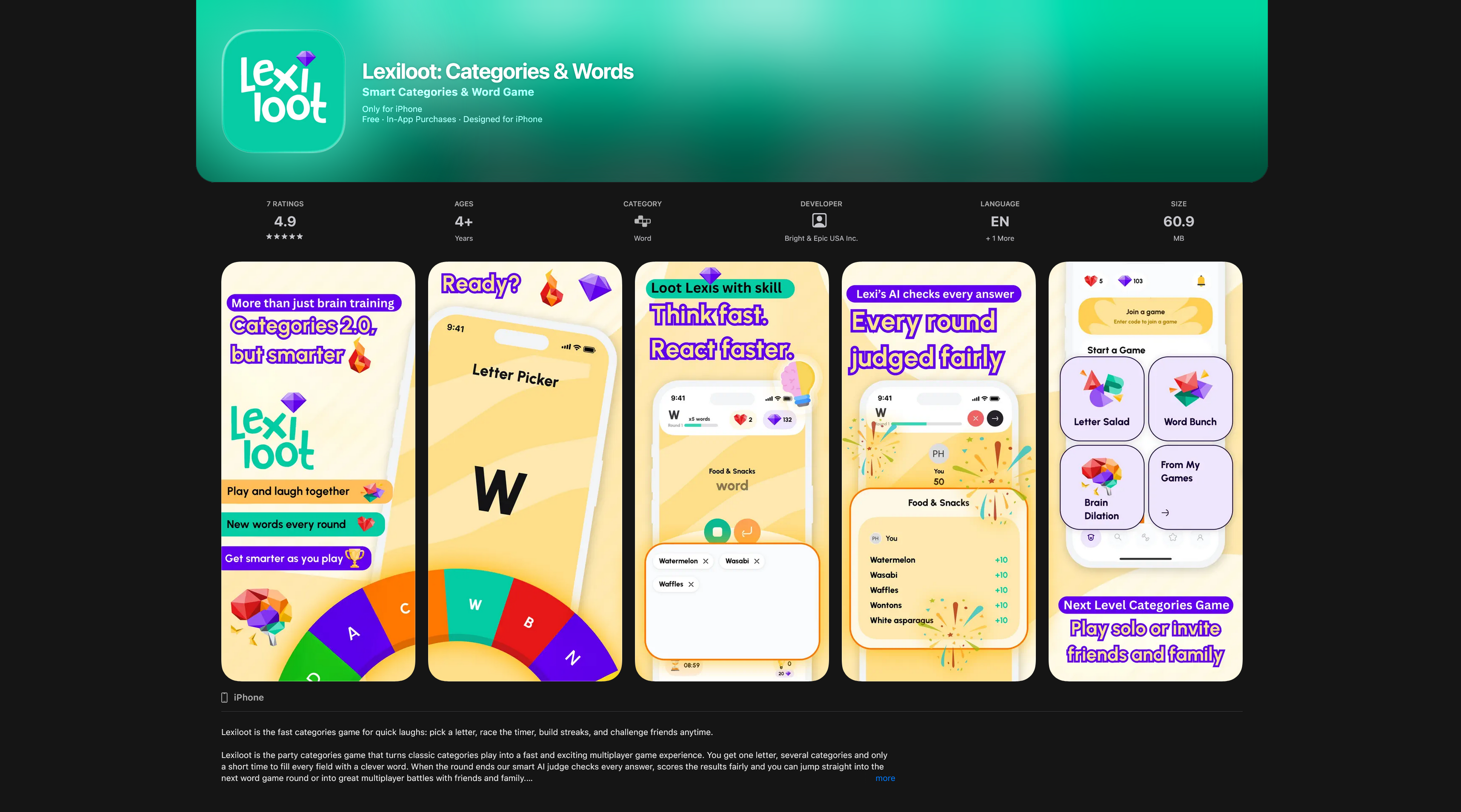
Whether you want solo brain training, a competitive family challenge, or structured vocabulary practice for a classroom, Lexiloot offers game modes that use real trainer mechanics in an entertaining format. Explore how games in education can deliver measurable results, try a categories game that builds thinking and vocabulary at the same time, or challenge friends with online category games that make spaced practice feel like play. Your next vocabulary breakthrough could be one game away.
Frequently asked questions
How does a vocabulary trainer improve word recall?
A vocabulary trainer uses spaced repetition and retrieval practice to help you remember words more effectively than simple memorization, with research showing recall rates of 61% versus 40% after just one week.
Are vocabulary trainers better than word games for learning?
Vocabulary trainers are designed to target memorization and retention, while many word games mainly build indirect skills like spelling and pattern recognition rather than direct vocabulary acquisition.
What features should I look for in a vocabulary trainer?
Choose a trainer with spaced repetition, customizable lessons, offline capability and multi-language support for the most flexible and effective learning experience.
Can vocabulary trainers be fun for families or social play?
Yes, many vocabulary trainers now offer multiplayer modes, adaptive games, and customizable content designed for groups and families, making shared vocabulary practice genuinely enjoyable for all ages.

