


TL;DR:
- Vocabulary is vital for reading, writing, listening, speaking, and overall academic success.
- Meaning-first instruction and engaging games significantly improve long-term vocabulary mastery.
- Combining explicit teaching with playful activities enhances retention and meaningful language use.
Vocabulary isn’t just about memorizing lists of words. It’s the foundation that holds up reading, writing, listening, and speaking all at once. In fact, vocabulary knowledge accounts for up to 64% of the variance in reading comprehension, which means students with stronger word knowledge consistently outperform their peers across nearly every subject. Yet most vocabulary instruction still relies on flashcards and fill-in-the-blank exercises. This article walks you through the science of vocabulary acquisition, compares instructional approaches, and shows you exactly which strategies, including games and cognitive training activities, produce real, lasting results.
Table of Contents
- Why vocabulary is foundational to learning
- How vocabulary instruction works: Meaning-first vs. form-first
- Strategies and interventions that make vocabulary stick
- Making vocabulary memorable: The science behind games and cognitive training
- Our take: The overlooked truth about vocabulary mastery
- Take action: Make vocabulary learning dynamic and fun
- Frequently asked questions
Key Takeaways
| Point | Details |
|---|---|
| Vocabulary underpins all learning | A well-developed vocabulary drives reading comprehension, academic performance, and cognitive growth. |
| Meaning-first works best | Introducing word meaning before spelling or pronunciation leads to stronger retention and deeper understanding. |
| Teaching with games boosts retention | Well-designed word games and cognitive play activities make vocabulary practice effective and enjoyable. |
| Use explicit, focused strategies | Target high-utility words, limit to a few each week, and blend visual, contextual, and gamified practice for maximum impact. |
Why vocabulary is foundational to learning
Vocabulary sits at the center of every academic skill students develop. When a child reads a sentence, their brain scans what it already knows to assign meaning to each word. If key words are missing from that mental catalog, comprehension breaks down fast. This is why vocabulary is foundational to learning, predicting not just reading comprehension but overall academic success and cognitive outcomes.
But vocabulary does more than help students understand text. It actively exercises multiple cognitive functions at once. When students encounter a new word, they engage memory, pattern recognition, contextual reasoning, and sometimes even emotional association. That’s a lot of mental work wrapped inside one small task.
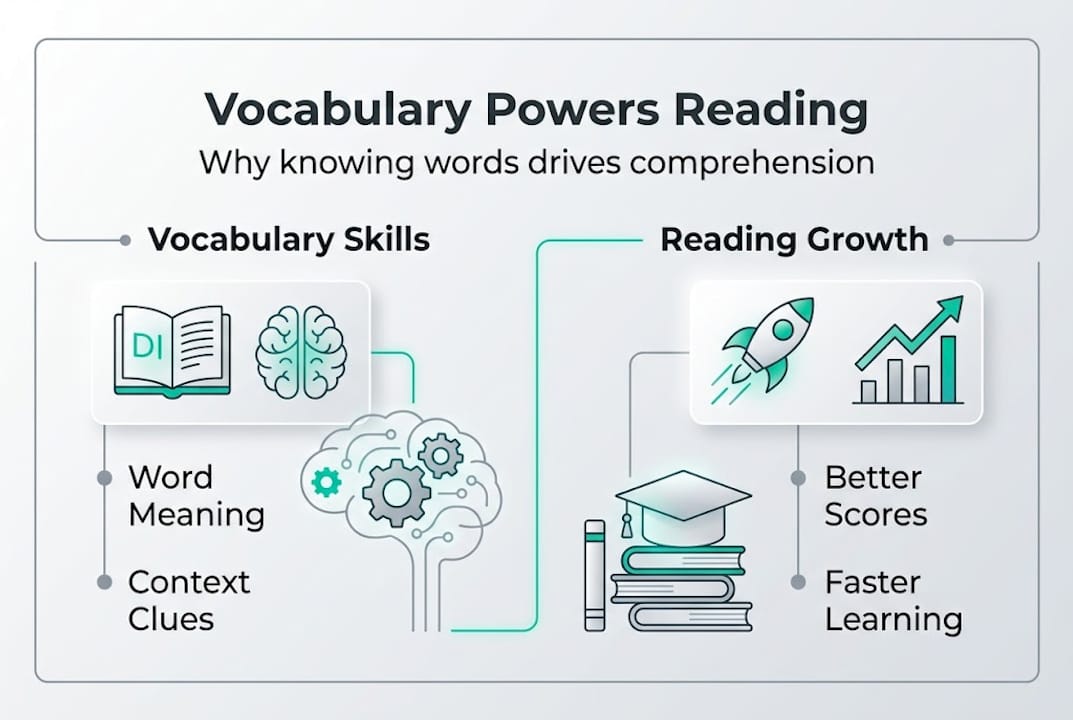
Here’s a look at how vocabulary knowledge connects to broader learning outcomes:
| Skill area | How vocabulary contributes |
|---|---|
| Reading comprehension | Directly predicts understanding of text |
| Writing quality | Enables precise, varied expression |
| Listening and speaking | Supports real-time processing and response |
| Critical thinking | Allows nuanced understanding of concepts |
| Academic performance | Correlates with achievement across subjects |
Research on vocabulary breadth and depth confirms that both knowing many words (breadth) and understanding them deeply (depth) matter, and that the balance between the two shifts as students progress through school.
Here are the core reasons vocabulary has such a powerful effect on learning:
- Memory activation: Knowing a word means retrieving it quickly, which strengthens neural pathways over time.
- Reading fluency: Students with rich vocabularies read more smoothly and with greater comprehension.
- Academic language: Subject-specific words in science, math, and history unlock entire domains of knowledge.
- Confidence and participation: Students who know more words are more willing to speak up and engage in class.
64% of reading comprehension variance is linked to vocabulary knowledge, making it one of the single strongest predictors of reading success in school-age children.
Understanding vocabulary and brainpower in learning makes it clear why targeted vocabulary instruction should be a priority from early childhood through high school and beyond.
How vocabulary instruction works: Meaning-first vs. form-first
Understanding the value of vocabulary, the next question is how to teach it most effectively. Two main instructional approaches exist, and the evidence strongly favors one over the other.
Meaning-first instruction starts with context and understanding. Students see a word used in a sentence or story, learn what it means, and then explore its spelling and pronunciation afterward. Form-first instruction does the opposite: students memorize how a word looks and sounds before they have any real sense of what it means.
Here’s how the two approaches compare in practice:
| Feature | Meaning-first | Form-first |
|---|---|---|
| Starting point | Context and definition | Spelling and phonetics |
| Cognitive load | Lower | Higher |
| Retention | Stronger long-term | Often surface-level |
| Best for | All learners, especially ELLs | Phonics-focused early literacy |
| Effect size | Large (Cohen’s d = 1.37) | Smaller |
Meaning-first instruction outperforms form-first with a large effect size, particularly for bilingual students and younger learners who are still building their mental frameworks for language.
For students learning English as an additional language, this distinction is even more critical. Starting with meaning gives students something concrete to anchor the new word to. Strategies for multilingual learners consistently show that context-rich exposure before formal spelling practice leads to deeper understanding and more confident use.
“When students understand what a word means before they learn how to spell it, the spelling becomes a label for something real, not a string of letters to memorize.”
Pro Tip: For difficult or abstract words, show a visual image, define the word in a meaningful sentence, and then revisit it at least three times over the following week before introducing its written form formally. This approach builds genuine vocabulary recall rather than temporary recognition.
Exploring how to teach word games effectively is a great next step once you understand the meaning-first foundation, since the best word games naturally follow this sequence by presenting words in rich, active contexts.
Strategies and interventions that make vocabulary stick
Having compared instructional approaches, let’s see which practical strategies consistently deliver results in real classrooms and homes.
The most effective vocabulary interventions share a few key features: they are explicit, they connect new words to content students already care about, and they revisit words multiple times in varied contexts. Vocabulary interventions have a large effect size of 1.179 on cognitive outcomes, clearly outperforming traditional methods like copying definitions from a dictionary.
Here are specific strategies that research backs up:
- Frayer Model: Students draw a four-section box for each word, filling it with the definition, characteristics, examples, and non-examples. This forces deeper processing.
- Semantic mapping: Students visually connect a new word to related words, ideas, and categories. It builds vocabulary networks, not just isolated definitions.
- Category games: Sorting words into groups by theme, function, or subject area reinforces classification and contextual thinking.
- Word scavenger hunts: Students find target words in books, signs, conversations, and media, making vocabulary part of real life.
- Marzano’s six-step process: Introduce, restate, create a representation, discuss, play with the word, and assess. It’s thorough and proven.
Explicit strategies like the Frayer Model, morphological analysis, and Marzano’s processes all show positive effect sizes in classroom research.

Effective teaching tactics for K-3 consistently point to rich discussion and repetition as the glue that holds new vocabulary in memory.
Pro Tip: Limit new vocabulary to 3-4 high-utility words per week. Trying to teach 20 words at once leads to surface-level familiarity, not real understanding. Tier 2 words, those that appear across many subjects and conversations, give students the most return on their learning investment.
For more engaging practice, word games for vocabulary building and the power of gamified learning show how structured play fits naturally alongside explicit instruction to deepen retention.
Making vocabulary memorable: The science behind games and cognitive training
With practical interventions mapped out, the final piece is how to make vocabulary activities engaging and unforgettable for both students and lifelong learners.
Games work for vocabulary learning because they tap into several powerful psychological processes at once. When students play a word game, motivation is high, which means attention is sharper. Repeated retrieval happens naturally as players recall and use words multiple times during a single session. And social learning kicks in through peer interaction, competition, and shared discovery.
Integrating games and play with instruction increases motivation and supports long-term vocabulary retention, consistent with cognitive load theory, which tells us that learning sticks better when the brain is engaged but not overwhelmed.
Here’s a breakdown of how different game types serve vocabulary learning:
| Game type | Primary benefit | Best age range |
|---|---|---|
| Scrabble and Boggle | Spelling fluency and word recognition | Ages 8 and up |
| Category sorting games | Category thinking and semantic grouping | Ages 5 and up |
| Collaborative puzzles | Cooperative vocabulary use in context | Ages 6 and up |
| Word of the week activities | Repeated exposure and daily use | All ages |
| Teacher-student game roles | Accountability and deeper engagement | Ages 9 and up |
The key is balance. Games shouldn’t replace structured vocabulary instruction. They should work alongside it. Think of games as the practice field where students put explicit learning to use in low-stress, high-motivation situations.
Here’s what effective game-based vocabulary practice looks like:
- Pair games with explicit pre-teaching so students have words to work with.
- Use classroom game ideas that naturally revisit target words multiple times per session.
- Incorporate game-based activities for language learning that blend speaking and writing tasks with play.
- Assign post-game reflection through short journal entries or recap questions to solidify meaning.
Pro Tip: After any word game, spend five minutes asking students to explain one word they used during the game in their own words. This post-game reflection closes the loop between playful practice and genuine understanding.
Exploring reasons to gamify vocabulary learning, the cognitive boost from word games, and options like the Categories Game for classrooms gives you a full picture of how digital and analog games can work together in any learning environment.
Our take: The overlooked truth about vocabulary mastery
All this evidence points to a key lesson that transcends typical study advice. Most people still think vocabulary growth is about exposure: read enough books, and the words will come. But exposure alone is rarely enough for deep, functional mastery. Students can encounter a word dozens of times and still not own it.
Real vocabulary mastery comes from using words in varied, meaningful, social contexts over time. Games aren’t just a fun add-on to serious instruction. They are a catalyst for ownership, curiosity, and genuine community around language. When a student wins a category challenge or outsmarts a classmate in a word puzzle, they’re not just playing. They’re encoding that vocabulary into long-term memory.
We believe educators and parents should stop treating games as dessert after the real learning is done. Instead, blend explicit vocabulary techniques with playful experiences from the start. Revisit words regularly in different formats: games, journals, conversations, and creative writing. That variety is what builds the family vocabulary-building workflows and classroom habits that lead to lasting growth.
Take action: Make vocabulary learning dynamic and fun
Ready to turn research into hands-on results? Here’s how you can put these ideas to work.
Lexiloot brings together the best of vocabulary instruction and game-based learning in one place. Whether you’re a teacher looking for classroom-ready challenges or a parent wanting to make word practice a daily habit, the app’s variety of word puzzles gives students repeated, engaging exposure to high-utility vocabulary in contexts that actually stick.
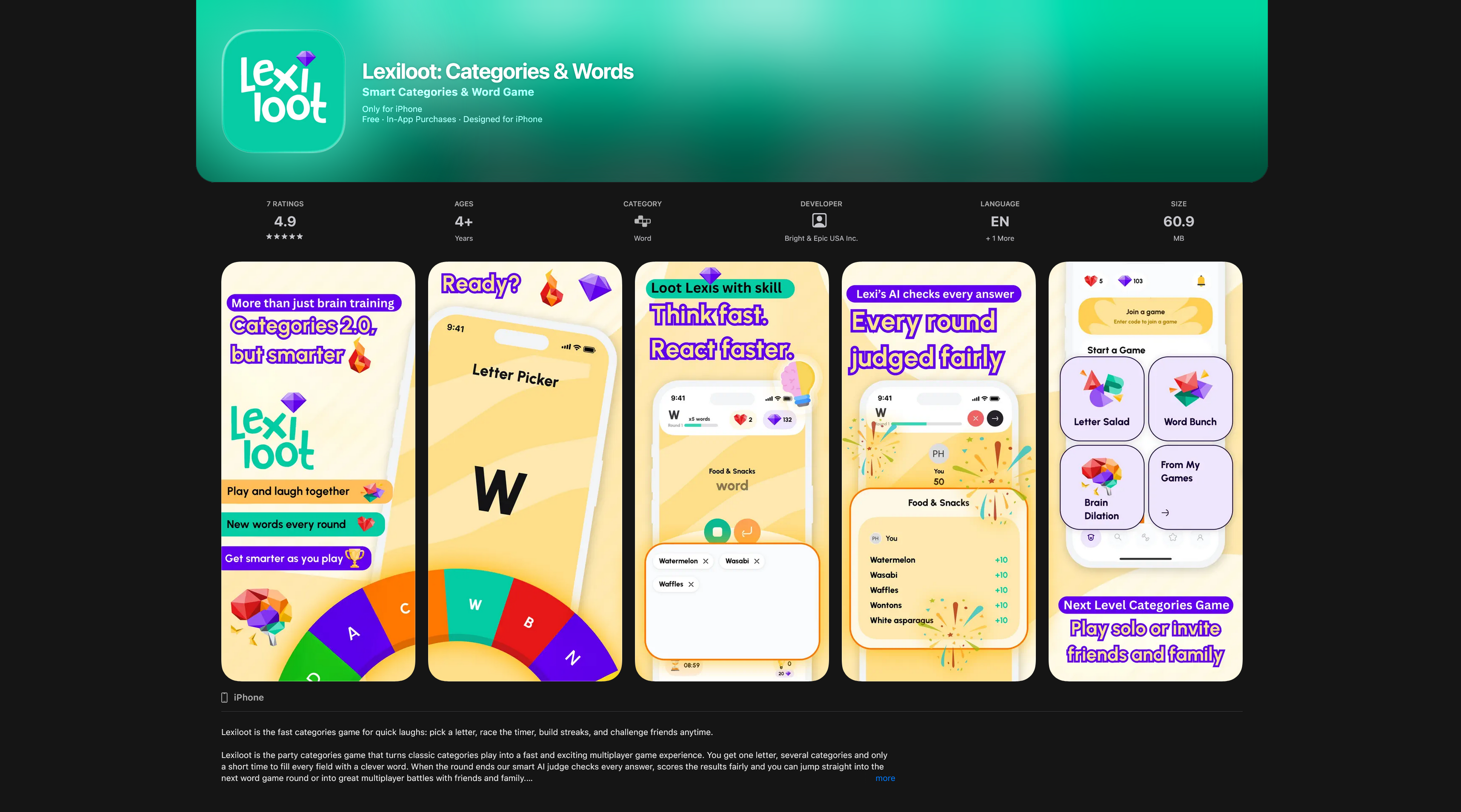
The app’s category-based games and multiplayer modes are built around the same principles this article covers: meaning-first exposure, active retrieval, and social motivation. Explore evidence-based educational games that align with what research shows actually works. And if you want fresh, engaging formats, check out modern puzzles for vocabulary that make every session feel new. Give it a try and share it with a colleague or fellow parent today.
Frequently asked questions
Why is vocabulary so important for student learning?
Vocabulary knowledge predicts reading comprehension and academic achievement, accounting for up to 64% of reading variance, making it one of the most powerful levers in a student’s educational success.
What’s more effective: teaching word meanings first or focusing on spelling and pronunciation?
Teaching meaning before form leads to better learning and retention. Meaning-first instruction outperforms form-first approaches with a large effect size, especially for bilingual and young learners.
How do word games improve vocabulary?
Word games boost motivation, reinforce word meaning in context, and make practice genuinely engaging. Integrating games with instruction increases motivation and supports long-term vocabulary retention.
How many new words should be taught at a time for deep learning?
Teaching 3-4 high-utility words per week is optimal. Dictionary games that revisit words repeatedly support the depth of understanding that leads to real retention.
Does vocabulary instruction benefit older learners or just kids?
Both kids and adults benefit from vocabulary instruction. Vocabulary breadth and depth research shows breadth matters most early on, while depth and nuance become increasingly important as students advance.
Recommended
- How to teach word games for better vocabulary in 2026
- 10 engaging vocabulary games to boost kids’ word skills
- Why gamify vocabulary learning: engaging kids in 2026
- Benefits of word games: vocabulary and cognition boost
- Cómo mejorar la comprensión lectora eficazmente en 2025 – Rescrito
- Children’s book tips for early readers: expert guide 2026

