


TL;DR:
- Effective cognitive games include variety, adaptability, evidence backing, fun, social features, and performance tracking.
- Word-based games like Words with Friends 2 and Scrabble GO boost vocabulary and strategic thinking through social play.
- Most cognitive gains are skill-specific (near-transfer), making targeted game selection essential for real improvement.
Picking the right cognitive game sounds simple until you open an app store and find thousands of options, all claiming to make you sharper, faster, and smarter. Some deliver real results. Others just feel productive while doing very little. This article cuts through the noise and walks you through the best evidence-based examples of cognitive games, with a focus on mobile options that work for all ages. You will learn how each game exercises different mental skills, supports vocabulary recall, and encourages social interaction, so you can make a confident, informed choice.
Table of Contents
- How to evaluate cognitive games: Key criteria
- Top word-based cognitive games for vocabulary and brainpower
- Puzzle and strategy cognitive games: Lumosity, WordBrain, and more
- Comparison of cognitive game types and how to choose
- What most players miss about cognitive games
- Try innovative word and cognitive games with Lexiloot
- Frequently asked questions
Key Takeaways
| Point | Details |
|---|---|
| Diverse game styles | Cognitive games range from word puzzles to adaptive brain trainers, each targeting different mental skills. |
| Evidence-based benefits | Regular play can improve specific skills like memory and vocabulary, with some benefits supported by research. |
| Fun drives learning | Choosing games you enjoy increases motivation, boosting both engagement and cognitive gains. |
| Mix genres for more impact | Combining word, puzzle, and strategy games provides the broadest brain challenge. |
How to evaluate cognitive games: Key criteria
Not every game labeled “brain training” actually trains your brain in any meaningful way. Before downloading the next trending app, it helps to know what separates genuinely effective cognitive games from ones that just feel challenging.
Here are the core criteria worth checking:
- Game variety: A strong cognitive game offers multiple challenge types, not just one repeated mechanic. Variety keeps the brain engaged and builds a wider range of skills.
- Adaptability: The best games adjust difficulty as you improve. Static difficulty quickly loses its training value once you adapt to it.
- Evidence of effectiveness: Look for games developed with input from researchers or backed by published studies. Not all apps meet this bar, but the best ones do.
- Fun factor: If a game feels like a chore, you will stop playing. Enjoyment drives consistency, and consistency drives results.
- Social features: Multiplayer options, leaderboards, and friend challenges add a layer of motivation that solo play rarely matches.
- Performance tracking: Progress dashboards help you see improvement over time, which is motivating and also reveals which skills need more work.
Computerized cognitive training shows moderate behavioral benefits, with outcomes moderated by dose, compliance, and age. That means frequency and effort matter just as much as which game you pick.
One important note: research also shows that improvements from cognitive games are often specific to the tasks you practice. You may get faster at the game’s puzzles without seeing major changes in unrelated skills. This is called near-transfer, and it is worth understanding before you set expectations. For a deeper look at the subject, explore word games’ cognitive benefits and what the research actually supports.
Pro Tip: Before committing to any cognitive game, play a free session yourself and check whether the developer references any scientific studies or partnerships. Transparency here is a good sign.
Top word-based cognitive games for vocabulary and brainpower
Word-based cognitive games are among the most popular and well-researched in the mobile gaming space. They combine language processing, memory recall, spelling fluency, and strategic thinking into formats that feel competitive and social.
Games like Words with Friends 2, Scrabble GO, Wordscapes, Boggle With Friends, and Wordox each bring something distinct: multiplayer word formation, speed challenges, and strategic vocabulary use that push your language skills in different directions.
Here is a quick breakdown of what each offers:
- Words with Friends 2: Asynchronous multiplayer with a tile-placement system similar to Scrabble. Great for strategic thinking and expanding your active vocabulary.
- Scrabble GO: The classic board game in mobile form, with ranked play, multiple game modes, and social features that make every match feel meaningful.
- Wordscapes: Fill-in-the-blank style puzzles where you swipe through letters to form words. Ideal for solo players who want a calming but stimulating challenge.
- Boggle With Friends: A timed, grid-based word search format that builds speed and pattern recognition alongside vocabulary.
- Wordox: A competitive tile game where players steal opponents’ words, encouraging aggressive strategy and broad vocabulary use.
The social element in these games deserves special attention. Playing against real people raises the stakes, which naturally sharpens focus and recall. You think harder when someone else is watching the clock. Understanding how word games boost learning can help you get more out of every session.
If you are looking for inspiration beyond the familiar titles, browsing creative word game examples reveals formats you may never have considered. Parents and teachers will also find excellent options in top vocabulary games for kids that mix challenge with age-appropriate fun.
For educators exploring broader methods, teaching vocabulary strategies provides a solid framework to pair with game-based learning.
Pro Tip: Rotate between at least two or three different word games each week. Each format activates slightly different vocabulary muscles, giving you broader cognitive and linguistic growth over time.
Puzzle and strategy cognitive games: Lumosity, WordBrain, and more
Beyond classic word games, cognitive games like logic puzzles and brain training apps add new dimensions to your mental workout. These options focus on memory, attention, processing speed, and problem-solving in ways that pure word games sometimes miss.

Lumosity offers 40+ games targeting memory, attention, flexibility, speed, and problem-solving, with adaptive difficulty and built-in performance tracking. It was developed in collaboration with researchers and gives you a personalized training program that evolves as your skills improve. The variety alone keeps it fresh across hundreds of sessions.
WordBrain uses a tile-connection mechanic where you connect scrambled letters to form hidden words. It offers daily puzzles and is available in multiple languages, making it an accessible option for language learners and seasoned word gamers alike.
Here is a comparison of leading puzzle and strategy cognitive games:
| Game | Core skills | Best for | Difficulty adapts? |
|---|---|---|---|
| Lumosity | Memory, attention, speed | All ages, structured training | Yes |
| WordBrain | Vocabulary, logic | Word lovers, language learners | Partial |
| Peak | Problem-solving, focus | Adults, self-improvement focus | Yes |
| Elevate | Reading, writing, math | Students, professionals | Yes |
| CogniFit | Memory, coordination | Older adults, clinical users | Yes |
Why does variety matter here? Because each game targets different neural pathways. Playing only one type of game, even a great one, builds a narrow skill set. Mixing formats keeps the challenge real.
- For memory improvement: Lumosity or CogniFit
- For vocabulary and language: WordBrain or Elevate
- For logic and problem-solving: Peak or Lumosity
- For academic skill building: Elevate
You can also explore puzzle varieties to discover formats that blend word play with visual reasoning for a fuller cognitive workout.
Pro Tip: Aim for short daily sessions of 10 to 15 minutes rather than long occasional play. Research consistently finds that regular, shorter sessions produce better skill retention than marathon play once a week.
Comparison of cognitive game types and how to choose
With so many engaging options, it is important to compare them directly and choose the right fit for your gaming and learning style.
| Game | Best audience | Main skills | Gameplay style | Pros | Cons |
|---|---|---|---|---|---|
| Words with Friends 2 | Adults, teens | Vocabulary, strategy | Turn-based multiplayer | Social, competitive | Ads in free version |
| Scrabble GO | All ages | Vocabulary, logic | Board game, ranked play | Familiar, varied modes | Monetization heavy |
| Wordscapes | Adults, casual | Vocabulary, relaxation | Solo puzzle | Calming, accessible | Less social |
| Lumosity | All ages | Memory, attention, speed | Mini-game collection | Broad training, tracked | Premium features cost |
| WordBrain | Word lovers | Vocabulary, logic | Tile puzzle | Daily challenges, multilingual | Harder to start |
| Peak | Adults | Focus, problem-solving | Mini-game collection | Clean design, adaptive | Some features paywalled |
How do you actually pick the right one? Follow these steps:
- Identify your goal. Do you want to build vocabulary, sharpen memory, improve focus, or just have fun? Different goals point to different games.
- Check for adaptability. If you want real cognitive growth, choose a game that adjusts its difficulty as you improve.
- Test the social features. If competition motivates you, prioritize games with leaderboards and multiplayer modes. If you prefer solo play, look for strong daily challenge systems.
- Start free. Almost every major cognitive game has a free tier. Spend a week with it before paying for anything.
- Stick with it. Transfer effects between game tasks and general cognition are mixed, meaning genre and play pattern matter a lot for seeing real-world benefits.
“Not all brain-training games are created equal. The genre you choose and how consistently you play will shape whether you see real cognitive gains or just get better at the game itself.”
For a broader overview of formats, the word game types overview offers helpful context before you commit to one style.
Quick tips by player type:
- Competitive players: Words with Friends 2, Scrabble GO, Wordox
- Social players: Boggle With Friends, Lexiloot
- Solo-focused players: Wordscapes, WordBrain, Lumosity
What most players miss about cognitive games
Here is something the marketing rarely says out loud: most of your cognitive gains will be close to the specific tasks you practice in the app. This is called near-transfer, and it is the normal outcome. Improvements are most commonly seen in game-specific tasks, with only partial transfer to general skills.
This does not mean cognitive games are a waste of time. It means you should choose games that practice skills you actually want to strengthen, rather than assuming any brain training app will make you broadly smarter. Word games genuinely improve vocabulary recall and spelling fluency. Attention-focused games genuinely improve sustained focus. The key is matching the game to your real goal.
The other thing players miss is how much enjoyment matters. When a game feels fun and social, you play more often. Consistent engagement is the actual driver of long-term improvement, not any single feature. To get the most from your sessions, explore word game strategies for real improvement that combine challenge, variety, and play frequency for lasting results.
Try innovative word and cognitive games with Lexiloot
If you are ready to put these strategies into practice, Lexiloot brings together word games, category-based challenges, and multiplayer competitions in one focused app. It is built for players who want real vocabulary growth and genuine brain engagement, not just busywork between ads.
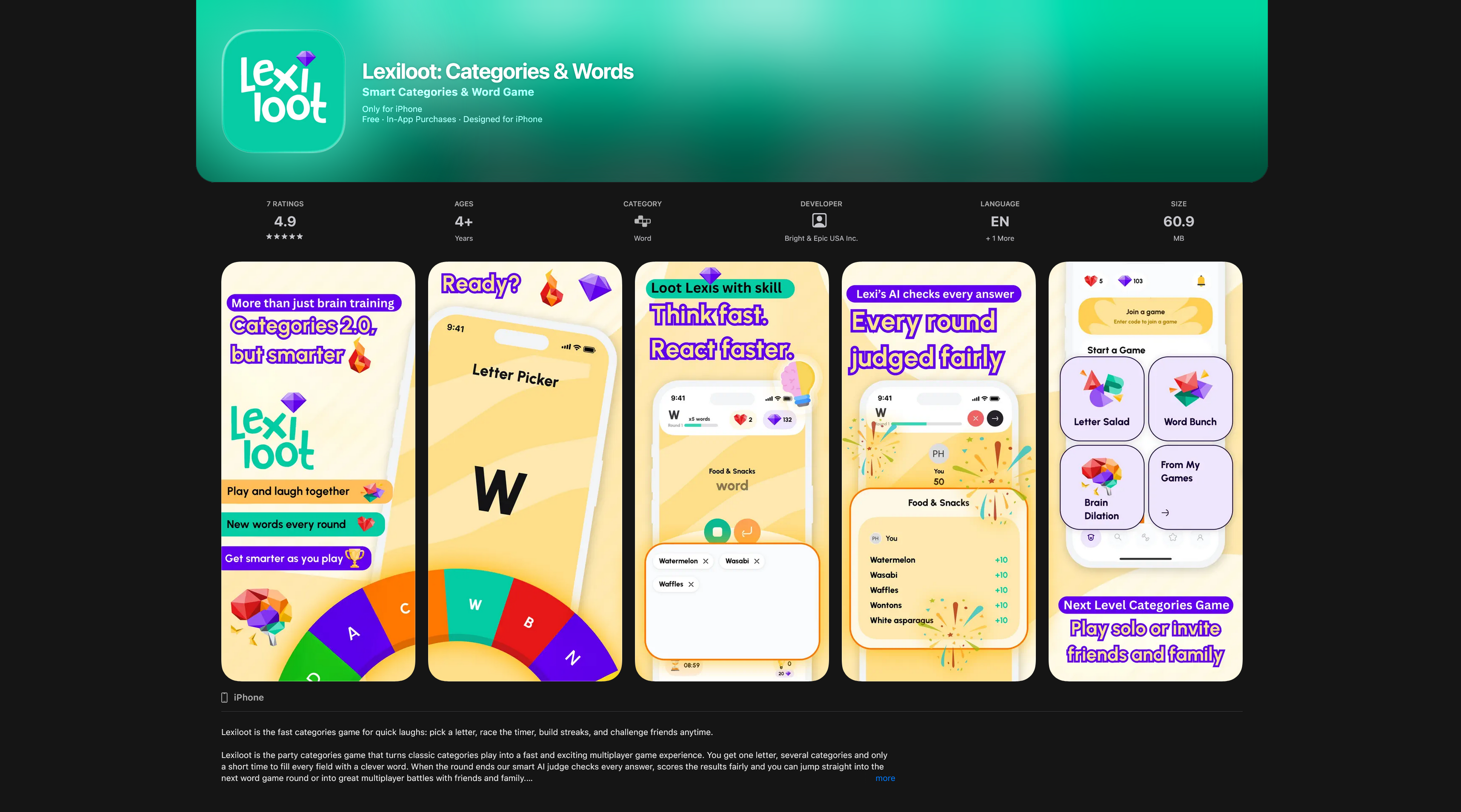
Lexiloot offers category-based game modes that build category thinking alongside vocabulary recall, a combination that few apps prioritize. You can challenge friends, compete on leaderboards, and work through puzzles designed to stretch your word knowledge in every session. Explore creative word game examples to see the variety available, or dive into word games for vocabulary growth to understand what each format builds. A stronger vocabulary and a sharper mind are closer than you think.
Frequently asked questions
What are the best free cognitive game apps?
Lumosity and WordBrain feature adaptive training and daily puzzles for various cognitive skills, while Words with Friends 2 and Wordscapes focus on vocabulary, speed, and multiplayer fun, making all four strong free starting points.
Do cognitive games really improve brain function?
Cognitive training shows moderate behavioral benefits, especially for near-transfer tasks, but broader improvements across unrelated skills are still debated among researchers. The clearest gains come from practicing skills directly related to the game you play.
Which cognitive games are best for vocabulary building?
WordBrain’s tile-connection mechanic directly supports vocabulary enhancement through active word formation, and it pairs well with Words with Friends 2 and Scrabble GO for a complete vocabulary-building routine.
How much should I play cognitive games for results?
Training dose and compliance are key factors in cognitive training outcomes, which is why short daily sessions of 10 to 15 minutes consistently outperform long, infrequent play for building and retaining new skills.

