


TL;DR:
- Effective puzzle solving relies on structured strategies, pattern recognition, and strategic flexibility.
- Using specific methods for anagrams, Wordle, and Connections improves accuracy and speed.
- Continuous practice with targeted tools enhances cognitive skills and mastery over different puzzle types.
You’re one letter away from cracking a Jumble, and then your mind goes blank. Or you’re in a Wordle match and you’ve burned four guesses without a single green tile. These moments are frustrating, but they’re also fixable. The truth is, most word puzzle struggles come down to missing a reliable system, not a lack of vocabulary. Whether you play solo puzzles during your commute or compete in multiplayer word battles, having a clear, repeatable strategy changes everything. This guide walks you through proven, step-by-step methods for solving anagrams, fill-in puzzles, Wordle, and Connections, so you can turn those near-misses into satisfying wins.
Table of Contents
- Essential tools and setup for word puzzle solving
- Step-by-step strategies for unscrambling and fill-in puzzles
- Optimizing your Wordle and code-cracker puzzle workflow
- Grouping, elimination, and advanced tactics for Connections and category games
- A fresh perspective: Why most step-by-step guides miss the real game mastery
- Want to practice and master word puzzles? Discover Lexiloot’s expert resources
- Frequently asked questions
Key Takeaways
| Point | Details |
|---|---|
| Preparation matters | Starting with the right mindset and tools sets the foundation for puzzle-solving success. |
| Systematic strategies win | Applying step-by-step methods—pattern recognition, elimination, and trial/error—dramatically improves solving rates. |
| Adaptation beats repetition | Expert solvers flexibly adjust tactics and spot traps, mastering puzzles faster than those who follow rote steps. |
| Practice improves speed | Regular puzzle practice boosts your pattern recognition and speeds up solution time, especially in mobile games. |
| Advanced tactics unlock mastery | Using grouping, elimination, and pattern-switching techniques empowers you to tackle even the toughest puzzles. |
Essential tools and setup for word puzzle solving
With a clear understanding of your challenge, let’s explore what you need to get started, both in terms of mindset and practical tools.
Before you solve a single puzzle, it helps to know what kind of thinker you currently are. Experts use predictive and intuitive thinking, while beginners tend to rely on trial and error. Neither approach is wrong, but knowing where you fall helps you choose the right tools and set realistic expectations. The goal is to gradually shift from reactive guessing to proactive pattern recognition.
Here’s what you actually need to get started:
- A vocabulary-building habit. Read widely, play daily word games, and review words you missed. Vocabulary recall improves with consistent exposure.
- A notepad or scratch space. Whether digital or physical, writing out letter combinations speeds up your thinking.
- A reliable word game app. Apps like Lexiloot let you practice creating word puzzles and building category thinking in a structured, fun environment.
- A basic understanding of letter frequency. Knowing that E, T, A, O, and I are the most common English letters gives you a real starting advantage.
Digital vs. analog solving tools
| Tool | Best for | Strengths | Weaknesses |
|---|---|---|---|
| Mobile word game app | Daily practice and multiplayer | Instant feedback, progress tracking | Screen fatigue |
| Notepad and pen | Anagram work and brainstorming | No distractions, tactile thinking | No auto-check |
| Online unscrambler | Verification only | Fast results | Builds dependency |
| Flashcard app | Vocabulary building | Spaced repetition | Not puzzle-specific |
For a deeper look at how different puzzle formats work, the word puzzle guide from Lexiloot is a great starting point. It covers puzzle types and what cognitive skills each one trains.
If you want to build unscramble strategies into your daily routine, start small. Five minutes of focused practice daily beats an hour of scattered play once a week.
Pro Tip: When tackling anagrams, write every letter on a separate sticky note or app tile and physically rearrange them. The act of moving letters around activates a different part of your problem-solving brain than just staring at a screen.
Step-by-step strategies for unscrambling and fill-in puzzles
Once you’re equipped, it’s time to apply systematic methods to tackle different puzzle types efficiently.
Anagrams and Jumbles feel chaotic until you have a process. Here’s a numbered method that works consistently:
- Write out all the letters. Don’t try to solve in your head. Get them on paper or a scratch pad.
- Separate vowels from consonants. This instantly reduces the noise and helps you see possible syllable structures.
- Look for common letter pairs. Identify pairs like TH, CH, and QU early, as these rarely change position in real words.
- Check for prefixes and suffixes. Words ending in -ING, -ED, -LY, or starting with UN-, RE-, or PRE- are common. Locking these in narrows your options fast.
- Use theme or context clues. If the puzzle has a category or topic, let it guide your guesses. Context is a powerful filter.
- Test your best guess aloud. Saying a word out loud helps your brain catch errors your eyes miss.
For fill-in puzzles, the approach shifts slightly. Start with the longest or most unique words first, since they have fewer placement options and anchor the rest of the grid. Then use these tactics:
- Work from intersecting letters outward
- Use elimination to rule out words that don’t fit crossing entries
- Watch for pluralization traps, where a word seems right but the S doesn’t fit the crossing letter
- Revisit earlier placements if you hit a dead end, since one wrong anchor can block the whole puzzle
Pattern-based methods give approximately an 85% success rate in fill-in puzzles when applied consistently, compared to pure guessing. That’s a meaningful difference when you’re playing against the clock in a multiplayer match.
For players ready to go deeper, advanced puzzle strategies cover how to apply these techniques under time pressure and in competitive formats.
Pro Tip: Separate your vowels first, every time. It sounds simple, but this single habit cuts your unscrambling time significantly because vowel placement is the backbone of almost every English word.
Optimizing your Wordle and code-cracker puzzle workflow
Now let’s focus on mastering popular mobile puzzles like Wordle, leveraging proven workflows and handling tricky edge cases.
Wordle rewards players who think in probabilities, not just possibilities. The key is a structured workflow that maximizes information with every guess.
Step-by-step Wordle workflow:
- Open with a high-frequency starter. Openers like SLATE or CRANE cover the most common English letters and give you the most useful feedback in one guess.
- Map your results immediately. Note which letters are confirmed, misplaced, or eliminated. Don’t hold this in your head.
- Eliminate impossible letters. Cross off any letter shown in gray. This narrows your next guess significantly.
- Prioritize misplaced letters. Yellow tiles tell you the letter exists but is in the wrong spot. Move it and try again.
- Watch for double letters. Words like ABBEY or LEVEL trip up many players. If you’re stuck, consider that a letter might appear twice.
- Verify before submitting. Check your word against all known constraints before locking in your guess.
Wordle opener performance
| Opener word | Avg. guesses to solve | Notes |
|---|---|---|
| SLATE | 3.54 | Covers S, L, A, T, E |
| CRANE | 3.61 | Strong vowel and consonant mix |
| AUDIO | 3.78 | Vowel-heavy, good for early mapping |
| RAISE | 3.65 | High-frequency letters, solid start |
Research using constraint satisfaction programming (CSP) heuristics shows a 99.9% Wordle success rate is achievable with optimal strategy. That’s not magic. It’s method.
Edge cases catch even experienced players. Double letters and ambiguous words are the most common traps. If you’ve confirmed four letters and nothing fits, double-letter combinations are usually the answer.
Using a notepad or the tracking features in apps like Lexiloot helps you build a vocabulary workflow guide over time. You start recognizing which letter patterns appear most often, and your solve speed improves naturally. For more on how word games in learning build real cognitive skills, it’s worth exploring how daily puzzle habits rewire your pattern recognition over weeks.
For additional winning Wordle tips, tracking your past guesses and noting which openers worked best for you personally is one of the most underrated habits.
Grouping, elimination, and advanced tactics for Connections and category games
Finally, let’s build on those stepwise processes and move into expert territory: grouping, elimination, and advanced thinking for Connections and category games.
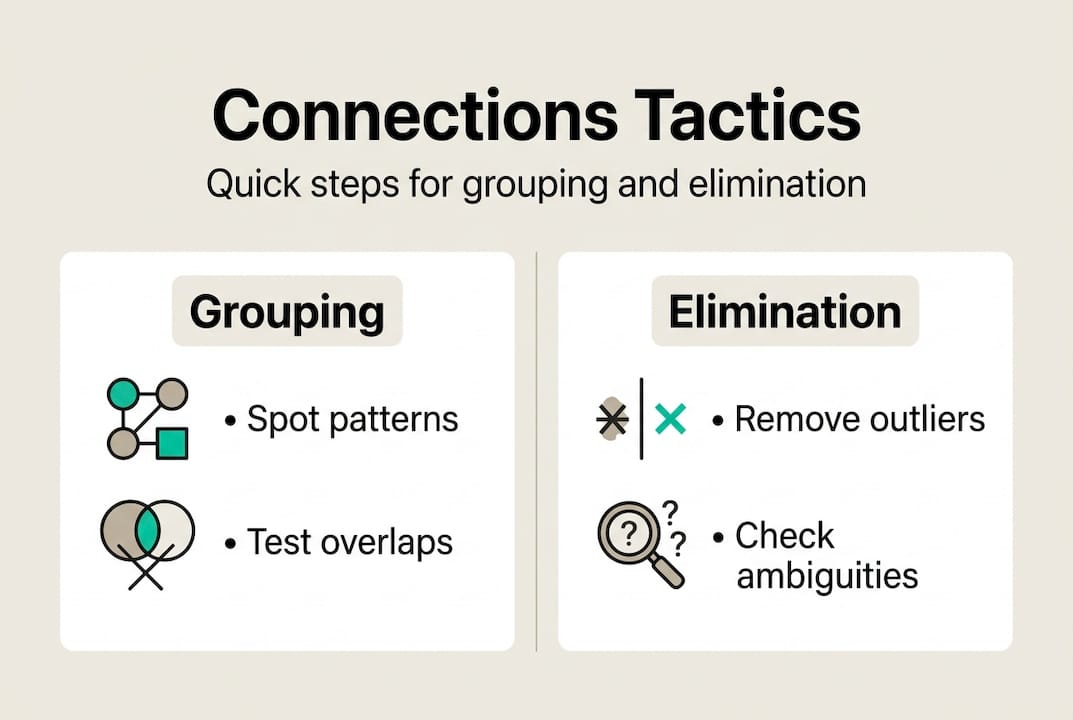
Connections puzzles ask you to sort 16 words into four groups of four. The challenge is that many words seem to fit multiple categories. That’s intentional.
Connections vs. category games: A tactical comparison
| Step | NYT Connections | Category word games |
|---|---|---|
| Start with | Most obvious group (yellow) | Clearest category match |
| Use | Process of elimination | Theme-based grouping |
| Watch for | Multiple meanings, wordplay | Overlapping categories |
| Avoid | Locking in purple too early | Forcing rare words into groups |
| Finish with | Hardest, trickiest group | Remaining process of elimination |
Identify obvious groups first and use elimination to work toward the harder ones. Here are expert tactics that make a real difference:
- Say words aloud. Your ear catches grammatical patterns your eyes skip over. A word that sounds like a verb might be the key to unlocking a group.
- Look for wordplay and double meanings. The hardest Connections groups almost always hinge on a word that means two different things.
- Use past themes as reference. Puzzle designers recycle structural ideas. If you’ve seen a “___ ball” pattern before, you’ll spot it faster next time.
- Notice grammar. All words in a group usually share the same grammatical form, all nouns, all verbs, all adjectives.
Critical tip: Never commit to the purple (hardest) group until you’ve confirmed the other three. One wrong placement cascades into multiple errors.
For a structured approach to daily puzzle habits, the casual puzzle workflow guide shows how to build these skills into a routine that’s actually enjoyable.
A fresh perspective: Why most step-by-step guides miss the real game mastery
Having covered step-by-step methods, it’s time to offer a fresh take on what separates top puzzle solvers from casual enthusiasts.
Most guides give you a checklist. Follow steps one through six, and you’ll solve the puzzle. That works, until it doesn’t. The real gap between good players and great ones isn’t the method they follow. It’s how quickly they recognize when to switch methods.
A systematic scan versus anchoring approach illustrates this perfectly. Some puzzles reward starting with the obvious. Others punish it by pulling you toward a trap. Knowing which situation you’re in requires judgment, not just process.
True mastery comes from active experimentation. Try a strategy, notice where it breaks down, and adjust. That feedback loop builds the kind of flexible intelligence that no checklist can teach. Edge cases, double letters, misleading categories, these are not obstacles. They are the actual game.
For players ready to push further, mastering advanced word puzzles explores how adaptability and creative thinking outperform rigid step-following in competitive play.
Pro Tip: Deliberately practice switching strategies mid-puzzle. Start with one method, then force yourself to try a different angle. This builds the mental flexibility that separates consistent winners from occasional lucky solvers.
Want to practice and master word puzzles? Discover Lexiloot’s expert resources
To continue your journey and put these step-by-step methods into practice, check out dedicated puzzles and guides from Lexiloot.
Lexiloot brings together everything you need to sharpen your puzzle skills in one place. From category challenges to multiplayer word battles, you can apply these exact strategies in real game scenarios and track your improvement over time.
Explore word game strategies that go beyond the basics and help you build genuine spelling fluency. Discover creative word game examples that make practice feel like play. And if you want to understand the bigger picture, the benefits of word puzzles guide shows how consistent play builds real cognitive skills at every age. Lexiloot is where strategy meets fun, and every game makes you a sharper thinker.
Frequently asked questions
What is the fastest way to solve anagrams in mobile word games?
Separate vowels and consonants, look for common letter pairs like TH or CH, and try adding S for plurals to quickly form words.
Are there specific openers that maximize Wordle success?
Using openers like SLATE or CRANE optimizes letter coverage and significantly increases the chance to solve Wordle in fewer guesses, with research showing an average of 3.54 guesses using optimal methods.
How can I avoid traps and ambiguous words in Connections puzzles?
Focus on grouping the obvious first, use elimination methods, and watch for multiple meanings or grammatical clues to spot tricky options.
What is the most effective strategy for fill-in puzzles?
Start with unique or longest words, then use trial and error or pattern recognition to fill in blanks efficiently, working from intersecting letters outward.
Does practicing step-by-step methods actually speed up puzzle solving?
Yes, regular practice builds efficient pattern recognition, and word search experts consistently solve hard grids in five to ten minutes, a pace that comes directly from structured, repeated practice.

