


TL;DR:
- Enjoyment in learning is a fundamental mechanism that enhances engagement, retention, and cognitive connection building.
- Effective fun incorporates agency, challenge, diversity, pleasure, a low-stress environment, and peer interaction simultaneously.
Fun is often treated as something kids deserve after the real work is done. But the role of fun in learning is far more significant than that. Research increasingly shows that enjoyment is not a reward for learning. It is a mechanism for it. When children feel safe, curious, and engaged, their brains process and retain new vocabulary more effectively, build stronger cognitive connections, and stay motivated long enough for real skill development to happen. This guide breaks down the evidence, the strategies, and the practical tools that make fun a serious asset in any learning environment.
Table of Contents
- What makes learning fun and why it matters
- How interactive word games boost vocabulary and retention
- The cognitive benefits of play and social interaction in learning
- Designing engaging word games: practical strategies and pitfalls
- Rethinking fun in learning: fresh perspectives educators and parents often miss
- How Lexiloot’s categories game supports fun and effective vocabulary learning
- Frequently asked questions
Key Takeaways
| Point | Details |
|---|---|
| Fun boosts learning | Fun elements like agency and peer interaction enhance motivation and vocabulary retention. |
| Games improve vocabulary | Interactive word games significantly raise vocabulary scores and long-term retention. |
| Play develops cognition | Purposeful social play supports executive functions essential for learning success. |
| Balance challenge and support | Optimal learning combines fun challenges with adult scaffolding and low stress. |
| Design with intention | Effective word games use familiar themes, praise over correction, and promote cooperation. |
What makes learning fun and why it matters
Not all fun is created equal. A classroom that runs trivia games every Friday feels fun. But that is different from the kind of purposeful, active engagement that actually improves outcomes. Recent research identifies six key elements that contribute to fun in learning beyond simple gamification: sense of agency, challenge, diversity in learning, pleasure, low-stress climate, and peer interaction.
Each of these matters for a specific reason.
- Agency means learners choose what to explore or how to approach a problem. That sense of control increases motivation and investment in the outcome.
- Challenge keeps the brain engaged. Tasks that are too easy produce boredom. Tasks that hit the right level of difficulty produce focus, a state where vocabulary recall and spelling fluency improve noticeably.
- Diversity in learning prevents monotony. Switching between spoken, written, and visual word tasks activates more cognitive pathways than repetition of a single format.
- Pleasure reinforces positive association with learning. When something feels good, the brain is more likely to return to it.
- Low-stress climate removes a significant barrier. Anxiety narrows attention and blocks the kind of flexible thinking needed to absorb new words and categories.
- Peer interaction creates natural language practice. Kids explain, debate, and guess with each other, generating far more vocabulary use than solo exercises typically do.
These elements work together, not in isolation. A game that offers challenge without a low-stress environment, for example, may produce frustration rather than learning. The importance of fun in education becomes clearest when all six elements are present at once, something the best word games and social play formats naturally provide. You can see how casual family gaming benefits vocabulary and cognitive development when these elements align.
Now that we understand why fun is powerful, let’s look at how games specifically boost vocabulary acquisition and retention.
How interactive word games boost vocabulary and retention
The benefits of playful learning are not just observable in classrooms. They are measurable. Gamified vocabulary tools like digital quiz-based platforms have produced statistically significant improvements in vocabulary success and retention rates when compared to traditional instruction. One study found that mean vocabulary scores jumped from 45.78 to 86.22 in elementary students using gamified tools, far outpacing the control group taught through conventional methods.
That kind of improvement does not happen by accident. Here is why game-based vocabulary learning works so well:
- Immediate feedback tells learners whether their guess was right before the information fades from working memory, which strengthens retention more than delayed correction.
- Repetition through play feels different from drilling. Students encounter the same word in five different rounds without feeling like they are studying.
- Social word games encourage learners to use new vocabulary out loud, and spoken production is one of the strongest reinforcement mechanisms available.
- Reduced anxiety matters enormously. Guessing games have been shown to improve vocabulary scores while also reducing learner anxiety and increasing confidence, a combination that traditional quizzes rarely achieve.
| Learning method | Vocabulary retention | Anxiety level | Student engagement |
|---|---|---|---|
| Traditional instruction | Moderate | High | Low to moderate |
| Gamified digital tools | High | Low | High |
| Social word games | High | Very low | Very high |
| Rote repetition | Low to moderate | Moderate | Low |
The table above illustrates why the impact of enjoyment on learning is not a soft or subjective claim. The data consistently shows that when learners enjoy the process, they retain more and feel better about returning to it. Knowing how to gamify vocabulary learning effectively means understanding that engagement is not decoration. It is the engine.
Pro Tip: Aim for a mix of individual and group word game formats in your sessions. Group formats lower anxiety, while individual rounds build personal accountability. Alternating between the two produces stronger vocabulary recall than either approach alone.
If you want to take vocabulary practice further, exploring advanced vocabulary practice strategies gives you a solid framework for moving beyond beginner-level gains.
Having seen how games practically boost vocabulary, let’s look at how play shapes cognitive skills and executive functions.
The cognitive benefits of play and social interaction in learning
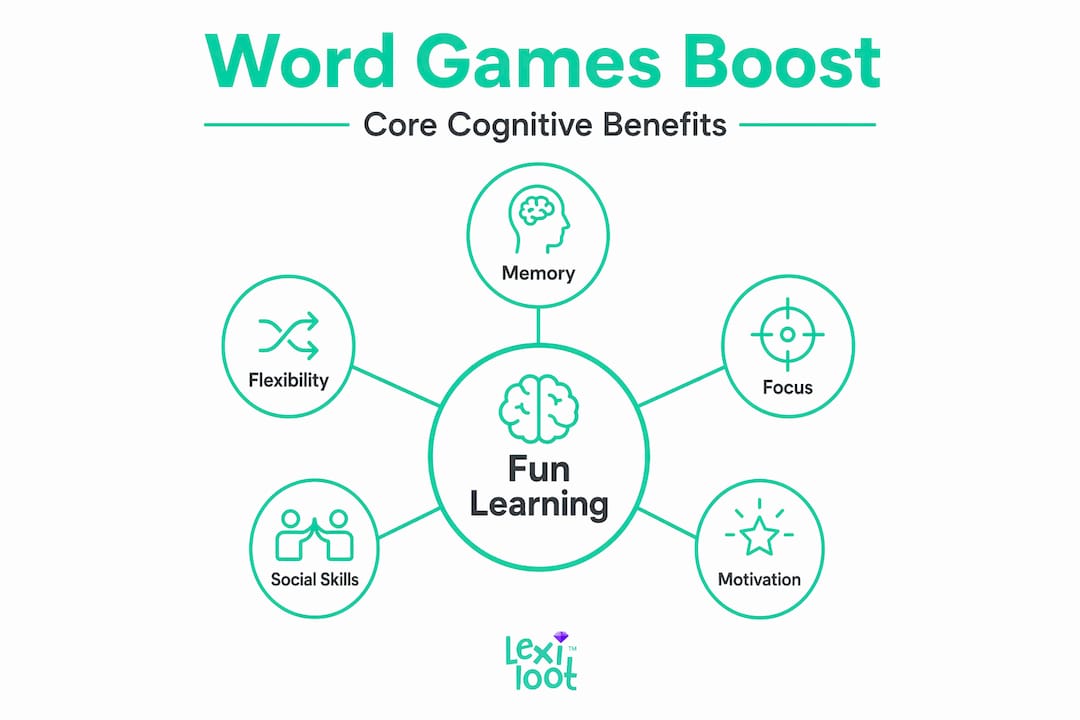
Vocabulary growth is only one part of what happens when kids engage in purposeful play. Fun learning strategies that include social interaction also build executive function skills, the mental tools children rely on for self-control, planning, and flexible thinking.

Playful learning develops working memory, inhibitory control, and cognitive flexibility simultaneously. These three skills are foundational for school readiness and academic performance, and they are much harder to build through passive instruction than through active, social play.
Here is how the development process unfolds during a well-designed word game:
- Working memory is exercised when a child holds a category in mind while scanning for matching words. Every round strengthens this capacity.
- Inhibitory control kicks in when a player resists blurting out the wrong answer, waiting for the right moment. This is effortful and productive.
- Cognitive flexibility develops when game rules change, categories shift, or players have to think about a familiar word in a new context.
- Self-regulation improves through repeated experience of managing winning and losing within a low-stakes social environment.
The social dimension amplifies these gains. Sociodramatic peer play with teacher scaffolding boosts executive function particularly well when adults prompt language use and guide conflict resolution during play. That means the teacher’s job is not to step back entirely. It is to ask the right questions, introduce a new word at the right moment, and help kids negotiate.
“Guided play, where children lead but adults scaffold, produces the richest combination of joy and cognitive challenge.”
Pro Tip: During a word game session, try pausing after a correct answer and asking, “Can you think of another word that fits the same category?” This single prompt extends vocabulary thinking without disrupting the fun.
Understanding these mechanisms around play-for-learning helps educators and parents make smarter decisions about which games to choose and how to participate in them.
Understanding these cognitive benefits helps us apply game and play strategies more effectively in educational settings.
Designing engaging word games: practical strategies and pitfalls
Knowing why fun works is useful. Knowing how to build it into word games is what makes a real difference in the classroom or at home. Engaging students through fun requires design thinking, not just good intentions.
What makes a word game session effective:
- Start with familiar themes. A categories game using animals or foods reduces initial frustration and builds early confidence. Students who feel capable early on are far more willing to take risks later.
- Use a high praise-to-correction ratio. Research supports a 1:3 praise-to-correction approach to keep players motivated and emotionally invested in the game.
- Vary the format. Rotate between timed rounds, guessing formats, team play, and category sorting. This keeps attention active and exercises different vocabulary skills.
- Scaffold language during play. Ask questions, offer hints, and introduce new words naturally in context, not as corrections.
- Prioritize group wins. Over-competition reduces motivation by shifting focus from learning to performance anxiety. Leaderboards are useful, but shared victories produce more sustained dopamine release and longer cognitive engagement.
Common pitfalls to avoid:
| Pitfall | Why it hurts learning | Better alternative |
|---|---|---|
| Excessive competition | Raises anxiety, lowers risk-taking | Celebrate team scores alongside individual ones |
| Skipping unfamiliar themes entirely | Limits vocabulary expansion | Introduce one new theme per session |
| Overcorrecting errors publicly | Embarrasses learners, reduces participation | Use gentle, private correction or reframe as a group puzzle |
| No adult involvement | Misses scaffolding opportunities | Participate actively, ask guiding questions |
| Repeating the same game format | Reduces engagement over time | Rotate formats every two to three sessions |
Knowing how to teach word games effectively also means recognizing that the learning is often happening in the gaps between moves, during discussion, laughter, and debate. Build in time for those moments. For broader word game strategies that strengthen both vocabulary and brain performance, there is a lot more to explore.
Pro Tip: After a game session, spend two minutes asking players to list their favorite new words from the round. This simple review step significantly improves next-day recall.
With these strategies and considerations in mind, let’s reflect on the broader perspective on fun in learning and what typical advice often overlooks.
Rethinking fun in learning: fresh perspectives educators and parents often miss
Here is what most articles about fun in learning get wrong. They treat fun as a delivery vehicle, a way to make important content more palatable. Sprinkle some games on top of a vocabulary lesson, and suddenly kids are engaged. That is not untrue, but it misses the deeper point.
Fun is not a coating. It is a condition. And creating that condition requires more than picking a good game. It requires understanding that agency, challenge, and social support all have to be present at the same time. A highly competitive game with no scaffolding and only one winner produces stress, not joy. A completely unstructured free play session produces fun but limited cognitive growth.
Guided play outperforms both free play and direct instruction by letting children lead while adults scaffold, maximizing vocabulary and executive function gains. That finding challenges two common habits among well-meaning educators and parents. Some step back too far, assuming the best thing they can do is get out of the way. Others stay too involved, turning play into a lesson and draining the joy out of it.
The most effective approach sits in between. You join the game. You ask a genuine question. You let the child figure it out. You introduce a new word when curiosity is already running high. That is guided play. It is intentional, warm, and responsive.
There is also a tendency to conflate variety with novelty. Rotating between new games every session can feel stimulating, but it can also prevent the kind of repeated exposure that builds real vocabulary fluency. The most effective guided play advantages come from formats that are familiar enough to allow focus but varied enough to stay fresh. A categories game played with different themes across multiple sessions hits this balance well.
To put these insights into practice, let’s explore how a mobile word game like Lexiloot’s categories game aligns with these principles.
How Lexiloot’s categories game supports fun and effective vocabulary learning
Everything described in this article, agency, challenge, low-stress social play, scaffolded interaction, and varied formats, is built into how Lexiloot works. The categories game lets players choose their own categories and pace, supporting the sense of agency that research links to deeper engagement. Multiplayer modes bring in the social interaction and healthy group competition that sustain motivation without tipping into anxiety.
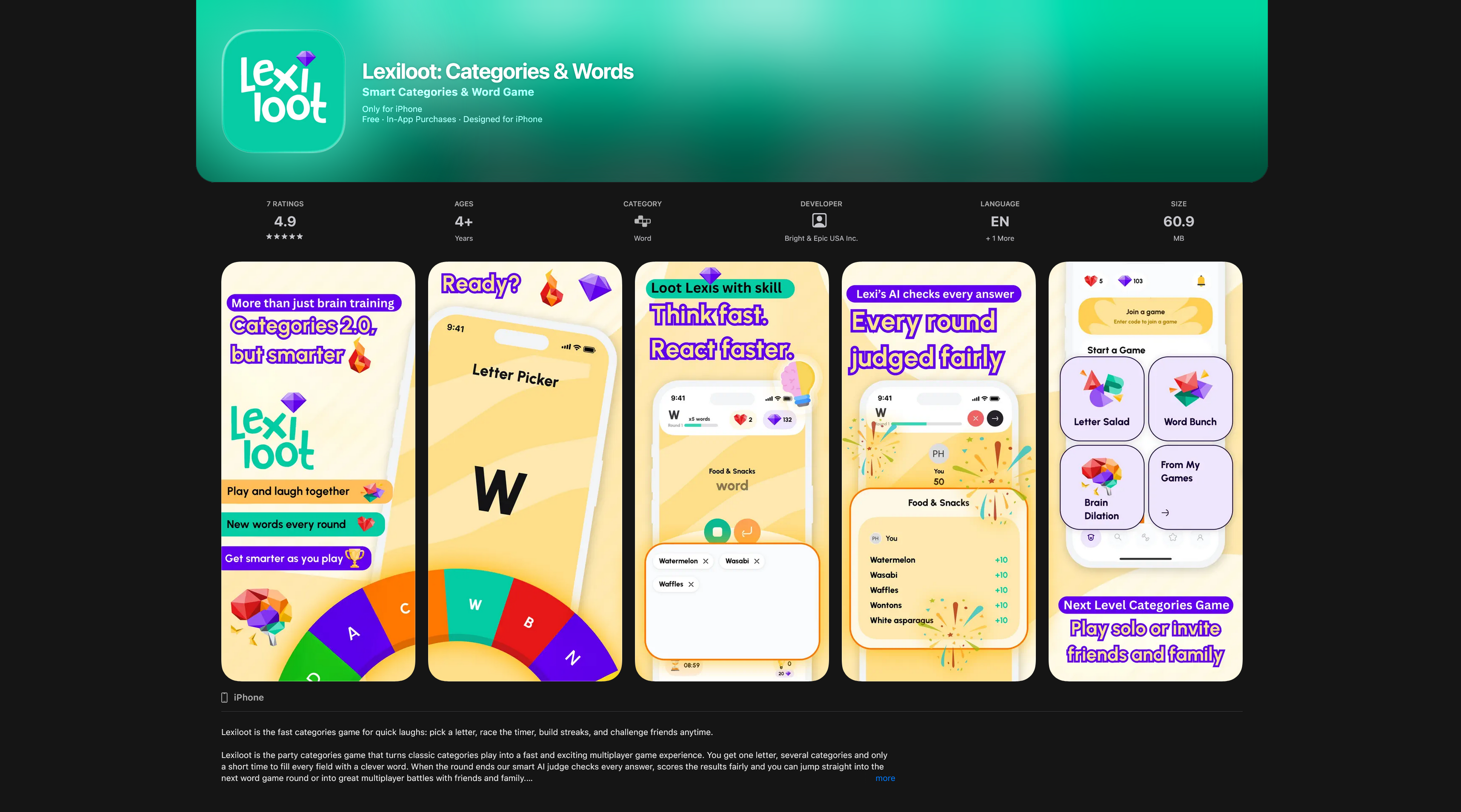
Lexiloot is designed for families, classrooms, and self-directed learners who want vocabulary and cognitive growth without the grind of traditional study. It is ad-free, built on a pay-once model, and structured so that every session feels like play while quietly building real skills. Whether you are a parent looking for something to share with your child or a teacher seeking mobile games for vocabulary learning that actually reinforce classroom content, Lexiloot fits naturally into the routine. Explore how word games boost vocabulary and see what a few minutes of daily play can build over time.
Frequently asked questions
Why is fun important in learning vocabulary?
Fun increases motivation, reduces anxiety, and creates a low-stress environment that enhances vocabulary retention and cognitive engagement. It acts as a catalyst for engagement, helping the brain form meaningful connections around new words rather than storing them as isolated facts.
How do word games improve cognitive skills besides vocabulary?
Word games foster executive function skills like working memory, cognitive flexibility, and self-regulation through social interaction, challenge, and scaffolded play. Play develops these skills simultaneously, supporting school readiness and deeper learning across subjects.
Can competition in games harm learning motivation?
Excessive competition can reduce motivation by shifting a learner’s focus from discovery to performance pressure. Promoting group wins and using a high praise-to-correction ratio helps sustain engagement, since group wins promote dopamine release that supports long-term cognitive benefits.
What is guided play and why is it effective?
Guided play lets children lead learning activities while adults provide light scaffolding, asking questions and introducing language at natural moments. This approach outperforms both free play and direct instruction because it preserves the joy and agency of play while keeping cognitive goals in view.

