


Category games online captivate millions of players, yet many underestimate their depth and diversity. Scattergories features over 100 category lists, each designed to challenge vocabulary and quick thinking in unique ways. This guide reveals how to choose, play, and benefit from category-based word games that combine entertainment with cognitive enhancement across all skill levels.
Table of Contents
- Introduction To Category Games Online
- Core Gameplay Types And Popular Online Category Games
- Cognitive And Social Benefits Of Playing Category Games
- Common Misconceptions About Category Games
- Comparison Of Game Formats And How They Affect Playstyle
- Common Categories Used And Their Impact On Gameplay
- Integrating Category Games In Social And Educational Settings
- Discover Lexiloot: Your Ultimate Category Games Platform
- FAQ
Key takeaways
| Point | Details |
|---|---|
| Category games boost vocabulary | Games like Scattergories train rapid word recall, vocabulary expansion, and strategic thinking through timed challenges and diverse category lists. |
| Timed vs free play formats | Timed rounds build competitive pressure and speed, while free play encourages creativity and deeper social interaction without constraints. |
| Misconceptions limit player engagement | Many dismiss category games as simple, yet they deliver complex cognitive benefits comparable to dedicated brain training exercises. |
| Category selection shapes difficulty | Choosing age-appropriate and thematic categories balances accessibility with challenge, maximizing fun and learning for diverse groups. |
| Online multiplayer enhances motivation | Social features like leaderboards, friend battles, and cooperative modes increase engagement and create lasting connections through shared gameplay. |
Introduction to category games online
Category games combine letter challenges with predefined lists, requiring players to name items fitting specific themes under time or turn constraints. Scattergories stands as the flagship example, where participants list words starting with a randomly selected letter that match various categories like food, cities, or occupations. This simple mechanic creates surprisingly complex gameplay that rewards both vocabulary depth and creative thinking.
Online platforms have transformed category games from tabletop activities into accessible digital experiences. Players now compete globally through mobile apps and web browsers, connecting with friends or strangers in real time. The digital shift enables instant scoring, automatic timer management, and vast category libraries that would be impractical in physical formats.
Core mechanics across category games share common elements:
- Unique answer scoring that rewards creativity and penalizes duplicate responses
- Category variety ranging from simple themes for beginners to obscure topics for experts
- Time pressure or turn limits that force quick decision making
- Multiplayer competition that drives engagement through social interaction
- Adjustable difficulty through category selection and rule variations
These games thrive on smartphones, tablets, and computers, offering both quick sessions during commutes and extended play for family game nights. Whether you prefer solo cognitive training or competitive multiplayer battles, free category games online for road trips and home entertainment deliver consistent mental stimulation wrapped in accessible, social gameplay.
Core gameplay types and popular online category games
Timed rounds create the quintessential category game experience by forcing rapid word generation under pressure. Players typically receive 60 to 180 seconds to list as many valid items as possible, with scoring based on unique answers that other players didn’t select. This format sharpens quick thinking and rewards players who can access obscure vocabulary while their competitors scramble for obvious choices.

Free play formats remove time constraints entirely, allowing participants to discuss answers, debate validity, and explore creative responses without pressure. These sessions emphasize social interaction over competition, making them ideal for casual family gatherings or educational settings where learning takes priority over winning. Players often discover unexpected connections between categories and generate more diverse answers when given unlimited time.
Multiplayer competition distinguishes category games through unique answer scoring that encourages strategic thinking. If three players all write “apple” for the fruit category, none receive points, but the player who wrote “apricot” scores because their answer stands alone. This mechanic transforms simple word listing into a psychological game where predicting opponent choices becomes as important as vocabulary knowledge.
Popular online variants include:
- Classic Scattergories with rotating letter dice and traditional category lists
- Speed-focused versions featuring 30-second rounds for maximum intensity
- Cooperative modes where teams collaborate to maximize unique answers
- Educational editions with curriculum-aligned categories for classroom use
- Custom game creators allowing players to design personalized category sets
Pro Tip: Match your gameplay format to your group’s energy level and goals. Choose timed rounds for competitive friends who thrive under pressure, but switch to free play when hosting mixed-age groups or prioritizing conversation over victory.
Explore scattergories alternative games and dedicated category game apps that offer innovative twists on traditional formats. Special themed versions like Valentine’s editions prove these games adapt seamlessly to any occasion or audience preference.
Cognitive and social benefits of playing category games
Category games function as disguised cognitive training tools that enhance multiple mental skills simultaneously. Players constantly activate semantic memory networks to retrieve words matching specific criteria, strengthening neural pathways responsible for vocabulary access and language processing. This rapid word retrieval under constraints mirrors real-world cognitive demands, from recalling names during conversations to generating creative solutions under deadline pressure.
Competitive and social dynamics increase engagement beyond what solo brain training apps typically achieve. The desire to outperform friends or climb leaderboards motivates sustained practice sessions that build cumulative benefits over time. Unlike isolated vocabulary drills, multiplayer category games embed learning within enjoyable social experiences that players voluntarily repeat without external incentives.
“Category games strengthen executive function by requiring players to simultaneously hold category rules in working memory, generate candidates from long-term storage, evaluate validity against constraints, and suppress obvious answers likely chosen by opponents.”
Mental benefits span all ages and skill levels:
- Children develop vocabulary breadth and learn categorical thinking essential for academic success
- Teenagers sharpen quick decision making and creative problem solving under time pressure
- Adults maintain cognitive flexibility and combat age-related mental decline through regular play
- Seniors preserve memory function and social connections through engaging group activities
- Language learners practice vocabulary recall in contextual, motivating scenarios
Educational applications leverage adjustable difficulty through category selection. Teachers assign simpler themes like colors and animals for elementary students, then progress to historical figures and scientific concepts for advanced learners. Classroom category games transform vocabulary practice from tedious memorization into competitive entertainment that students request repeatedly.
Social benefits extend beyond cognitive gains. Players improve communication skills by explaining answers, debating validity, and negotiating house rules. Friendly competition builds relationships through shared experiences and inside jokes that emerge from memorable gameplay moments. The benefits mirror puzzle solving for adults, creating relaxation and satisfaction through achievable challenges that reward persistence and creativity.
Common misconceptions about category games
Many potential players dismiss category games as trivial entertainment suitable only for children or casual gatherings. This misconception ignores the complex cognitive processes these games demand, including rapid semantic search, strategic opponent modeling, and creative constraint satisfaction. The apparent simplicity of listing words masks sophisticated mental operations that challenge even highly educated adults.
Myth: Category games lack meaningful brain training benefits compared to dedicated cognitive exercise apps.
Fact: Research demonstrates comparable executive function enhancement between category games and specialized brain training programs. Both activate prefrontal cortex regions responsible for working memory, inhibitory control, and cognitive flexibility. Category games deliver these benefits within engaging social contexts that increase adherence and long-term practice.
Myth: Timed rounds limit creativity and reduce enjoyment by creating unnecessary stress.
Fact: Time pressure serves distinct cognitive purposes beyond artificial difficulty. Constraints force automatic rather than deliberate processing, accessing different memory pathways and revealing vocabulary that players didn’t consciously know they possessed. The mild stress response actually enhances memory consolidation, making practiced skills more durable. Players who exclusively avoid timed play miss half the cognitive and competitive benefits these games offer.
Myth: Digital versions cannot replicate the social enjoyment of physical category games.
Fact: Online platforms expand social possibilities beyond geographic limitations. Players maintain connections with distant friends through regular game sessions, join global communities of enthusiasts, and access features like instant replay analysis and performance tracking impossible in physical formats. While in-person gatherings offer unique benefits, digital category games create new forms of social interaction rather than simply replicating analog experiences.
Common category lists provide appropriate challenge for diverse skill levels:
- Simple concrete nouns suit beginners and children learning categorical thinking
- Abstract concepts and specialized knowledge categories challenge experienced players
- Mixed difficulty lists within single games balance accessibility with expert engagement
- Custom category creation allows precise difficulty calibration for specific groups
Understanding these realities helps players appreciate category games as legitimate cognitive tools worthy of regular practice, not mere diversions for killing time.
Comparison of game formats and how they affect playstyle
Format choice dramatically influences cognitive demands, social dynamics, and player satisfaction. Timed rounds transform word generation into high-stakes decision making where speed competes with creativity. Players must balance the safety of obvious answers against risky unique choices that score higher but require more cognitive effort to access under pressure.
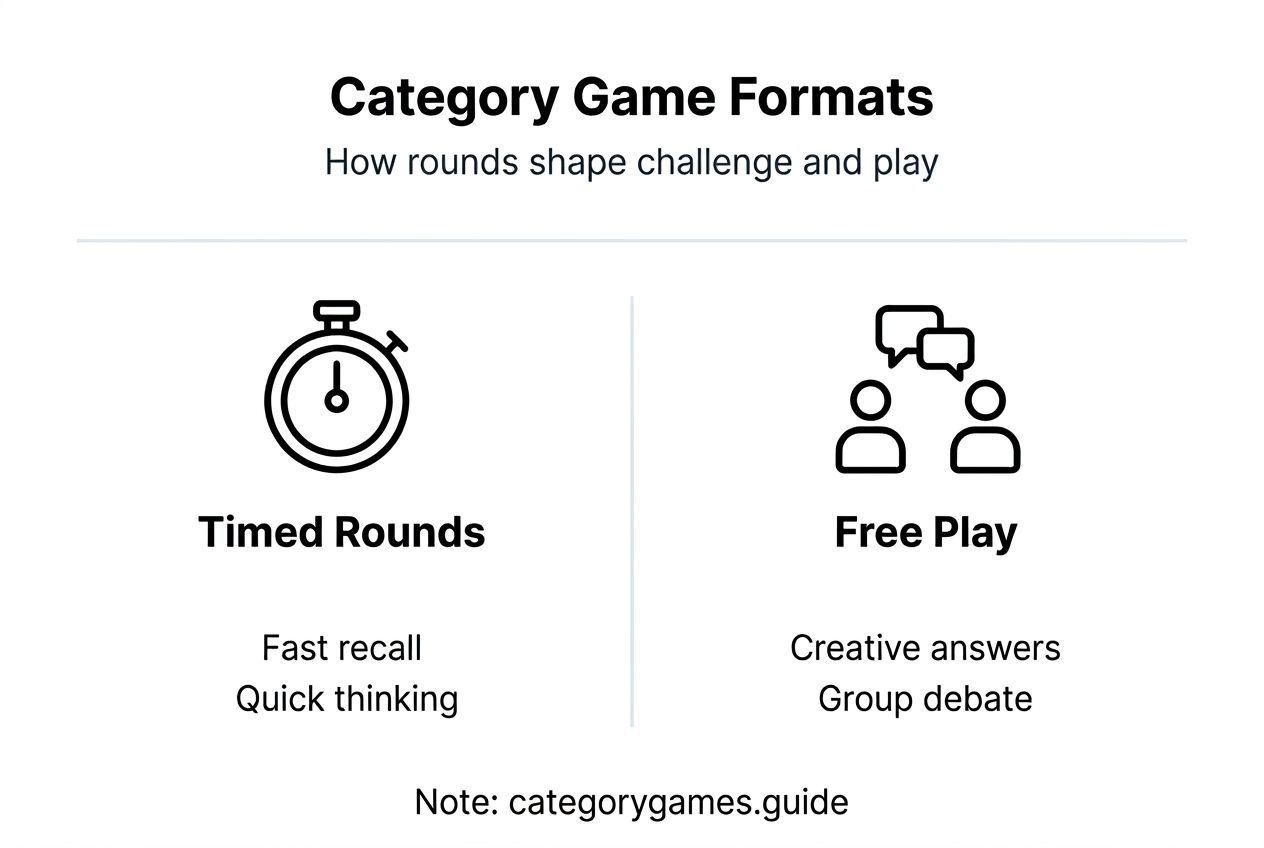
Free play removes urgency entirely, shifting focus from speed to depth. Participants explore unexpected connections, debate answer validity, and build on each other’s ideas through discussion. This format particularly benefits educational settings where explaining reasoning matters as much as final answers, and mixed-ability groups where slower thinkers contribute valuable insights given adequate processing time.
| Feature | Timed Rounds | Free Play |
|---|---|---|
| Primary skill | Rapid recall speed | Creative thinking depth |
| Cognitive demand | High pressure, automatic processing | Relaxed deliberation, strategic planning |
| Social interaction | Competitive tension, celebration of victories | Cooperative discussion, shared exploration |
| Ideal for | Competitive gamers, cognitive training | Families, classrooms, casual social gatherings |
| Drawback | May stress slower thinkers, limits discussion | Can drag without structure, reduces excitement |
| Difficulty scaling | Shorter times increase challenge exponentially | More obscure categories create depth challenges |
Strategic considerations differ markedly between formats. Timed players develop heuristics for quickly generating category-appropriate words, often working alphabetically through the target letter or visualizing physical locations containing category items. Free play participants employ collaborative brainstorming, building semantic chains where one answer triggers associations leading to others.
Pro Tip: Alternate between formats within single gaming sessions to exercise different cognitive muscles. Start with timed rounds to energize participants and establish competitive baseline, then transition to free play for deeper discussion and inclusive participation from quieter group members.
Situational format selection:
- Family game night: Free play maximizes inclusive participation and conversation
- Competitive tournaments: Strict timed rounds with standardized category lists ensure fair comparison
- Cognitive training: Timed practice builds mental speed, free play develops semantic network richness
- Educational assessment: Free play reveals reasoning and knowledge depth beyond simple recall
- Road trip entertainment: Phone-based timed rounds provide structured distraction
Players benefit from experiencing both formats regularly. Fast play habits in other domains demonstrate how time constraints build efficiency that persists even during untimed activities, while deliberate practice without pressure develops strategic depth that informs quick decisions under future constraints.
Common categories used and their impact on gameplay
Popular category themes balance universal accessibility with vocabulary challenge. Food items and animals provide reliable starting points that even young children can engage with, ensuring no player feels completely lost. Cities and occupations introduce geographic and professional knowledge that rewards broader life experience without requiring specialized education.
Category difficulty stems from multiple factors beyond simple familiarity. Narrow categories like “vegetables starting with the letter Q” create artificial scarcity that forces creative stretching of definitions. Broad categories like “things” remove useful constraints, paradoxically making word generation harder through analysis paralysis. The sweet spot lies in moderately specific themes that suggest clear semantic boundaries while permitting unexpected creative answers.
| Category Type | Examples | Difficulty Level | Ideal Age |
|---|---|---|---|
| Concrete nouns | Animals, colors, foods, toys | Easy | 5-8 years |
| Common places | Cities, countries, restaurants, stores | Medium | 9-12 years |
| Abstract concepts | Emotions, virtues, sports terms, professions | Medium-Hard | 13+ years |
| Specialized knowledge | Historical figures, scientific terms, literary works | Hard | 16+ years |
| Creative combinations | “Things that are round,” “Items in a kitchen” | Variable | All ages |
Age-appropriate selection ensures inclusive gameplay across generations. Children’s categories focus on concrete, visually imaginable items within their daily experience. Adult categories incorporate cultural references, professional terminology, and abstract concepts that reward broader knowledge bases. Multi-generational games succeed by mixing difficulty levels, allowing different players to shine on different rounds.
Strategic category selection tips:
- Alternate between familiar and challenging themes to maintain engagement without frustration
- Match categories to group interests like sports, movies, or hobbies for natural knowledge activation
- Introduce novel categories gradually to expand comfort zones without overwhelming players
- Use seasonal or event-specific categories like holiday-themed lists for topical relevance
- Create custom categories reflecting inside jokes or shared experiences for personalized fun
Cognitive benefits vary by category type. Concrete noun categories strengthen basic semantic networks and vocabulary breadth. Abstract categories develop metaphorical thinking and conceptual flexibility. Specialized categories reward curiosity and general knowledge accumulation. Rotating through diverse category types provides comprehensive mental exercise more effectively than repeatedly practicing identical lists.
Explore ultimate category lists organized by letter and difficulty to discover fresh challenges. Well-curated category collections prevent gameplay from becoming stale while continuously introducing new vocabulary and knowledge domains for players to master.
Integrating category games in social and educational settings
Hosting successful online category game sessions requires thoughtful preparation and moderation. Start by selecting a platform that supports your group size and desired features, whether video chat with separate scoring or integrated apps handling game mechanics automatically. Test technology beforehand to avoid frustrating delays that kill momentum and enthusiasm.
Step-by-step hosting guide:
- Gather participants through calendar invites specifying expected duration and casual nature to ease anxiety
- Select 8-12 diverse categories spanning difficulty levels to maintain interest across multiple rounds
- Explain scoring rules clearly, especially unique answer bonuses and challenge procedures for disputed validity
- Establish house rules for acceptable answers, like whether brand names count for generic categories
- Moderate actively by keeping time, resolving disputes diplomatically, and maintaining energetic pacing
- Debrief after gameplay by discussing memorable answers, surprising vocabulary gaps, and interesting debates
Tailoring categories for mixed abilities transforms potential frustration into inclusive enjoyment. Pair simple categories like colors with complex ones like architectural styles, allowing different players to contribute strong answers on different rounds. This rotation prevents anyone from dominating completely or falling too far behind, maintaining competitive tension without discouragement.
Educational applications extend beyond vocabulary drilling into comprehensive language arts instruction. Teachers use category games to introduce new thematic units, assess prior knowledge, and provide engaging review before assessments. The competitive element motivates students who typically disengage from traditional worksheets, while unique answer scoring rewards creative thinking alongside factual accuracy.
Classroom integration strategies:
- Assign curriculum-aligned categories like “Revolutionary War figures” or “geometric shapes” for content reinforcement
- Use free play format for small group discussions that surface misconceptions requiring instruction
- Implement timed rounds as formative assessment revealing which vocabulary students access automatically
- Create student-designed categories as creative projects demonstrating mastery of thematic connections
- Track individual progress over time to document vocabulary growth and cognitive development
Pro Tip: Schedule five-minute post-game reflection where players share which categories challenged them most and what strategies they discovered. This metacognitive discussion deepens learning by making unconscious mental processes explicit, helping players improve performance and appreciate the sophisticated thinking category games demand.
Mobile category games enable spontaneous play during transitions, wait times, or breaks without requiring physical setup. Social settings benefit from games that create natural conversation starters and shared experiences. Hosting great game nights involves similar principles like clear rules, appropriate difficulty, and energetic facilitation that keeps all participants engaged throughout the experience.
Discover Lexiloot: your ultimate category games platform
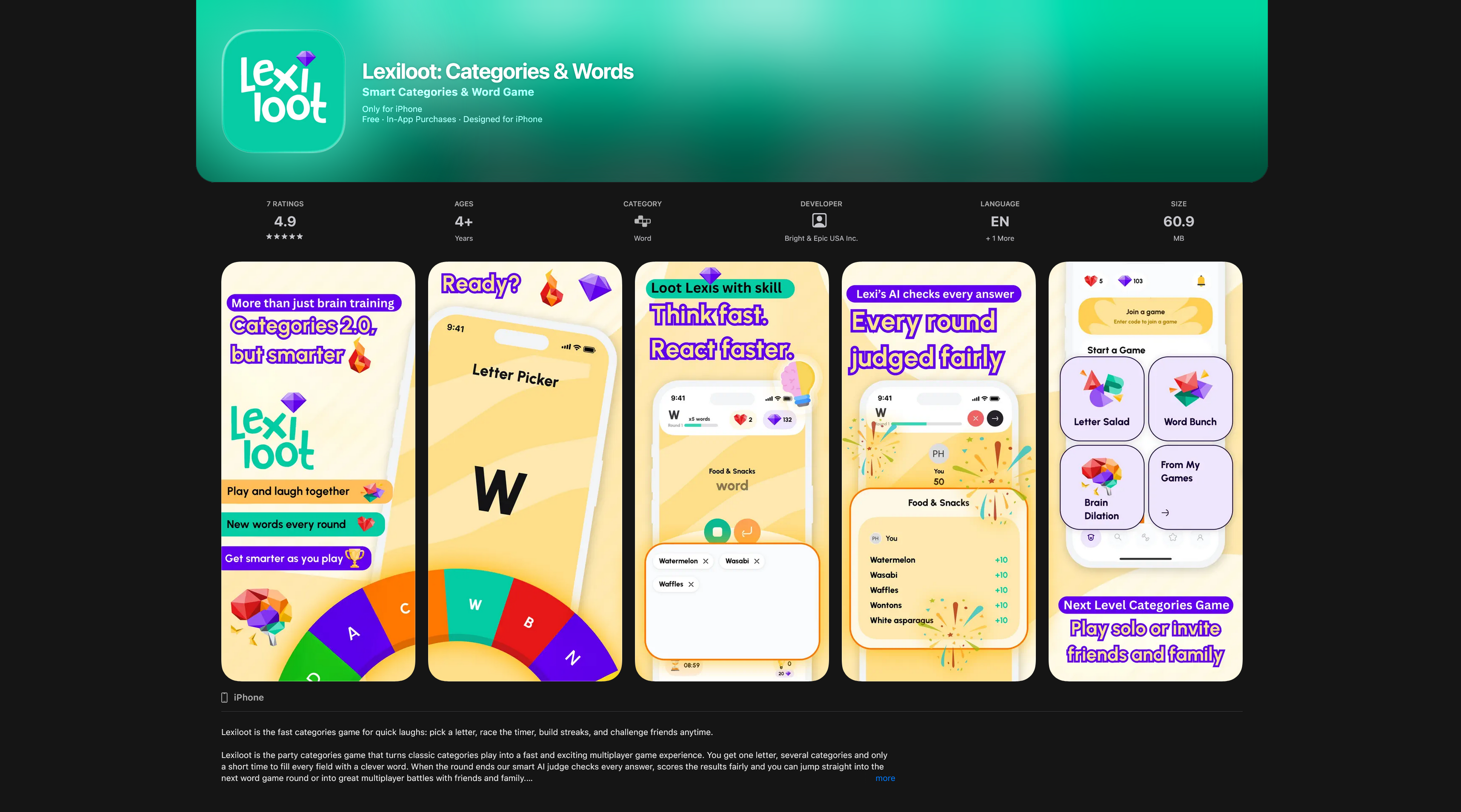
Lexiloot delivers everything this guide recommends within a single, comprehensive platform designed specifically for category game enthusiasts. The category game app offers both timed competitive rounds and relaxed free play modes, letting you match format to your mood and group dynamics. Multiplayer features connect you with friends or global opponents, while solo modes provide cognitive training whenever you need quick mental exercise.
Unlike subscription services that charge recurring fees, Lexiloot employs a fair pay-once premium model. You gain lifetime access to advanced features, expanded category libraries, and ad-free gameplay through a single purchase, no hidden costs or annual renewals. This approach respects your budget while ensuring sustained platform development that benefits all users.
The platform excels at accommodating diverse needs. Classroom implementations provide teachers with curriculum-aligned categories and progress tracking. Families enjoy road trip entertainment that keeps everyone engaged during long drives. Serious gamers access competitive leaderboards and tournament modes for skill-based ranking against global players.
Lexiloot transforms category games from simple diversions into comprehensive cognitive training tools wrapped in genuinely entertaining social gameplay. Whether you seek vocabulary expansion, brain training, or connection with friends across distances, Lexiloot provides the features, flexibility, and fairness that modern gamers demand.
FAQ
What are the best categories for beginners in category games?
Start with concrete, everyday categories like animals, colors, foods, and common objects. These themes require no specialized knowledge and allow beginners to experience success immediately, building confidence before progressing to more challenging topics. Classroom-tested category lists prove which themes work best for new players across age groups.
How do timed rounds affect gameplay in category games?
Timed rounds increase cognitive pressure, forcing players to access vocabulary automatically rather than through deliberate search. This format develops rapid recall skills and suits competitive environments where speed distinguishes expert players. The urgency creates excitement but may overwhelm beginners, making format selection important for group composition. Learn how to play on your phone with adjustable time limits for personalized difficulty.
Can category games improve my vocabulary and cognitive skills?
Yes, category games enhance vocabulary breadth, rapid word retrieval, and executive function through repeated practice in engaging contexts. Regular play strengthens semantic memory networks and cognitive flexibility comparably to dedicated brain training programs. The competitive and social elements increase motivation, leading to sustained practice that builds cumulative benefits over time. Explore comprehensive category game apps designed specifically for cognitive enhancement alongside entertainment.
What makes Lexiloot different from other category game platforms?
Lexiloot combines subscription-free premium access, multiple gameplay formats, and rich social features within a single platform optimized for both casual fun and serious cognitive training. The pay-once model eliminates recurring costs while providing lifetime access to expanding category libraries and new features. Age-appropriate content serves everyone from elementary students to competitive adults, with educational tools for classroom integration and social features for friend groups. Discover why players choose Lexiloot over traditional alternatives for superior features and fair pricing.

