


TL;DR:
- Well-designed vocabulary challenges promote consistent word learning across all ages.
- Combining engagement, structure, and progress tracking enhances vocabulary retention and motivation.
- Using digital and physical tools together strengthens long-term vocabulary mastery.
Vocabulary growth doesn’t happen by accident. Most learners, whether kids in a classroom or adults using a mobile app during their commute, plateau quickly without structured challenge and meaningful repetition. The good news is that a well-designed vocabulary challenge process gives every learner, at every age, a clear path to consistent improvement. Spring 2026 proved just how powerful this approach can be, with 1.2 million learners from 122 countries mastering 5.34 million words and setting a new global record. This article walks you through the full process, from understanding what a vocabulary challenge actually involves to running one yourself with confidence.
Table of Contents
- Understanding the vocabulary challenge process
- Setting up your vocabulary challenge: Tools and requirements
- Step-by-step guide: Running the vocabulary challenge
- Pitfalls, edge cases, and maximizing outcomes
- Why the real value of a vocabulary challenge isn’t just the words
- Bring your vocabulary challenge to life with Lexiloot
- Frequently asked questions
Key Takeaways
| Point | Details |
|---|---|
| Clear challenge structure | Both classroom and mobile challenges thrive with routines and goal-setting. |
| Effective gamification | Games and apps boost vocabulary retention, especially with daily practice and spaced repetition. |
| Balance competition | Adjust challenge elements to maintain motivation and reduce anxiety for diverse groups. |
| Tools matter | The right mix of apps, resources, and classroom activities makes vocabulary learning more engaging. |
| Focus on growth | The real impact goes beyond lists—challenges drive cognitive gains, collaboration, and lifelong skills. |
Understanding the vocabulary challenge process
A vocabulary challenge process is a structured, goal-oriented routine that guides learners to discover, practice, and actively use new words over a set period of time. It is not simply handing someone a word list and expecting them to memorize definitions. Real vocabulary challenges are designed with purpose. They give learners specific tasks, clear goals, and a way to measure their own progress as they go.
These challenges work in two main settings: classrooms and mobile game platforms. Both approaches share the same core purpose, but they look and feel different in practice.
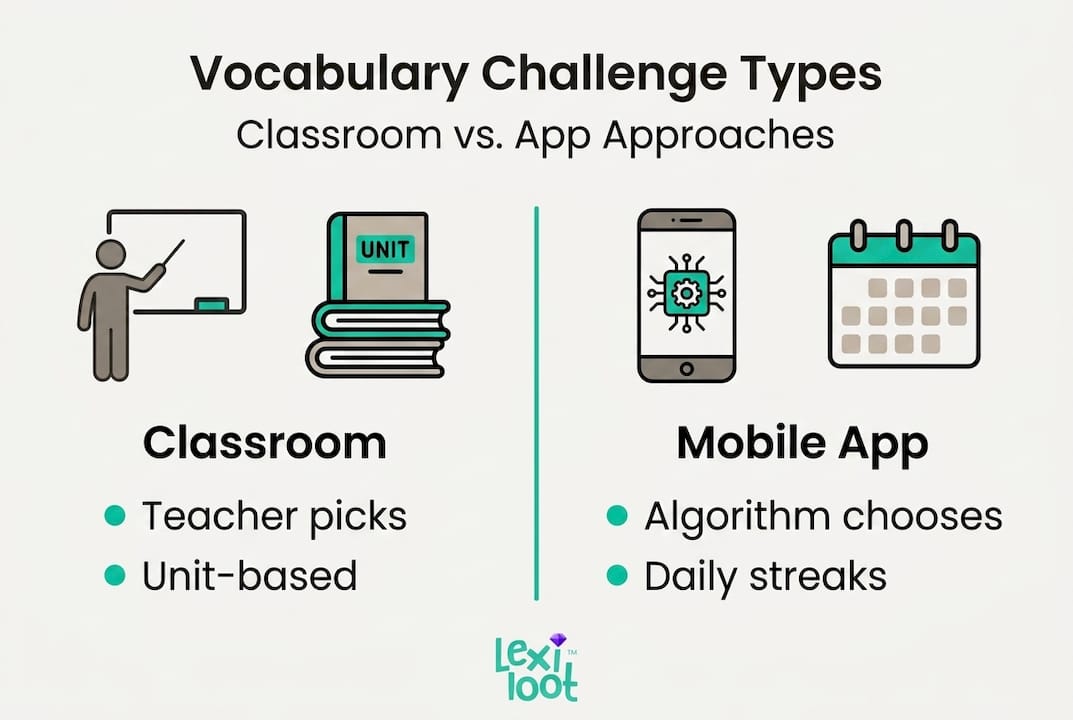
Classroom vocabulary challenges typically involve a teacher selecting a focused word set, often tied to a subject unit or grade-level reading. Students encounter words in context through reading passages, discussions, and writing tasks. The teacher tracks participation, celebrates milestones, and adjusts the pace based on how the class responds. Classroom challenges often unfold over one or two weeks and include a mix of individual and group activities.
Mobile app challenges operate differently. Apps like those studied across 38 major research trials use daily challenges, hints, spaced repetition, and leaderboards to keep learners coming back and building retention. The system adapts to each player’s performance, nudging them to revisit words they almost remembered and celebrating words they’ve fully mastered. This creates a personalized challenge experience that scales across thousands of learners simultaneously.
Here is a comparison of how the two approaches differ:
| Feature | Classroom challenge | Mobile app challenge |
|---|---|---|
| Word selection | Teacher-curated | Algorithm-driven or user-selected |
| Pacing | Weekly or unit-based | Daily micro-sessions |
| Feedback | Teacher or peer feedback | Instant in-app scoring |
| Social element | Group discussion, pairs | Leaderboards, multiplayer modes |
| Tracking | Grade book, observation | Automated progress reports |
| Accessibility | School hours | Anytime, anywhere |
Research backs up the power of both approaches. A major meta-analysis found that mobile vocabulary apps produce an effect size of g=0.962 across short-term studies and d=1.28 in long-term studies, which places these tools firmly in the high-impact category for vocabulary learning.
Both settings become significantly more effective when they share three key components:
- Engagement: Learners need a reason to care. Curiosity, mild competition, and social rewards all drive engagement when used thoughtfully.
- Structure: Clear goals, defined word sets, and a predictable rhythm give learners something to push against.
- Tracking: When learners can see their own progress, motivation stays strong. This is why understanding why gamify vocabulary learning matters so much for sustainable results.
The intersection of those three elements is where real vocabulary growth lives. Understanding the gamified learning benefits that research supports helps you design or choose a challenge that will actually stick for the learners in your care.
Setting up your vocabulary challenge: Tools and requirements
Knowing what a vocabulary challenge is only gets you so far. The next step is gathering what you need to actually run one well. Whether you are a teacher preparing a unit or a parent looking for something to do with your kids on the weekend, the setup process matters more than most people expect.
A structured 10-minute weekly routine that includes introducing a word, visualizing it, relating it to synonyms, and using it in writing or speaking creates a reliable challenge structure that is easy for both teachers and learners to follow consistently.
Here is a practical checklist for setting up your vocabulary challenge in each setting:
Classroom setup:
- A focused word list of 8 to 15 words per week, chosen for relevance to current content
- Vocabulary journals or a shared whiteboard space for visible learning
- A simple point system that rewards correct usage in speaking and writing
- A class leaderboard (physical or digital) to track cumulative scores
- Time blocked in the weekly schedule for at least two active practice sessions
Mobile or home setup:
- A vocabulary app or platform that supports spaced repetition and progress tracking
- A consistent daily window of 10 to 15 minutes for play or practice
- A shared leaderboard or family challenge to add social motivation
- Optional: physical flashcards to bridge the gap between screen time and hands-on review
The following table summarizes the tools available and what each one contributes:
| Tool | Best use | Benefit |
|---|---|---|
| Vocabulary app | Daily solo practice | Spaced repetition, instant feedback |
| Whiteboard | Group review sessions | Visual, collaborative word mapping |
| Flashcards | Physical reinforcement | Multi-sensory recall practice |
| Leaderboard (digital/physical) | Ongoing motivation | Social accountability, friendly competition |
| Vocabulary journal | Writing integration | Productive vocabulary use |
| Word games | Engagement and review | Fun, low-stakes practice |
Pro Tip: Mixing physical and digital tools is one of the most effective moves you can make. When a child writes a word by hand and then sees it in an app challenge, the brain encounters it through multiple pathways. That layered exposure is what shifts a word from short-term recognition to genuine vocabulary ownership.
If you want deeper guidance on classroom implementation, the resource on how to teach word games covers proven approaches for different grade levels. You can also find a curated list of engaging vocabulary games to round out your toolkit.
Step-by-step guide: Running the vocabulary challenge
With your tools ready, it is time to actually run the challenge. The steps below work for both classroom and mobile settings. Adapt the timing and format to fit your learners’ needs, but try to keep the core sequence intact.
Step 1: Choose your word set and set a clear goal. Select 8 to 15 words for a one-week challenge, or 20 to 30 words for a two-week run. Make the goal specific. Instead of “learn new words,” aim for “use each word correctly in a sentence by Friday” or “reach 200 points on the app by Sunday.”
Step 2: Introduce words with context. Never just read a definition aloud. Show the word in a sentence. Ask learners what they think it might mean before revealing the definition. This activates prior knowledge and creates a memorable first encounter with the word.
Step 3: Practice daily with variety. Rotate activities across the week so learners engage with words in different ways. Day one might focus on recognition through matching. Day two could involve writing sentences. Day three might use the words in a short class discussion or a timed app game round.

Step 4: Track and display progress. Classroom competitions over one week that award points for using words correctly in context are proven to sustain motivation. Post scores on a visible board or inside the app. Update it at the start of each session so learners feel the momentum building.
Step 5: Hold a challenge event. At the end of the week, run a short challenge session. In a classroom, this might be a rapid-fire oral quiz where students earn bonus points for using a word in an original sentence. In an app, this could be a final multiplayer round or a timed solo sprint.
Step 6: Celebrate and reflect. Recognize every learner’s growth, not just the top scorers. Ask learners to identify one word they feel confident about now that they didn’t know at the start. This reflection step builds metacognition, which means learners begin to understand how they learn best.
Step 7: Reset and repeat with new words. A family word games workflow guide can help you build a sustainable rotation so the challenge stays fresh week after week without starting from scratch each time.
Pro Tip: If you are running a longer challenge over a month, break it into weekly sprints with a mini-celebration at the end of each sprint. This keeps energy high across the full duration and prevents the motivation dip that often hits around week two.
For teachers looking for variety across grade levels, the collection of language learning games offers adaptable formats that can slot directly into a challenge week structure.
Pitfalls, edge cases, and maximizing outcomes
Even well-designed vocabulary challenges can run into trouble. Knowing the common pitfalls in advance lets you adjust before learners disengage or feel discouraged.
The most important issue to watch for is competitive stress. Research makes this clear:
“Gamification increases motivation, but competitive elements may cause anxiety in some learners, and the focus tends to favor receptive over productive vocabulary knowledge.” Gamification and Anxiety
That means a challenge built entirely around winning can actually work against the quieter or more anxious learners in your group. They stop taking risks. They stop guessing. And when learners stop guessing, vocabulary growth slows down. This concern is reinforced by contrasting research showing that mobile platforms excel at building receptive vocabulary knowledge but need intentional productive extension tasks, like speaking and writing, to develop full word mastery.
Here is how to prevent the most common problems:
- Shift from individual to team competition. When learners work in pairs or small groups, the social pressure shifts from personal performance to collective effort. Anxiety drops. Collaboration rises.
- Celebrate streaks, not just scores. Recognize learners who maintain a daily practice streak, not only those who accumulate the highest points. This rewards consistency over raw talent.
- Build in low-stakes rounds. Include practice sessions where no points are recorded. These let struggling learners experiment without fear of falling behind on the leaderboard.
- Vary the task types. If every challenge activity tests the same skill, say, multiple-choice recognition, some learners will consistently underperform. Rotate between writing, speaking, drawing, and game-based formats to give different learners moments to shine.
- Watch for word-level anxiety. Some learners freeze on long or unfamiliar words. Breaking those words into parts, showing prefixes, roots, and suffixes, can make a word feel approachable rather than intimidating.
- Adjust for age and ability. A challenge designed for fifth graders will overwhelm second graders and bore eighth graders. Separate word lists and goal levels help every group feel appropriately stretched without being demoralized.
Resources like vocabulary and brainpower development offer deeper insight into how word games build cognitive resilience alongside vocabulary. And if you want to see how modern formats address these pitfalls with smart design, modern word puzzles shows what thoughtful, low-anxiety challenge design actually looks like in practice.
Why the real value of a vocabulary challenge isn’t just the words
Most people assume the point of a vocabulary challenge is to learn more words. That’s part of it, but it misses the bigger picture entirely.
When you run a vocabulary challenge well, you are also building metacognition. Learners start to notice how they learn, which strategies help them remember words, and which methods fall flat for them personally. That self-awareness transfers directly to reading comprehension, test preparation, and lifelong learning habits.
You are also building social confidence. When students talk through a word’s meaning with a partner or explain a definition in their own words, they practice communication skills alongside vocabulary recall. Those interactions matter beyond the word itself.
And you are building self-efficacy. When a learner finishes a challenge week and realizes they can now use ten words they had never heard of seven days ago, something shifts in how they see themselves as a learner. That shift is often more powerful than any single vocabulary gain.
The real mistake is measuring a vocabulary challenge only by how many words were learned. Authentic, low-pressure practice, the kind that encourages gamify vocabulary learning through play rather than stress, builds community, confidence, and cognitive habits that outlast any single challenge. Those are the outcomes worth designing for.
Bring your vocabulary challenge to life with Lexiloot
Ready to put everything you have read into action? Lexiloot is built for exactly this moment. Whether you are a teacher setting up your first classroom word challenge or a parent looking for a way to build vocabulary habits at home, Lexiloot gives you a ready-made platform that handles structure, tracking, and engagement for you.
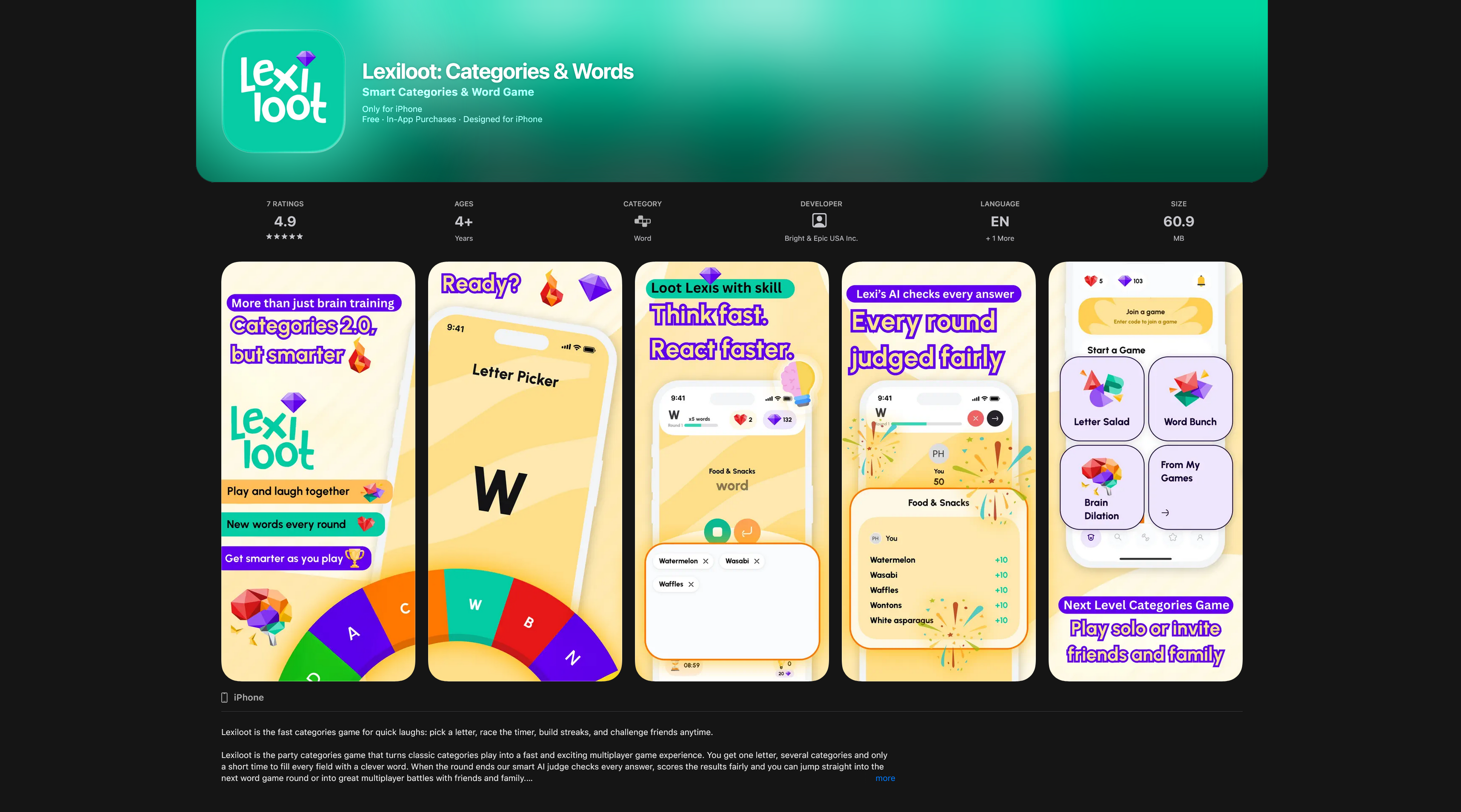
Lexiloot’s category-based games, multiplayer modes, and daily challenges cover the full vocabulary challenge process in one place. You can explore games in education strategies to see how the app aligns with proven classroom approaches, try creative word game examples to spark fresh ideas for your next challenge week, and learn how vocabulary builds skills across reading comprehension and cognitive development. With a pay-once model and no subscriptions, Lexiloot is a practical, lasting investment for families and educators alike.
Frequently asked questions
What is a vocabulary challenge process?
A vocabulary challenge process is a structured routine where individuals or groups compete or collaborate to learn and actively use new words through games, classroom activities, or app-based tasks over a set period of time.
Are vocabulary challenges effective for all age groups?
Yes, research consistently shows strong results across age groups. Mobile vocabulary apps produce an effect size of g=0.962 in short-term studies and d=1.28 in long-term studies, confirming high impact on receptive vocabulary knowledge for learners of all ages.
What is spaced repetition and why does it matter?
Spaced repetition means reviewing words at increasing time intervals, which forces the brain to retrieve a word just before it would forget it. Long-term vocabulary gains in mobile app studies consistently point to spaced repetition as one of the strongest drivers of lasting retention.
How can competition be managed to prevent stress or anxiety?
Use team or cooperative formats, reward progress streaks instead of only top scores, and include low-stakes practice rounds. Cooperative play reduces anxiety while maintaining the motivational benefits that make challenge-based learning effective for most learners.

