


You’re mid-round, the timer is ticking, and someone groans: “Not countries again.” Running dry on fresh category ideas is the fastest way to kill the momentum of an otherwise electric ABC game session. The good news? A well-chosen category list does more than fill time. It sharpens vocabulary, speeds up thinking, and turns a casual game night into something genuinely memorable. This guide gives you 80+ hand-picked classic, family-friendly, and advanced categories, complete with sample answers, comparison tables, pro tips, and ideas for group and app-based play.
Table of Contents
- How the ABC game works and why categories matter
- Classic categories: Timeless crowd-pleasers
- Family-friendly and kid categories: Make play inclusive
- Advanced and creative categories: Level up the challenge
- At-a-glance: Comparison table of categories for every group
- Tips, rules, and common questions for ABC category games
- Digital and social play: Bringing ABC categories to mobile and online
- Level up your ABC categories: Try Lexiloot word games
- Frequently asked questions
Key Takeaways
| Point | Details |
|---|---|
| Mix up categories | Use classic, family, and advanced categories to keep every ABC game round engaging for any group. |
| Unique answers win | Scoring rewards creative thinking and vocabulary—the more original, the better. |
| Adapt for all ages | Lower complexity and use relatable topics for younger kids or learners to maximize fun. |
| Play online easily | Try mobile apps or video calls for digital ABC category games with any group. |
How the ABC game works and why categories matter
Before you dive into the lists, let’s clarify how categories shape every round.
The ABC game, also widely known as Scattergories, is built around one simple mechanic: a letter is rolled (or drawn), and every player races to fill a list of categories with words starting with that letter, all under time pressure. According to the Scattergories board game rules, the game uses a letter die and a list of categories, awarding points only for unique answers that no other player wrote. That last part is what makes category selection so critical.
Here’s what a standard round looks like:
- A letter is revealed (rolled or randomly selected)
- Players write one answer per category that starts with that letter
- A timer runs (usually 3 minutes)
- Answers are read aloud, duplicates are crossed out, and unique answers score one point each
- The player with the most points wins the round
The categories you choose directly affect how hard or easy the round feels. Simple categories like “animals” work great for kids and beginners. Trickier ones like “collective nouns” push adults to think harder and faster. Categories also drive group negotiation: players debate whether “hot dog” counts as a food starting with “H” or whether “Hulk” is a valid fictional character. That back-and-forth is where vocabulary growth and word games and cognition actually happen.
Stat: The official game excludes letters Q, U, V, X, Y, and Z to keep play flowing smoothly.
Knowing how to play categories well means understanding that the category list is the heart of every round. Choose wisely, and you control the energy in the room.
Classic categories: Timeless crowd-pleasers
With that foundation, here’s your ultimate list of classic, never-fail categories.
These are the categories that have appeared on official game lists for decades. They work because almost everyone has enough knowledge to play, and they still produce surprising, funny, and creative answers. Classic categories include Boys’ names, U.S. cities, School supplies, Vegetables, Articles of clothing, Sports, Parts of the body, and Fictional characters.
| Category | Sample Answer (Letter “B”) |
|---|---|
| Boys’ names | Benjamin |
| U.S. cities | Boston |
| School supplies | Binder |
| Vegetables | Broccoli |
| Articles of clothing | Belt |
| Sports | Basketball |
| Parts of the body | Brain |
| Fictional characters | Batman |
| Things in a kitchen | Blender |
| Animals | Bear |
| Musical instruments | Bass guitar |
| Things at a beach | Bucket |
| Occupations | Baker |
| Board games | Battleship |
| Things that are cold | Blizzard |
Why do classic categories work so well for all ages?
- Broad knowledge base: Almost every player, young or old, can name a sport or an animal.
- Fast recall: Familiar themes reduce hesitation and keep the energy high.
- Easy judging: Clear categories mean fewer arguments about whether an answer counts.
- Great for classroom category games: Teachers can use these lists straight out of the box.
Pro Tip: Mix 2 or 3 classic categories into every round alongside harder ones. It gives newer players a fighting chance and keeps the game from feeling intimidating.
Family-friendly and kid categories: Make play inclusive
Once you have classics, it’s easy to add playful themes everyone can enjoy together.
Young children, ESL learners, and mixed-age groups need categories that feel concrete and familiar. Abstract or niche categories frustrate young players and slow the game down. Kid-friendly categories include Animals, Fruits, Colors, Toys, Foods you eat with your hands, Cute animals, Children’s book titles, and Things in a backpack.
Here’s a simple numbered guide to adjusting category complexity for younger players:
- Start with visuals. Use categories tied to things kids can see or touch, like “things in the classroom” or “colors.”
- Limit the list. Use 6 categories instead of 12 for players under age 8.
- Allow more time. Give younger players 4 to 5 minutes instead of 3.
- Use team play. Pair a child with an adult so they can brainstorm together.
- Celebrate all answers. For very young kids, focus on participation over scoring.
Why do concrete categories lower frustration and boost engagement?
- Kids can picture the answer immediately, which reduces anxiety.
- Familiar themes like “foods” or “animals” connect to everyday life.
- Success builds confidence, which keeps kids coming back for more rounds.
- These categories also work beautifully for fun word games for kids in school or at home.
Pro Tip: For pre-readers, skip the writing entirely. Just say an animal that starts with “B” out loud, or point to something blue in the room for the letter “C.” The game still works, and nobody feels left out.
Advanced and creative categories: Level up the challenge
If every round feels too familiar, try these advanced and creative themes for a new level of play.

Once your group has mastered the classics, it’s time to introduce categories that spark real debate and push vocabulary to its limits. Advanced categories include Collective nouns, Onomatopoeia, Homonyms, Movies where the protagonist dies, Nepo babies, and Jobs that won’t exist in 50 years.
Here are 12 advanced and creative categories worth adding to your rotation:
- Collective nouns (a murder of crows, a parliament of owls)
- Onomatopoeia (words that sound like what they describe: sizzle, bang)
- Homonyms (words with two meanings: bark, bat)
- Jobs that won’t exist in 50 years (toll booth operator, travel agent)
- Things that are both a verb and a noun (run, jump, light)
- Fictional villains (Voldemort, Venom)
- Words borrowed from another language (ballet, burrito)
- Things you’d find in a haunted house (bones, bats)
- Compound words (butterfly, bookshelf)
- Emotions (boredom, bliss)
- Things that come in pairs (boots, binoculars)
- Phrases that include a number (“back to square one,” “behind the eight ball”)
“Using harder categories forces players to access deeper vocabulary and think more flexibly. That mental stretch is exactly what makes the game genuinely educational, not just entertaining.”
Want to create your own advanced categories? Think about topics your group knows well, then add a twist. A group of movie fans might love “Oscar-winning films.” A science class might enjoy “elements on the periodic table.” Tailoring categories to your audience makes every round feel personal and keeps advanced puzzle strategies fresh. You can also explore vocabulary boosting puzzles for more inspiration.
At-a-glance: Comparison table of categories for every group
Still not sure which categories to select? Use this quick reference guide.
Mixing category types is the smartest move you can make. Optimal ABC game play mixes classic, easy, and advanced categories for the best balance of vocabulary gains and fun.
| Type | Age/Skill | Example Categories | Sample Answer (“F”) | Ideal Use |
|---|---|---|---|---|
| Classic | Ages 8+ | U.S. cities, Sports, Occupations | Fort Worth, Football, Firefighter | Game nights, road trips |
| Family/Kid | Ages 4+ | Animals, Fruits, Colors | Flamingo, Fig, Fuchsia | Family play, ESL learners |
| Advanced | Teens/Adults | Collective nouns, Homonyms | Flock, Fly | Classrooms, video calls |
| Creative | All ages | Things in pairs, Compound words | Flip-flops, Fireplace | Party games, team play |
This table makes it easy to build a balanced round. For a family game night, try two classic, two kid-friendly, and two creative categories. For a classroom challenge, lean on advanced and classic options. For more ideas on teaching with word games, there are plenty of structured approaches that work at every grade level.
Tips, rules, and common questions for ABC category games
Before you start your next game, double-check these rules and expert shortcuts.
The official ABC/Scattergories rules exclude certain letters, count only unique answers, and allow the group to vote on disputed answers. Knowing these rules upfront prevents arguments and keeps the game moving.
Here are the top 5 rules every group should agree on before the first round:
- Unique answers only. If two players write the same answer, both score zero for that category.
- The group votes on disputes. If an answer seems questionable, the majority decides.
- First and last names both count. “Bruce Banner” scores for the letter “B” under fictional characters.
- Alliteration is allowed. “Big Bear” counts for the letter “B” under animals.
- No changing answers after time is called. Pens down means pens down.
Stat: The standard round timer is 3 minutes, though many groups adjust this based on age and difficulty.
Pro Tip: Add a bonus round where every player must use a different category theme from the previous round. No repeats allowed. It forces creative thinking and keeps the cognitive and social benefits of the game working at full strength.
For rare letters like “J” or “W,” give players an extra 30 seconds. When two answers are very similar (like “sneakers” and “shoes” for footwear), let the group decide together. That negotiation is part of the fun.
Digital and social play: Bringing ABC categories to mobile and online
Ready to play online or through your favorite devices? Here are this year’s best options and creative variations.
Digital play has made ABC category games more accessible than ever. While mobile adaptations tend to focus on phonics and tracing, true category-based ABC games are rarer in app stores, making social play via video call a popular workaround. Here are the best ways to play digitally:
- Video call play: Share your screen with a Google Slides or Google Sheets scorecard. One person calls the letter, everyone writes answers in their own column, and the group reads aloud at the end.
- Group chat play: Post the letter and category list in a group chat. Set a timer and have everyone reply with their answers at the same time.
- Printable sheets: Download or create a category sheet and use it for in-person or hybrid play.
- Word game apps: Explore online categories games that offer built-in category lists, timers, and multiplayer scoring.
- Virtual classrooms: Teachers can use shared documents or classroom apps to run rounds with the whole class at once.
For family nights over video call, assign one person as the “judge” each round. They read answers aloud, call out duplicates, and keep score. Rotating the judge role keeps everyone engaged and adds a fun layer of responsibility.
Level up your ABC categories: Try Lexiloot word games
If you’re looking for even more ways to play or want to streamline your next category game night, Lexiloot has you covered.
Lexiloot brings the full ABC categories experience to your phone, with pre-built category lists, multiplayer battles, and vocabulary-building modes for every skill level. Whether you’re setting up a categories game for kids or jumping into a competitive round with friends, the app handles the setup so you can focus on playing.
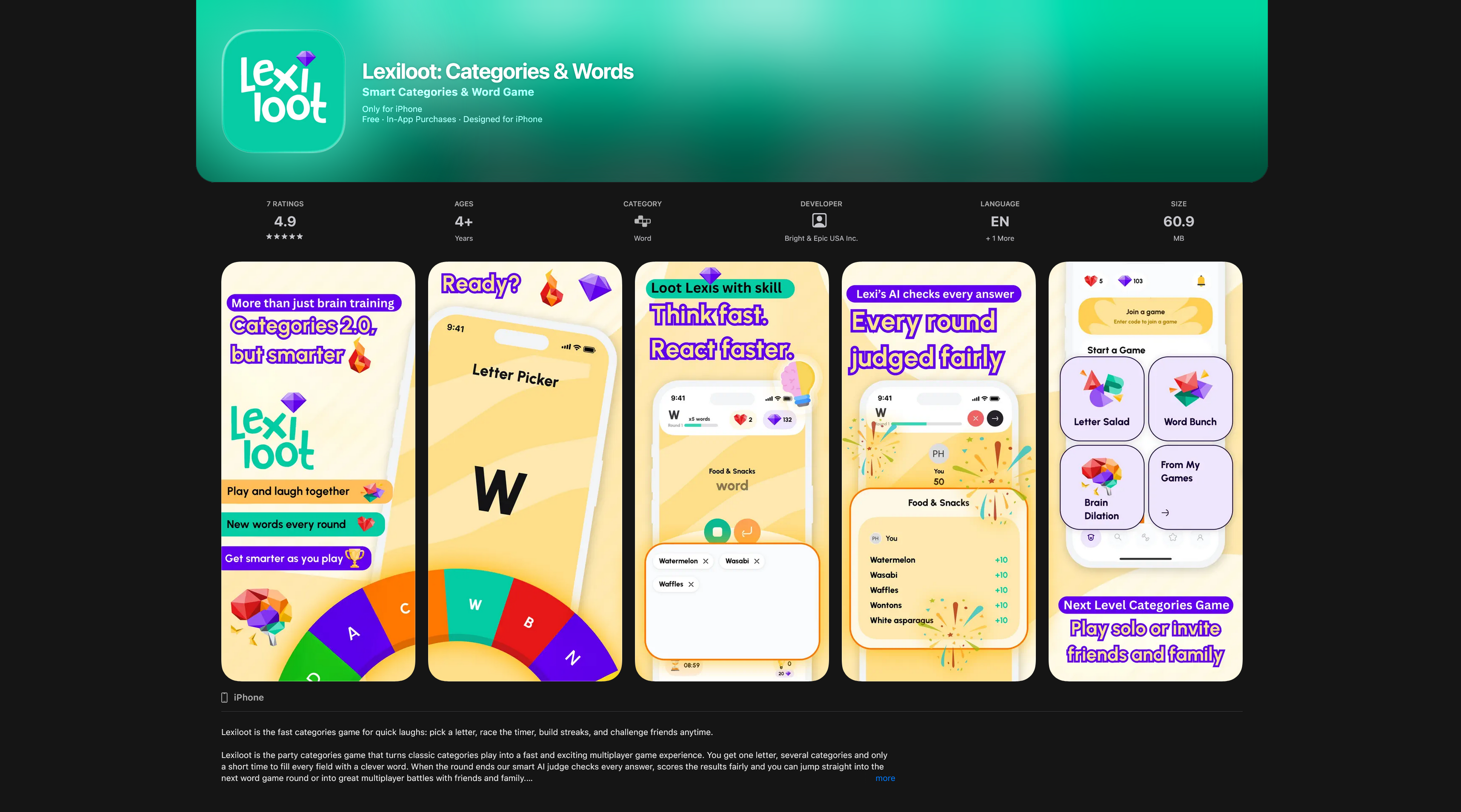
Explore category games online with built-in timers, unique answer detection, and leaderboards that make every round feel like a real competition. For players who want to push further, Lexiloot’s brain-training modes and advanced strategies for mobile gamers offer a genuine challenge. It’s a pay-once model, no subscriptions, and it works for families, classrooms, and solo players alike.
Frequently asked questions
What are good categories for the ABC game with kids?
Animals, fruits, colors, and toys are perfect starting points for kids’ ABC games. Things found in a backpack or foods you eat with your hands also work great for younger players.
How many categories should we use in each ABC game round?
A standard round uses 12 categories, but 6 to 8 categories works better for younger kids or shorter sessions. Adjust based on your group’s age and energy level.
Can ABC category games be played online or over Zoom?
Yes, absolutely. You can run classic or custom category rounds over video calls using shared documents for scoring and group judging. Social play via Zoom has become one of the most popular digital adaptations of the game.
What happens if two players give the same answer?
Duplicate answers score zero for both players. Only unique, valid answers earn a point, which is exactly what makes creative thinking so rewarding in this game.
What letters are excluded in standard ABC category games?
The official game excludes Q, U, V, X, Y, and Z from the letter die. This keeps gameplay smooth and prevents frustrating rounds where almost no answers are possible.

