


Family game night has a way of losing steam fast. You pull out the same old board game, someone complains it’s boring, and the evening fizzles before it even starts. The good news is that word games solve this problem in a surprisingly effective way. They keep everyone at the table, laughing and thinking, while quietly building vocabulary recall and cognitive skills at the same time. Word games can boost vocabulary test scores by up to 43% with regular play. This guide walks you through a clear, step-by-step workflow for choosing, playing, and getting the most out of word games as a family or classroom group.
Table of Contents
- Why choose word games for family fun?
- Getting started: Materials and game setup
- Workflow step 1: Select the right word game
- Workflow step 2: Playing for maximum learning
- Workflow step 3: Troubleshooting and adaptations
- Workflow step 4: Measuring progress and keeping it fun
- Take family word play further with Lexiloot
- Frequently asked questions
Key Takeaways
| Point | Details |
|---|---|
| Engagement boosts learning | Family word games increase motivation and memory compared to traditional study. |
| Choose games wisely | Matching games to age and ability keeps sessions fun and productive. |
| Mix physical and digital | Combining board games and apps sustains interest and offers research-proven gains. |
| Adapt for inclusivity | Simple rule changes make word games accessible for all vocabulary levels. |
Why choose word games for family fun?
Word games stand out because they make learning feel invisible. Kids are not sitting at a desk memorizing definitions. They are competing, laughing, and strategizing, and vocabulary growth happens naturally in the background. That shift from rote repetition to active play is a big deal for motivation and long-term retention.
The social side matters just as much. Multiplayer word games foster social interaction and inclusivity, bringing different ages and skill levels together around a shared goal. When a younger child beats an older sibling at a word challenge, that moment builds confidence and connection at the same time.
Digital word game research confirms that game-based learning consistently outperforms traditional methods in both engagement and vocabulary scores. Here is what families and educators gain from regular word game sessions:
- Stronger spelling fluency and vocabulary recall
- Improved category thinking and pattern recognition
- Better communication and turn-taking skills
- Increased motivation to read and write independently
- A shared family or classroom ritual that kids actually look forward to
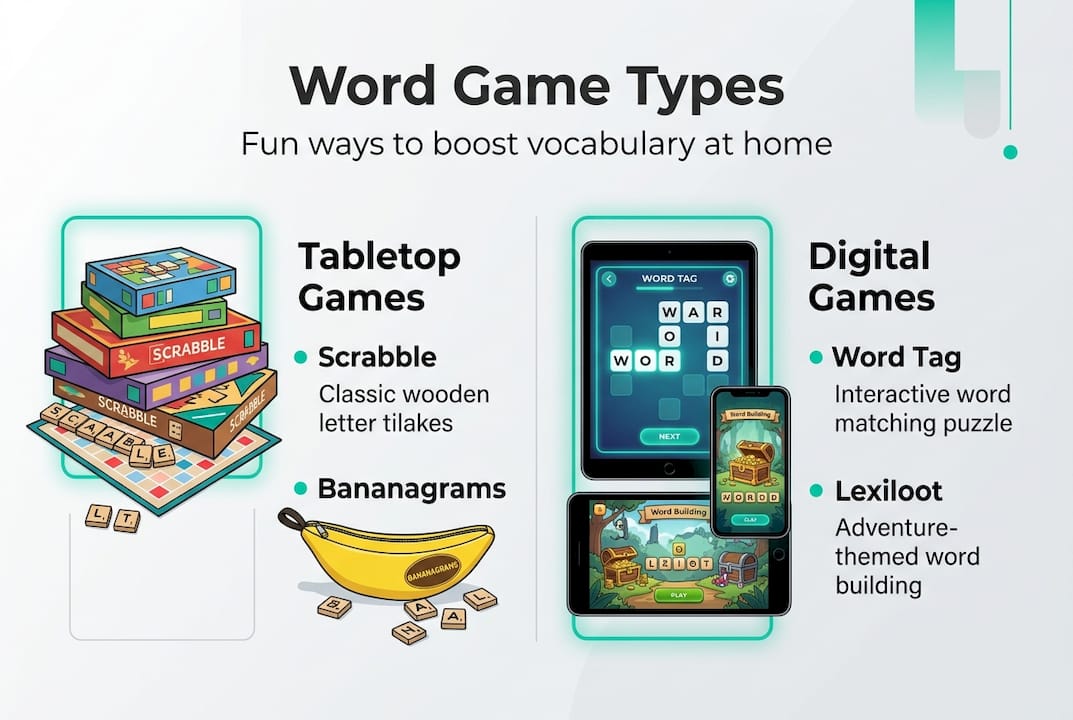
Explore the full range of types of word games to find the right fit for your group, or explore word puzzles that target specific vocabulary goals.
Getting started: Materials and game setup
Now that you’re motivated, let’s cover what you’ll need to get started and how to set everything up for smooth, stress-free play. The good news is that you do not need much. A mix of physical and digital options gives you the most flexibility.
Physical game checklist:
- A word board game such as Upwords, which is accessible for groups and solo play
- Letter tiles or card decks for quick, low-setup games
- A timer (a phone works fine)
- Score sheets or a small notebook
Digital game checklist:
- A tablet or smartphone with a reliable word game app installed
- Headphones if playing in a shared space
- A stable internet connection for multiplayer modes
Here is a quick comparison to help you decide what to set up first:
| Game type | Best age range | Players | Setup time |
|---|---|---|---|
| Board word games | 8 and up | 2 to 6 | 5 to 10 minutes |
| Card-based word games | 6 and up | 2 to 8 | Under 5 minutes |
| Digital word apps | 6 and up | 1 to unlimited | Instant |
| Tile-based games | 7 and up | 2 to 4 | 5 minutes |
Pro Tip: Rotate between physical and digital games every few sessions. Physical games build tactile engagement and face-to-face connection, while digital apps add variety and instant feedback. Mixing both keeps interest high over weeks and months. You can even try creating your own word puzzles to personalize the experience for your group.
Workflow step 1: Select the right word game
With your materials ready, you’re on to the exciting part: choosing the perfect word game for your next family session. The right game depends on three things: group size, age range, and skill level. Here is a simple process to follow:
- Count your players. Games with two to four players work well for focused family sessions. Larger groups need games that support more participants without long wait times between turns.
- Check the age range. Most games list a recommended age on the box or app description. Use this as a starting point, not a strict rule.
- Assess vocabulary levels. If you have a wide mix of ages, choose a game that allows for different difficulty levels or team play.
- Match the goal. Want to build spelling fluency? Go for tile-based games. Want strategic thinking? Try a deduction-style word game.
- Rotate regularly. No single game holds attention forever. Plan to switch things up every two to three weeks.
| Game | Age | Play style | Key benefit |
|---|---|---|---|
| Word Tag | 8 and up | Digital, solo or group | Spaced repetition for better retention |
| A Little Wordy | 10 and up | Card-based, 2 players | Strategic thinking over big vocabulary |
| Upwords | 8 and up | Board, 2 to 4 players | Spelling fluency and creativity |
| Lexiloot | 6 and up | Digital, multiplayer | Category thinking and vocabulary growth |
Pro Tip: Let kids take turns picking the game for the session. Giving them ownership over the choice increases buy-in and enthusiasm before the first tile is even placed. Check out teaching word games for more guidance on introducing new games smoothly.
Workflow step 2: Playing for maximum learning
You’ve chosen a game. Now make the most of each session with techniques that turn fun into real learning. The structure of how you play matters almost as much as which game you choose.
- Start with a warm-up round. Spend two to three minutes reviewing words from the last session. This activates vocabulary recall before new words are introduced.
- Use clues and hints strategically. Instead of giving away answers, offer category hints. “It’s a type of animal” is more educational than spelling out the word.
- Celebrate new words out loud. When someone uses an unfamiliar word correctly, pause and acknowledge it. This reinforces the learning moment.
- Apply spaced repetition. Research suggests that up to 1000 words per year can be learned with just 20 minutes of daily play when spaced repetition is built into the game structure.
- Mix game types within a session. Alternate between a strategy-focused game and a vocabulary-focused one to keep different parts of the brain engaged.
“Game-based learning environments that include digital formats outperform rote learning in both engagement and vocabulary scores, making them a strong choice for classrooms and homes alike.”
Pro Tip: Aim for eight exposures to a new word across different sessions. The brain needs repeated, varied contact with a word before it moves into long-term memory. Explore modern word puzzles that are designed with this principle in mind.

Workflow step 3: Troubleshooting and adaptations
Even the best-planned game sessions can hit snags. A younger child gets frustrated with complex rules. An older player gets bored with easy words. Someone refuses to take their turn. These moments are normal, and they are fixable.
Common issues and quick fixes:
- Frustration with rules: Simplify the rules for the first two rounds. Play an open-hand practice game before the real session starts.
- Skill imbalance: Use team play to balance strong and weaker players. Pair a confident reader with a younger child.
- Waning interest mid-game: Introduce a mini-challenge, like a bonus point for the longest word, to re-energize the group.
- ESL or younger learners struggling: Customizing rules or simplifying games makes them more inclusive for ESL and younger children without removing the challenge for others.
- One player dominating: Rotate the role of “game leader” each session so everyone gets a chance to set the pace.
“The most effective word game sessions are the ones where every player feels capable of contributing, regardless of their current vocabulary level.”
Scaffolding is a useful concept here. It means temporarily supporting a learner with extra hints or easier words, then gradually removing that support as their confidence grows. Apply it naturally during play, and you will see even hesitant players start to take risks with new words. Visit word game strategies for more practical techniques.
Workflow step 4: Measuring progress and keeping it fun
After a few sessions, you will want to see real progress while making sure enthusiasm never fades. Tracking does not need to be complicated. Simple methods work best.
Easy ways to track progress:
- Keep a vocabulary journal where each player writes down one new word per session
- Use score sheets to track improvement over time, not just who wins
- Check in-app statistics if you are using a digital game, many apps show words learned and accuracy rates
- Note which categories or word types each player finds easiest and hardest
Research on structured word games shows that advanced game models cover over 89.5% of common 3 to 5 letter words efficiently, meaning well-designed games naturally expose players to the words that matter most.
Pro Tip: End every session with a “favorite new word” share. Each player picks one word they learned or used during the game and says it out loud. This simple ritual reinforces memory and gives everyone a moment to shine.
Build in mini-challenges every few weeks to keep motivation high. A family word tournament, a timed spelling round, or a category challenge adds variety without requiring new materials. Celebrate milestones, like a player’s first time winning or using a five-letter word correctly, with small, meaningful recognition. Explore language games for growth to find fresh challenges that match your group’s progress.
Take family word play further with Lexiloot
Once you’ve built momentum with your family or classroom word game routine, you might want even more ideas and tools to keep growing vocabulary skills and cognitive engagement.
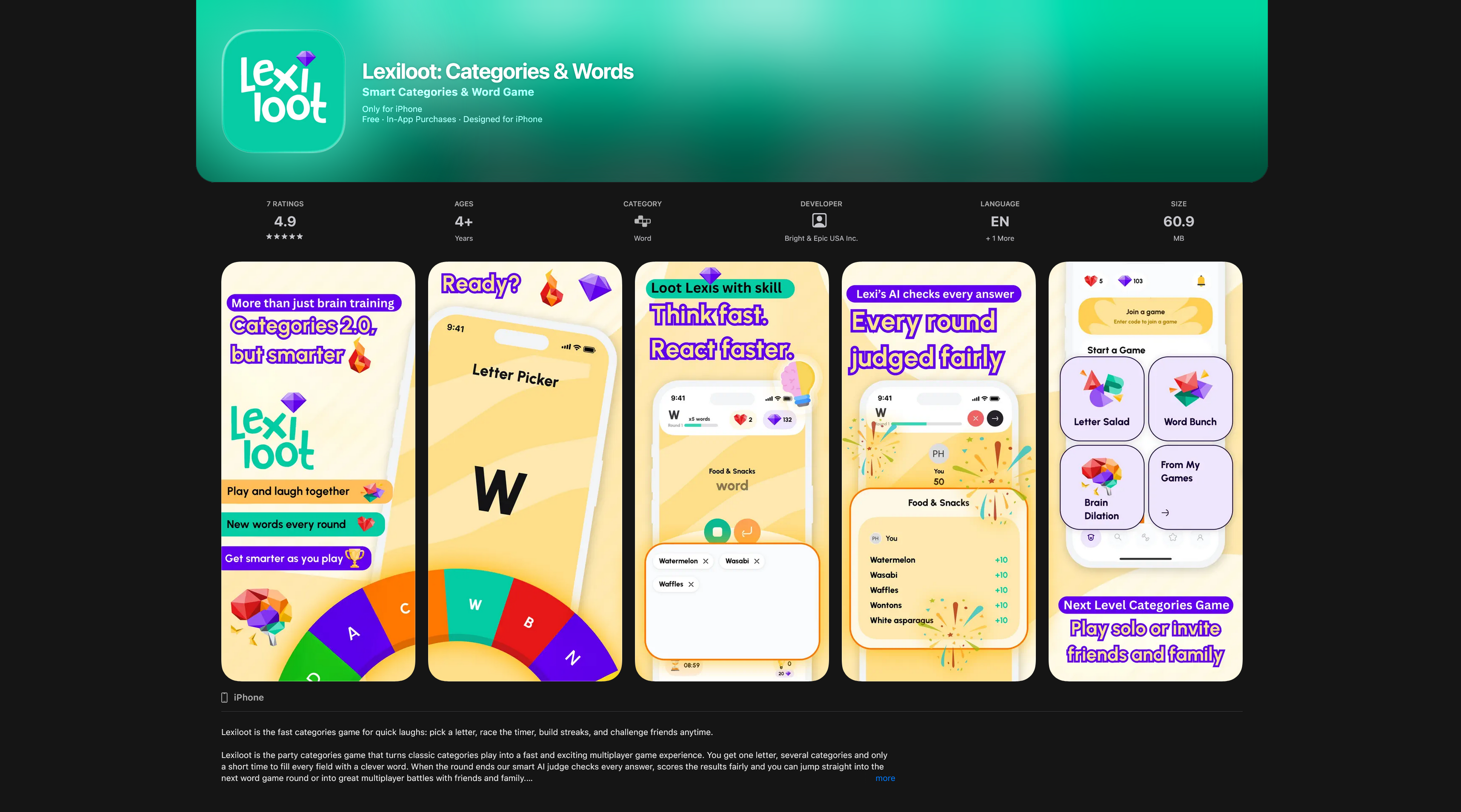
Lexiloot brings together multiplayer word challenges, category-based games, and vocabulary-building modes in one app designed for families, students, and educators. You can explore winning strategies for word games to sharpen your approach, or read about the vocabulary and cognition benefits that regular play delivers. Whether you want casual family fun or a more structured learning challenge, Lexiloot gives you the tools to boost cognitive and social growth at every level. It is a one-time purchase with no subscriptions, making it easy to commit to long-term learning without ongoing costs.
Frequently asked questions
What age is best to start family word games?
Kids as young as 6 can start with simple games like Bananagrams Word-a-Melon and expand to more strategic games by age 10. Starting early builds a strong foundation for spelling fluency and vocabulary recall.
Which word game improves vocabulary fastest?
Apps that use spaced repetition, like Word Tag, can add up to 1000 new words per year with just 20 minutes of daily play. Consistent, short sessions outperform occasional long ones.
How do multiplayer word games help social skills?
Playing with others encourages collaboration, communication, and strategic thinking. The multiplayer format makes games inclusive and fun for mixed-age groups, building connection alongside vocabulary.
Can I make word games easier for younger children?
Yes. By simplifying rules and using easier clue cards, word games adapt well to younger or lower-vocabulary players without losing the fun for everyone else at the table.

