


TL;DR:
- Fun, social, and repetitive vocabulary games produce lasting learning gains.
- Classic and digital games can be adapted for all ages and settings.
- Consistent game use, variety, and enthusiasm enhance vocabulary development.
Finding the right vocabulary game for your child or classroom feels harder than it should. There are hundreds of options out there, from flashcard apps to board games to printable worksheets, and it is not always clear which ones actually build lasting word knowledge. The good news is that research points to a clear winner: games that are fun, social, and repeated regularly produce real vocabulary recall gains. This article walks you through a practical framework for choosing vocabulary games, highlights the best classic and digital options, and gives you ready-to-use ideas for any age or setting.
Table of Contents
- How to evaluate vocabulary games for kids
- Classic vocabulary games every child should try
- Digital word games: Modern tools for engaging learners
- Active, collaborative, and movement-based vocabulary games
- How to adapt vocabulary games for every learner
- Our expert perspective: What really works in vocabulary game selection
- Explore more fun: Word puzzle games for every age
- Frequently asked questions
Key Takeaways
| Point | Details |
|---|---|
| Choose variety | Mix classic, digital, and active games for the best vocabulary gains. |
| Aim for engagement | Games that motivate and involve kids are proven to boost learning. |
| Personalize the game | Adapt rules and tools to suit age, ability, and classroom or home needs. |
| Proof in numbers | Research shows the right games can increase vocabulary retention by 30–43%. |
How to evaluate vocabulary games for kids
With the selection challenge in mind, let’s start with a simple way to filter and choose the best vocabulary games for your context. Not every game works for every child, and a few clear criteria can save you a lot of time.
Here are the most important factors to look for:
- Engagement level: Does the game hold attention for at least 10 to 15 minutes? Kids learn more when they are genuinely absorbed.
- Adaptability: Can you adjust the word list, rules, or difficulty for different ages or skill levels?
- Feedback loops: Does the game give immediate feedback, such as a correct or incorrect signal, so kids can self-correct?
- Collaborative or competitive elements: Both motivate children, but in different ways. Mixing both across sessions keeps energy high.
- Session length: Short, focused sessions of 10 to 20 minutes tend to produce measurable gains faster than long, infrequent ones.
One important point: serious games improve receptive vocabulary but work best when combined with traditional practice, not as a complete replacement. Think of games as the engine and direct instruction as the fuel.
Also consider your setting. Classrooms with reliable internet can use digital tools, while homes or rural schools may need low-tech or offline options. You can read more about teaching word games effectively and explore why gamify vocabulary learning works so well for children at different stages.
Pro Tip: Rotate games every two to three weeks. Novelty keeps motivation high and prevents kids from gaming the system instead of learning the words.
Finally, look at the vocabulary game benefits beyond just word count. The best games also build category thinking, spelling fluency, and the confidence to use new words in conversation.
Classic vocabulary games every child should try
Now that you know how to evaluate options, let’s spotlight classic vocabulary games that never go out of style. These require little or no preparation and work equally well at home or in a classroom.
Word of the Week Challenge is one of the simplest and most effective approaches. You introduce one new word on Monday, post it somewhere visible, and encourage everyone to use it naturally throughout the week. By Friday, most kids have internalized the word through repeated, meaningful exposure rather than rote memorization.
Dictionary Scavenger Hunt turns the dictionary into a game board. Give students clues about a word’s meaning, part of speech, or first letter, and challenge them to find it first. It builds reference skills alongside vocabulary recall.
According to Edutopia, low-tech vocabulary games like these are highly engaging and easy to implement across grade levels. They are especially valuable in settings where screens are limited.
Here are a few more classics worth adding to your rotation:
- Vocabulary Bingo: Replace numbers with target words. Students mark a word when you read its definition aloud.
- Word Sorts: Give students a set of word cards and ask them to group by meaning, category, or word family.
- 20 Questions with Words: One player thinks of a vocabulary word, and others ask yes or no questions to identify it.
These games work for groups of two to thirty students, which makes them ideal for both family game nights and full classrooms. Check out the family word game guide for more ideas you can use at home.
Pro Tip: Offer a small, non-food reward for creative use of target words outside the game, like using a new word correctly in a sentence during lunch. This extends learning beyond the session.
For a deeper look at how these games connect to vocabulary and brainpower, the research is surprisingly strong even for simple, screen-free formats.
Digital word games: Modern tools for engaging learners
Alongside these classics, today’s tech-savvy students thrive on digital games with built-in analytics and adaptive challenges. The data on specific platforms is worth knowing before you choose.
30.5% vs. 19.3%: Students using Quizizz for gamified vocabulary quizzes showed a 30.5% improvement in recognition and retention, compared to 19.3% with traditional methods.
That is a meaningful gap. And it is not just Quizizz. The Word Tag app delivered up to a 43% improvement in vocabulary test scores, making it one of the strongest performers in recent studies. Digital Snakes and Ladders also showed statistically significant vocabulary gains (p<0.05) in classroom trials.
Here is a quick comparison to help you choose:
| Platform | Best for | Key feature | Offline option |
|---|---|---|---|
| Quizizz | Classrooms, ages 8+ | Teacher-created quizzes, analytics | No |
| Word Tag | Independent learners | Adaptive difficulty, spaced repetition | Partial |
| Digital Snakes & Ladders | Small groups | Familiar format, low barrier | No |
| Lexiloot | Families and classrooms | Categories, multiplayer, pay-once | Yes (some modes) |
When choosing digital over offline, consider equity. Not every student has reliable home internet or a personal device. Digital tools shine brightest in structured classroom sessions or as optional home enrichment, not as the only vocabulary practice a child gets.
Look for spaced-repetition features when evaluating any app. This means the game re-presents words you struggled with more often, which is one of the most research-supported methods for long-term retention.
Explore modern vocabulary games and word puzzle varieties to find digital options that fit your classroom or home setup.
Active, collaborative, and movement-based vocabulary games
Digital resources are powerful, but social, active play creates motivation and deeper learning for many students. Kinesthetic learners especially benefit from games that get them moving and talking.
Reading Race is a word identification game where students race to find and read target words on cards or a board. Decoding gains from Reading Race appear even after short interventions, which is encouraging for busy teachers.

Categories Game asks players to name as many words as possible within a category, like animals, foods, or action words, within a time limit. It builds category thinking and vocabulary recall at the same time.
Vocabulary Charades has students act out a word without speaking. It is surprisingly effective because it forces deeper processing of word meaning.
Here is a quick reference table for active vocabulary games:
| Game | Age range | Group size | Materials needed |
|---|---|---|---|
| Reading Race | 5 to 9 | 2 to 10 | Word cards |
| Categories Game | 6 to 14 | 2 to 30 | None |
| Vocabulary Charades | 7 to 14 | 4 to 20 | Word list |
| Vocabulary Relay | 8 to 12 | 6 to 30 | Whiteboard |
These games are also well-suited for neurodiverse learners. Games are especially effective for struggling readers and can be adjusted easily for different needs, such as allowing oral responses instead of written ones or reducing the word list length.
For a ready-to-run version of the categories classroom game, you will find structured formats that work for grades K through 8.
How to adapt vocabulary games for every learner
Every game is most effective when it is customized for your students. Here is how to adapt any vocabulary game for your setting.
- For young children (ages 4 to 7): Use picture-word matching, simple categories, and oral responses. Keep sessions under 10 minutes.
- For older students (ages 10 to 14): Introduce competitive elements, timed challenges, and more abstract vocabulary categories like emotions or scientific terms.
- For mixed-age groups: Assign roles based on skill level. Older students can act as team captains or clue-givers, which reinforces their own vocabulary while supporting younger players.
- For ESL learners: Pair words with images or gestures. Use bilingual word lists if needed, and focus on high-frequency vocabulary first.
- For low-tech or rural settings: Prioritize oral games, physical card sets, and whiteboard activities. Many of the most effective games need zero technology.
“Even short interventions of around five hours produce meaningful vocabulary gains and transfer to untrained words, suggesting games build flexible word knowledge, not just rote recall.”
This is worth remembering when you feel like you do not have enough time. A few well-designed sessions each week can move the needle significantly.
Flexibility is the real key. Swap written tasks for oral ones when a student struggles with reading. Shorten word lists for beginners. Add bonus rounds for advanced players. The game structure stays the same, but the experience fits the learner.
For more practical strategies, visit teach better vocabulary games and find ready-to-adapt formats for classrooms and homes.
Our expert perspective: What really works in vocabulary game selection
Here is something most vocabulary game guides will not tell you: the specific game matters less than how consistently and enthusiastically you use it. We have seen teachers spend hours searching for the perfect game when the real issue was that they used the same three activities for six months straight.
Variety and rotation are the real drivers of sustained vocabulary growth. When kids know a new game is coming, they show up curious. That curiosity is where real learning starts.
The other common pitfall is underestimating low-tech options. Digital platforms get the most attention, but a well-run Categories Game or Word of the Week Challenge often outperforms a flashy app, especially when the teacher is genuinely excited about it. Enthusiasm is contagious.
Student input also matters more than most educators expect. When you ask kids which games they enjoy most or invite them to suggest new twists on familiar formats, engagement goes up noticeably. Ownership over the game creates ownership over the vocabulary.
Finally, games build community. When students laugh together over a charades guess or celebrate a teammate’s creative word use, vocabulary learning stops feeling like work. That social energy is what makes the gains stick. To understand more about how this works, explore gamify vocabulary learning and the research behind it.
Pro Tip: Celebrate creative uses of target words beyond the game itself. When a student uses a new word correctly in a story or conversation, make a small moment of it. That recognition reinforces the behavior and motivates the whole group.
Explore more fun: Word puzzle games for every age
Ready to liven up word learning and keep building? Lexiloot brings together the best of classic and digital vocabulary games in one place, designed for families, educators, and kids of all ages.
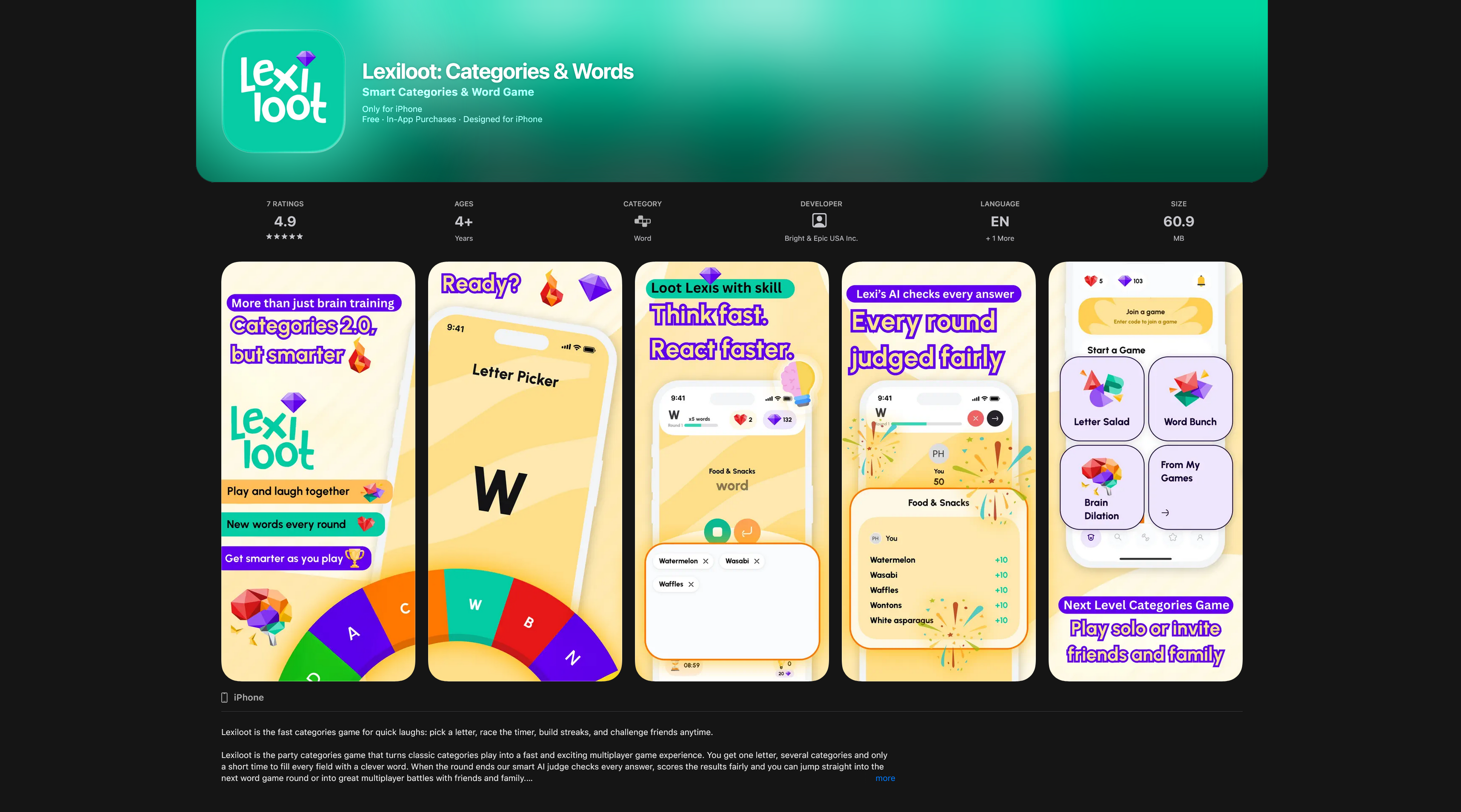
Whether you are looking for modern vocabulary games with adaptive challenges, a structured categories game for kids you can run in your classroom tomorrow, or step-by-step guidance to create your own word puzzles tailored to your students, Lexiloot has you covered. The app combines multiplayer competitions, category challenges, and vocabulary-building modes in a pay-once model, so there are no ongoing fees. Explore the resources, pick a format that fits your setting, and watch word confidence grow.
Frequently asked questions
Which vocabulary game works best for struggling readers?
Active games like Reading Race are a strong choice because word identification games improve decoding even after short interventions. Collaborative group games also reduce pressure and build confidence alongside vocabulary skills.
How do I make vocabulary games work for mixed-age groups?
Choose games where the word list and rules can be adjusted by skill level. Games like Categories and Dictionary Scavenger Hunt are naturally flexible, and games are adaptable for various learner needs including mixed ages and abilities.
What research supports the impact of vocabulary games?
Multiple studies show strong gains. Quizizz and Word Tag increase vocabulary by 30% to 43% compared to traditional methods, and movement-based games show significant gains even in short sessions.
Are screen-free vocabulary games still effective?
Absolutely. Screen-free games like Word of the Week and dictionary scavenger hunts are highly effective and work well in any environment, including rural or low-tech classrooms where devices are limited.

