


TL;DR:
- Active engagement, desirable difficulty, and consistency are key for effective brain training techniques.
- Spaced repetition, retrieval practice, and mnemonic devices most reliably improve memory and learning.
- Tailoring methods to individual learning styles and making effortful strategies engaging increases long-term success.
Countless brain training methods are competing for your attention, all promising sharper focus and better grades. The real challenge is not finding tips. It is figuring out which ones actually work. Some strategies feel productive but barely move the needle, while others look simple on the surface and deliver serious results. This guide cuts through the noise and gives you a clear, evidence-backed look at the techniques that genuinely improve memory, focus, and academic performance. We have also included practical ways to make these habits stick, so you can start seeing real progress without overhauling your entire schedule.
Table of Contents
- How to evaluate brain training techniques
- Top brain training tips for students: The essentials
- Brain training games and apps: What works?
- Which brain training methods fit your studying style?
- Why easy brain training rarely works (and what to do instead)
- Boost your brain training with interactive learning games
- Frequently asked questions
Key Takeaways
| Point | Details |
|---|---|
| Active techniques win | Methods that require retrieval and effort—like mnemonics and quizzes—improve memory and focus better than passive study. |
| Routine matters | Consistency and embedding brain training into daily routines drive sustainable gains. |
| Personalization helps | Matching techniques to your learning style or strengths makes training stick and feel less daunting. |
| Quality over quantity | Evidence-based games and challenges are more effective than random puzzles or commercial brain apps. |
How to evaluate brain training techniques
Not all techniques labeled as “brain training” actually boost cognitive skills for studying. This is an important starting point. Before investing time in any method, you need a simple framework for judging whether it is worth your effort.
The most reliable brain training techniques share a few key features:
- Active engagement: Methods that require you to retrieve, organize, or apply information outperform passive approaches. Strategies for improving working memory consistently show that active engagement through mnemonics and retrieval beats passive rereading by a significant margin.
- Desirable difficulty: The best techniques feel effortful. According to research on learning sustainability, effective methods require what scientists call “desirable difficulties,” meaning they demand mental effort that ultimately leads to stronger, more durable learning gains.
- Consistency within routines: A technique practiced once a week will rarely produce lasting change. You need to embed your chosen strategies into daily habits for the results to compound over time.
- Motivational alignment: Techniques that include fun or interactive elements support consistency. Understanding the role of educational apps in modern learning shows that engagement and motivation are closely tied to how long students stick with a method.
- Cognitive load management: Good techniques help your brain organize and store information rather than overwhelm it. Chunking (grouping related items into smaller sets) and outsourcing details through notes are classic examples.
Statistic spotlight: Spacing study sessions over time consistently outperforms massed practice (cramming), and this effect holds across subjects and age groups. The research is clear: how you practice matters as much as what you practice.
Getting familiar with core brain training terms also helps you recognize quality when you see it, whether you are evaluating a study strategy, an app, or a game.
Pro Tip: When trying a new brain training method, give it at least three weeks of daily practice before judging whether it works. Most techniques need time to build momentum before results become visible.
Top brain training tips for students: The essentials
Knowing what to look for, here is a practical list of the highest-impact techniques every student can try. These are all backed by solid evidence and can be adapted to almost any subject or study schedule.
-
Use mnemonic devices and chunking. Mnemonics help your brain create shortcuts for storing and retrieving information. Acronyms, rhymes, and storytelling are all classic examples. Chunking works by grouping related pieces of information together so your brain treats them as a single unit rather than many separate ones. Memory strategies like these have been shown to improve both working memory and long-term retention across academic subjects.
-
Try concept mapping and visualization. Drawing a visual map of how ideas connect forces your brain to organize information in a structured way. This is especially useful in subjects like biology, history, and literature, where relationships between concepts matter. When you visualize information, you create a second mental pathway that makes it easier to recall details later.
-
Adopt spaced repetition and interleaving. Spaced repetition means spreading your study sessions over days or weeks rather than cramming everything into one long session. Interleaving means mixing up different topics or subjects within a single study session. Both approaches, supported by evidence-based study research, are significantly more effective for long-term retention than blocked, repetitive practice.
-
Practice self-testing and retrieval. Close your notes and try to recall what you just studied. Write it down, say it out loud, or quiz yourself with flashcards. Retrieval practice strengthens the memory trace more than any amount of rereading. This technique is one of the most consistent findings in all of learning science.
-
Prioritize mindfulness, sleep, and physical exercise. These are foundational. Mindfulness practice reduces stress hormones and measurably improves attention and memory, with researchers noting better sustained attention after consistent practice. Sleep is when your brain consolidates what you learned during the day. Physical exercise increases blood flow to the brain and supports the growth of new neural connections.
-
Use structured breaks like the Pomodoro method. Working in focused 25-minute blocks followed by a 5-minute break keeps your attention from wearing thin. It also prevents the cognitive overload that comes from long, uninterrupted study sessions.
“Mnemonic devices, concept mapping, and retrieval practice are not just good ideas. They are the techniques that consistently separate students who retain information from those who feel like they are studying but not learning.”
Pairing these techniques with fun brain training games can reinforce habits and keep your motivation high, especially on days when studying feels like a chore.
Pro Tip: Combine spaced repetition with self-testing for maximum effect. Review a topic after one day, then three days, then a week, always testing yourself rather than just rereading your notes.
Brain training games and apps: What works?
Beyond core techniques, many students ask whether brain training games and apps are genuinely effective or just entertaining distractions. Here is the evidence.
The honest answer is that it depends on the design of the app and how you use it. Research published in cognitive performance studies shows that brain training games improve cognitive functioning, processing speed, and working memory with statistically significant results across multiple studies, though some effects are comparable to aerobic exercise and the transfer to real-world academic tasks can be mixed.
For students with ADHD or attention-related challenges, the results are especially promising. Gamified learning apps have been shown to improve attention (measured by reaction times) and academic skills in reading, writing, and math compared to non-gamified alternatives, with gains maintained at an eight-week follow-up.
What separates effective apps from time-wasters?
- Variety: Apps that switch between task types keep the brain challenged and prevent adaptation to a single pattern.
- Adaptivity: Good apps adjust difficulty as you improve, which keeps you in the productive zone of challenge without crossing into frustration.
- Credible evidence: Look for apps that cite research or are developed with input from educators or cognitive scientists.
- Social and competitive elements: Features like leaderboards, multiplayer modes, and friend challenges improve consistency because social accountability makes it easier to keep showing up.
- Integration of real skills: The best apps build vocabulary, category thinking, and language recall alongside cognitive skills, so your gains transfer to academic work.
| Feature | Effective apps | Less effective apps |
|---|---|---|
| Difficulty adjustment | Adaptive to your level | Fixed or random |
| Skill coverage | Multiple cognitive skills | Single repetitive task |
| Social elements | Multiplayer, leaderboards | Solo only |
| Evidence base | Research-backed design | No cited evidence |
| Transfer to academics | Real vocabulary/language gains | Abstract tasks only |
Using social brain training games or following a step-by-step brain training program can help you select tools that genuinely build skills rather than just entertain. And if you want to strengthen focus alongside your game-based practice, pairing apps with strategies like micro-tasking for focus adds another productive layer.
Which brain training methods fit your studying style?
With so many evidence-based options, the best results come from tailoring your brain training to your unique learning style. There is no single “best” method for every student.
Consider how working memory training research frames the long-term impact of personalized training: just five weeks of daily adaptive computer-based working memory exercises improved working memory capacity by 0.40 to 0.46 standard deviations. Even more impressively, students also saw gains in fluid intelligence, inhibitory control, and geometry scores, with a 16% higher likelihood of placement in an advanced school track three years later. Those are meaningful, lasting results that go far beyond simple test-score bumps.

Here is a simple guide to matching methods with common studying styles:
| Studying style | Best-fit methods | Academic benefit |
|---|---|---|
| Visual thinker | Concept maps, diagrams, color coding | Retention in science, history |
| Social learner | Multiplayer games, group quizzing | Speaking, discussion, debate |
| Creative mind | Storytelling mnemonics, rhymes, songs | Language arts, foreign languages |
| Structured thinker | Spaced repetition schedules, Pomodoro | Math, technical subjects |
| Neurodiverse learner | Gamified apps, visual strategies | Attention, working memory |
- Visual thinkers do especially well with concept maps and color-coded notes that turn abstract ideas into spatial layouts their brain can navigate.
- Social learners benefit from multiplayer games and peer quizzing because the social element adds accountability and makes retrieval practice feel less like work.
- Creative students often retain information better when it is attached to a story, song, or rhyme, so mnemonic strategies are a natural fit.
- Neurodiverse learners may find gamified, interactive approaches particularly supportive because they break tasks into manageable steps and provide immediate feedback.
Exploring the types of brain games available can help you identify which formats energize you rather than drain you. You can also apply the same logic to your study schedule by setting clear study goals that align with your academic targets.
Pro Tip: If you notice a strategy is not sticking after a few weeks, do not assume brain training does not work for you. Try switching the format. A visual learner who dislikes flashcards might thrive with a concept mapping app instead.
Why easy brain training rarely works (and what to do instead)
Here is a perspective that most brain training advice skips over: the reason so many students do not see results is not that they are lazy or unmotivated. It is that they are drawn to the strategies that feel easiest, and easy rarely equals effective.
Research on study strategy adoption reveals something striking. Students actually know about effective strategies like retrieval practice and spaced repetition. They just avoid them because these methods feel cognitively costly. They take more time and effort. They create mild anxiety. Rereading your notes, on the other hand, feels comfortable and familiar, so your brain tells you it is working even when it is not.
This is the core problem with most “easy” brain training. The strategies that feel productive in the moment, scrolling through flashcard apps passively, rereading highlighted text, watching summary videos without pausing to recall, often produce a sense of fluency without genuine learning. You feel like you know the material until the test reveals otherwise.
The path forward is not to make studying painful. It is to make effortful strategies more approachable. That is where the right kind of gamification genuinely helps. When retrieval practice is wrapped in a word game, or when spaced repetition feels like leveling up rather than grinding through a schedule, students are far more likely to engage consistently. And consistent engagement is what turns brain training from a short-term experiment into lasting cognitive gains.
Our advice: commit to one effortful strategy for 30 days. Pair it with something interactive to keep the motivation alive. Track your progress, even informally. Students who treat brain training as a long-term habit rather than a quick fix almost always outperform those who do not. You can also strengthen your commitment by setting study goals that make your intentions concrete and measurable.
Boost your brain training with interactive learning games
Ready to put these strategies to work? Here is how interactive resources can help bring your brain training routine to life.
At Lexiloot, we have built a platform where the science of effective learning meets the energy of competitive, social gaming. Our word games and vocabulary challenges are designed to make “desirable difficulty” feel like a fun challenge rather than a chore, turning active recall, category thinking, and vocabulary recall into game mechanics you will actually want to return to.
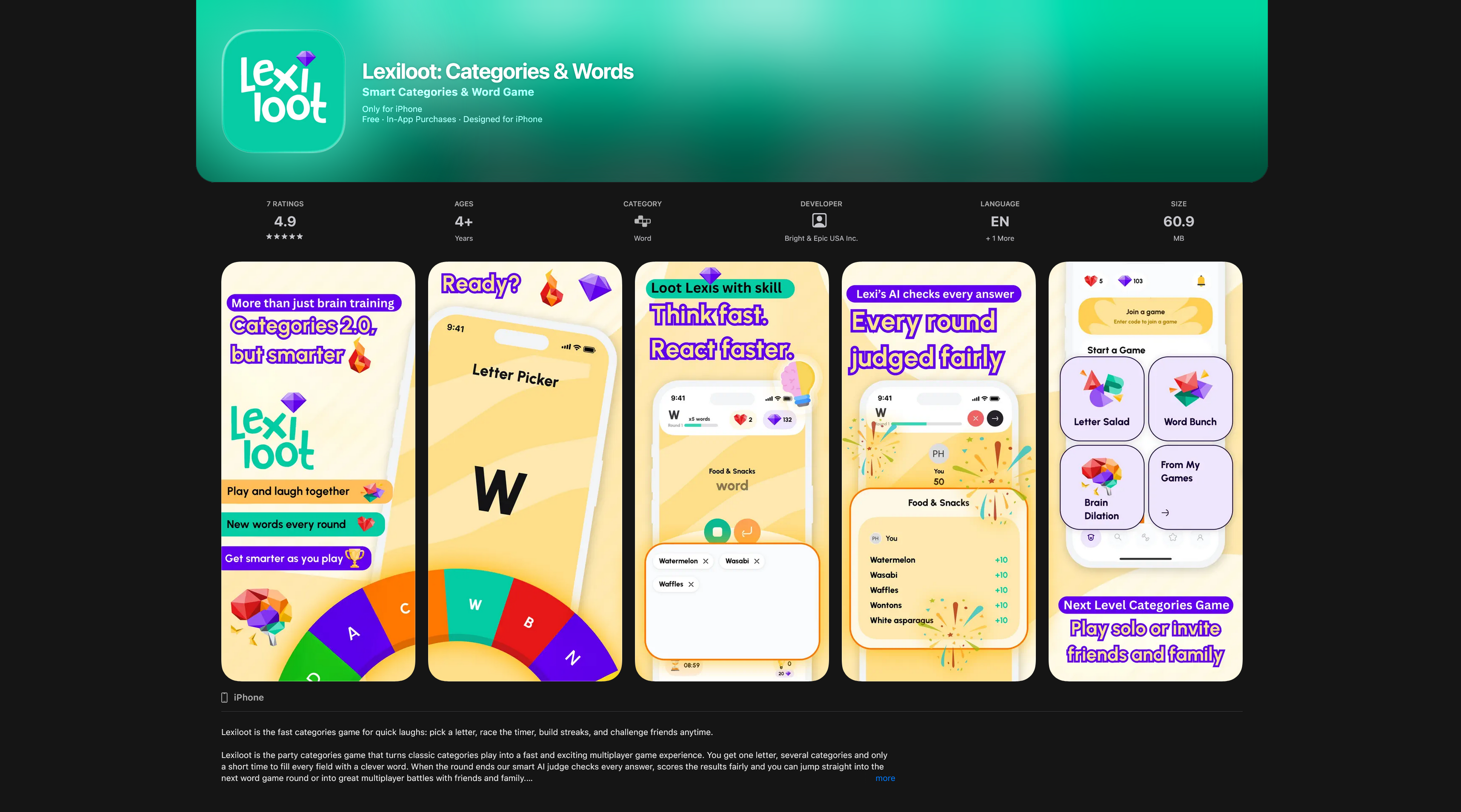
Whether you are exploring creative word game examples to spark ideas, looking for word games that build vocabulary and brainpower, or wanting to understand how vocabulary builds reading comprehension skills, Lexiloot has resources designed with students like you in mind. With a pay-once model, ad-free gameplay, and multiplayer modes that bring social accountability into your routine, it is a straightforward way to add an evidence-aligned brain training habit to your day. Try it and see how much more fun the effortful stuff can be.
Frequently asked questions
What is the most effective brain training technique for students?
Spaced repetition and retrieval practice are among the most effective strategies, consistently outperforming passive methods like rereading and highlighting across subjects and age groups.
How do brain training games improve student performance?
Quality brain training games have been shown to improve memory and processing speed in multiple studies, particularly when the game design incorporates adaptivity, variety, and educational principles.
How much sleep should I get for optimal brain function?
Students should aim for 7 to 10 hours each night, as sleep is when the brain consolidates new information and restores the cognitive resources needed for focused learning.
Do brain training apps work for everyone?
Not equally. Most students see gains in attention and memory, but results depend heavily on app quality, design, and consistency of use over time.
How long does it take to see results from brain training?
Meaningful improvements in attention can emerge after several weeks, with more durable gains appearing after months of consistent, embedded practice.

