


TL;DR:
- Playing targeted games like action, strategy, and word games can enhance attention, memory, and executive functions. Moderate, purposeful gaming (4 to 16 matches weekly) offers cognitive benefits without negative effects. Benefits vary by age and population, with older adults and those with ADHD seeing significant improvements.
Far from being a mindless pastime, playing the right kinds of games can sharpen your mind in measurable ways. Research shows that gaming, especially action and word games, delivers real improvements in attention, memory, and executive function. That might sound surprising if you’ve spent years worrying about screen time, but the science is clear and growing. In this article, we’ll walk through how different game types affect the brain, what the research actually proves, how much gaming is ideal, and how you can put these findings to work for kids, students, and lifelong learners.
Table of Contents
- How different game genres sharpen your mind
- The science: What studies reveal about gaming and cognition
- The “dose” effect: How much and what type of gaming matters
- Practical tips: Leveraging word and social games for learning
- The bigger picture: What most articles miss about gaming and the brain
- Explore word games that boost brainpower and learning
- Frequently asked questions
Key Takeaways
| Point | Details |
|---|---|
| Diverse game types benefit cognition | Action, strategy, and word games each uniquely strengthen attention, memory, and problem-solving skills. |
| Moderation beats marathon play | The best cognitive benefits come from moderate, regular gaming—not excessive or sporadic sessions. |
| Social play multiplies gains | Social word games boost not only cognitive skills but also emotional well-being and learning motivation. |
| Personalization matters | Effects vary by age and individual; choosing the right game and dose is key to maximizing results. |
How different game genres sharpen your mind
Not all games work the brain the same way. Just like physical exercise targets different muscles depending on the activity, different game genres engage distinct cognitive systems. Understanding those differences helps you choose games with purpose, not just for entertainment.
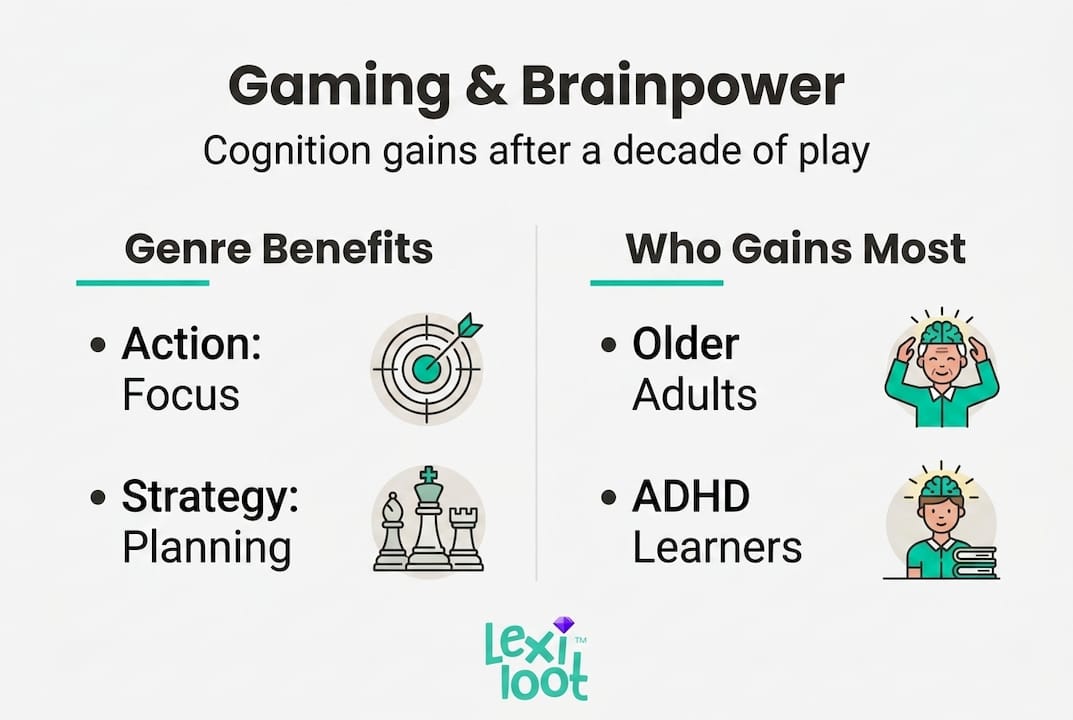
Action games are some of the most studied. They demand rapid visual scanning, quick decision-making, and constant tracking of moving objects. According to a growing body of research, action games improve attention, working memory, executive function, processing speed, and spatial reasoning. That’s a wide range of skills from a single genre. The reason is simple: fast-paced games push the brain to process multiple streams of information at once, which strengthens neural pathways related to attention and response.
Strategy games work differently. Instead of split-second reactions, they ask players to plan ahead, manage resources, and shift priorities as conditions change. These demands build executive functions like task switching, goal setting, and inhibitory control. They also encourage flexible thinking, which is the ability to step back and reconsider a plan when it stops working.
Word and social games are especially valuable for language learners and educators. Strategy and word games enhance problem-solving and verbal fluency. Games that involve naming, categorizing, and spelling put vocabulary recall and category thinking to work in ways that feel engaging rather than like studying. Learning word games and brainpower connections helps explain why educators increasingly turn to these formats in classrooms.
| Game genre | Key cognitive skills targeted |
|---|---|
| Action games | Visual attention, processing speed, spatial skills |
| Strategy games | Planning, task switching, problem-solving |
| Word games | Vocabulary recall, verbal fluency, spelling fluency |
| Social games | Communication, memory, emotional resilience |
Here’s a quick summary of the key skills each type develops:
- Action: Faster reactions, better focus under pressure
- Strategy: Improved planning and mental flexibility
- Word: Stronger vocabulary and category thinking
- Social: Memory consolidation and cooperative thinking
For practical examples of games that activate these systems, check out top cognitive game examples that target each skill area.
“Different game mechanics create different cognitive demands, and those demands shape how the brain grows and adapts over time.”
The science: What studies reveal about gaming and cognition
Knowing the theory is one thing. But what does the evidence actually show when researchers put gaming to the test?
The findings are encouraging across multiple groups. One of the most striking results involves word games and aging. Word games delayed cognitive aging by up to 10 years, while action and strategy games showed sustained neural changes over 30 weeks of play. That’s not a small effect. It suggests that the right kind of play, done consistently, can meaningfully slow age-related mental decline.
For children and younger learners, small to moderate overall cognitive benefits emerge across studies, with larger effects seen in structured intervention studies where game use is intentional and guided.

For people with ADHD, the results are particularly notable. A recent meta-analysis found a moderate effect size of g=0.79 in perception and SMD=0.42 for ADHD populations on cognition. That’s a meaningful improvement in a group that often struggles with sustained attention and working memory.
Here’s a look at how cognitive gains compare across different groups:
| Population | Key benefit | Effect size |
|---|---|---|
| Children | Memory, attention | Small to moderate |
| Older adults | Cognitive aging delay | Large (up to 10 years) |
| ADHD individuals | Focus, working memory | Moderate (SMD=0.42) |
| General adults | Executive function | Small to moderate |
Some numbered highlights from the research:
- Word games can offset cognitive aging by nearly a decade with consistent play.
- Action game training over 30 weeks produces measurable changes in brain structure and function.
- ADHD populations show moderate but clinically meaningful gains in attention and memory.
- Structured, guided game use produces larger gains than casual, unguided play.
For educators who want to integrate these findings into the classroom, games in education offers practical strategies backed by real research. And if you’re curious about the cognitive science behind gameplay, word games and cognition breaks down the mechanisms in accessible terms.
The “dose” effect: How much and what type of gaming matters
While the benefits are clear, they don’t come from unlimited play. The relationship between gaming time and cognitive outcomes follows something closer to a curve than a straight line. More is not always better.
Optimal play is moderate, around 4 to 16 matches per week. Beyond that range, excessive gaming at more than 3 hours per day can lead to attention problems and disrupted sleep. Even within that window of benefit, children playing more than 3 hours daily improved certain memory scores but also showed increased risks for attention deficits. That’s a nuanced finding worth holding onto.
Here’s what smart, intentional gaming looks like in practice:
- Choose games that match your goals. If you want to build vocabulary, word games are more effective than action shooters.
- Set session limits. For kids under 12, aim for 30 to 45 minutes per session. For teens and adults, 60 to 90 minutes is a reasonable cap before a break.
- Space sessions throughout the week. Regular, shorter sessions outperform long, occasional marathons for learning and memory.
- Pair gaming with reflection. Talking about what you played or learned helps consolidate memory and deepen understanding.
- Avoid gaming right before bed. Screen stimulation close to sleep time disrupts sleep quality, which undoes many of the cognitive benefits gained during play.
“The dose makes the difference. Moderate, purposeful gaming is a brain investment. Excess play without intention is just consumption.”
Pro Tip: For families looking to balance fun and learning, the family word games guide offers practical session plans and game recommendations by age group.
Practical tips: Leveraging word and social games for learning
Now let’s get specific. Here’s how educators, parents, and gamers can apply what we know about gaming and cognition in daily life.
Social word games trigger multi-system engagement, benefiting both cognitive and emotional health. That’s important because it means these games aren’t just building vocabulary. They’re also helping kids and adults manage stress, communicate better, and stay mentally resilient.
For educators:
- Use category-based word games as a warm-up activity to wake up attention at the start of class.
- Build vocabulary challenges around curriculum themes, so game content reinforces what students are already learning.
- Introduce competitive but cooperative formats where students work in teams, which adds social and emotional benefits to the cognitive workout.
- Rotate game types throughout the week to target different skills: spelling fluency on Monday, category thinking on Wednesday, creative word building on Friday.
- Reflect as a class after each session. Ask students what strategies they used and what new words they encountered.
For parents:
- Choose games rated for your child’s age that also stretch vocabulary and problem-solving.
- Play alongside your kids when possible. Co-play boosts engagement and makes learning a shared experience.
- Set a consistent game time that doesn’t compete with homework or sleep.
- Celebrate progress with words, not just wins. Notice when your child uses a new word from a game in conversation.
Pro Tip: If you’re new to word game formats, explore engaging vocabulary games for ideas sorted by age and skill level, or look at teaching word games for classroom-ready approaches.
Sample game ideas by age:
- Ages 5 to 8: Picture-based category games, simple rhyming challenges
- Ages 9 to 12: Word ladders, spelling battles, vocabulary trivia
- Ages 13 and up: Strategy-based word games, multiplayer competitions, timed category challenges
- Adults and older learners: Crosswords, category sorting under time pressure, social word battles
The bigger picture: What most articles miss about gaming and the brain
Most coverage of gaming and cognition swings between two extremes. Either games are rotting kids’ brains, or they’re miracle brain trainers. Neither story is fully accurate.
Here’s our honest take: mixed evidence and publication bias mean that not every game, and not every player, gets the same cognitive boost. Studies that show dramatic gains often involve short training periods with highly specific tasks. The gains are real, but they don’t always transfer neatly to the classroom or workplace.
Cognitive improvements tend to be most reliable when the game closely matches the skill you’re trying to build. A word game won’t make someone better at spatial reasoning. A fast-action game won’t automatically improve reading comprehension. Transfer depends on similarity between the game task and the real-world task.
This is why we believe informed, goal-oriented game use matters more than simply logging hours. The question isn’t just “how much?” but “what for?” Educators and parents who choose games with a specific skill outcome in mind are far more likely to see lasting brain gains than those who rely on screen time alone to do the work.
The research is genuinely promising. But its power depends on how thoughtfully you apply it.
Explore word games that boost brainpower and learning
If you’re ready to put these insights into action, Lexiloot is built around exactly these principles. The app combines word games, category challenges, and multiplayer modes designed to build vocabulary recall, category thinking, and spelling fluency in ways that are fun for the whole family.
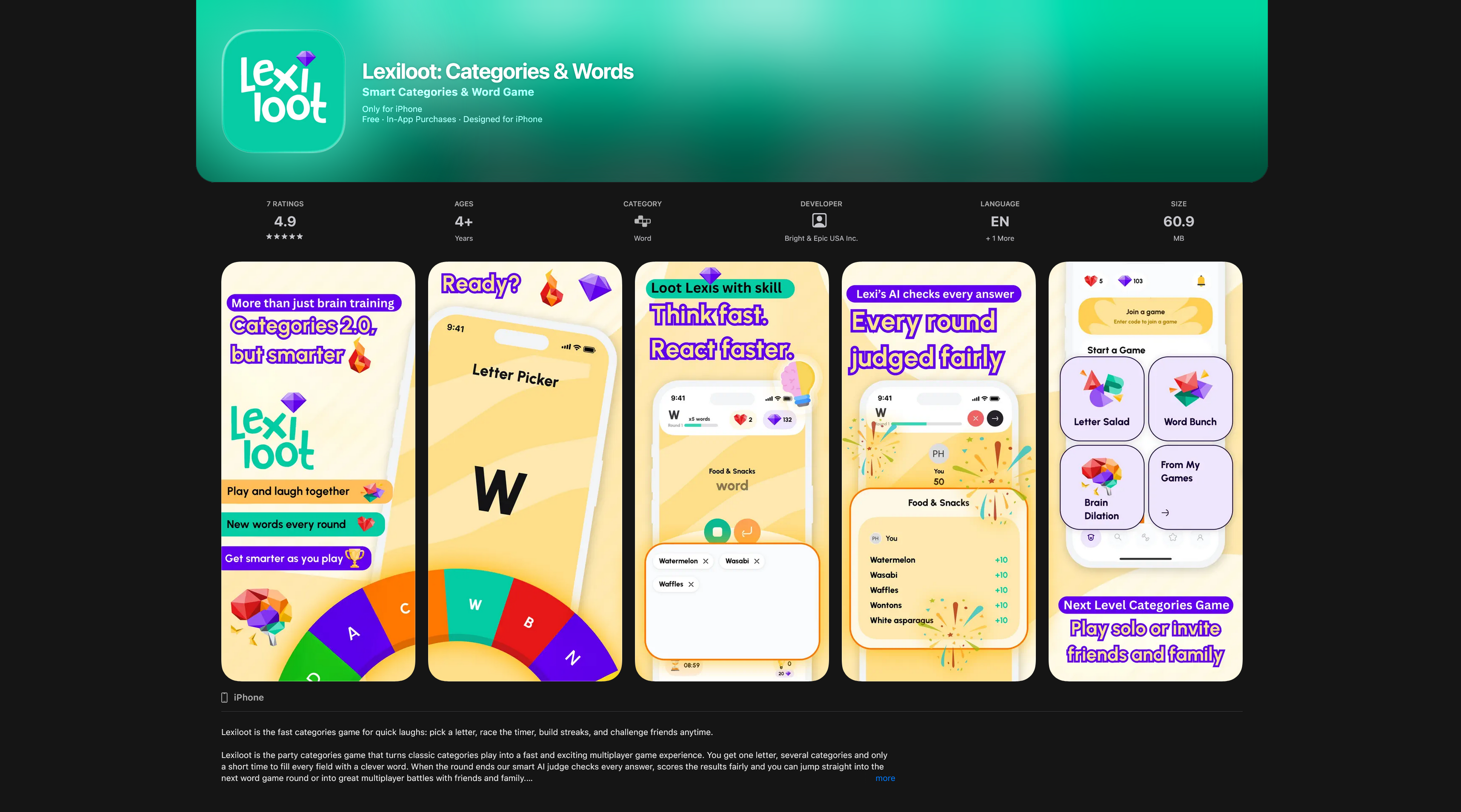
Whether you’re a teacher looking for game strategies for education, a parent searching for creative word game examples, or a learner who wants to grow through play, Lexiloot gives you a purposeful, social, and science-informed gaming experience. Explore vocabulary brainpower with word games and see how the right game, played with intention, can genuinely sharpen your mind.
Frequently asked questions
Which video game genres give the biggest cognitive benefits?
Action games boost attention and spatial skills most, while strategy and word games most improve executive function and language. The genre you choose should match the specific skill you want to strengthen.
How much gaming is optimal for brain benefits?
Moderate play, about 4 to 16 matches per week, delivers the best gains. More than 3 hours of daily gaming can impair attention and sleep, which offsets the benefits.
Do cognitive gains from gaming transfer to real-life tasks?
Some improvements do transfer, but most are modest outside of targeted training. Transfer depends on how closely the game task mirrors the real-world skill you’re aiming to improve.
Are gaming benefits different for children, older adults, or people with ADHD?
Yes. Older adults and ADHD populations often experience larger improvements in executive function and working memory compared to general adult populations.
Can social and word games improve emotional well-being as well?
Yes. Social word games engage both cognitive and emotional systems, helping build memory and resilience through collaborative and competitive group play.

