


TL;DR:
- Categories word games challenge players to quickly list words within specific themes, enhancing vocabulary and thinking skills. They are social, competitive, and adaptable, making learning engaging for all ages. Playing regularly supports cognitive development, social connection, and language confidence.
Word games have a reputation for being quiet, solo activities. But categories games are rewriting that story. These fast-paced, theme-based challenges are now played on phones, in classrooms, and around kitchen tables, bringing families and friends together while quietly building vocabulary recall, category thinking, and spelling fluency. Whether you’re a parent looking for screen time that actually teaches something, a teacher searching for classroom engagement tools, or a casual gamer who loves a good mental challenge, categories word games offer something genuinely useful. This article explains what they are, how they work, and how you can get the most out of them.
Table of Contents
- What are categories word games?
- Core mechanics and gameplay styles
- Social competition and engagement features
- Educational impact and expert strategies
- Why categories games are more than just play: Our perspective
- Level up your wordplay with Lexiloot: Play, learn, and connect
- Frequently asked questions
Key Takeaways
| Point | Details |
|---|---|
| Social and educational fun | Categories word games blend competition and collaboration to engage players of all ages while building vocabulary and thinking skills. |
| Mechanics drive engagement | Points, leaderboards, and multiplayer turns make categories games more interactive and addictive than traditional word puzzles. |
| Real learning benefits | Research shows up to 23% higher vocabulary retention and meaningful brain training for students, families, and adults. |
| Strategies matter | Using the right starter words, creative combinations, and adapting to edge-case challenges can boost both scores and learning. |
What are categories word games?
Categories word games challenge players to list or name words that belong to a specific theme or group. The category might be “animals that live in the ocean,” “things you find in a kitchen,” or “words that start with the letter B.” The goal is to think quickly, recall vocabulary, and outpace your opponents before time runs out.
This style of play is different from a standard crossword or word search. Instead of finding a hidden word, you’re generating words from memory. That distinction matters because it activates a different kind of thinking. Your brain scans what it already knows and filters it by category, which strengthens both vocabulary recall and flexible thinking.
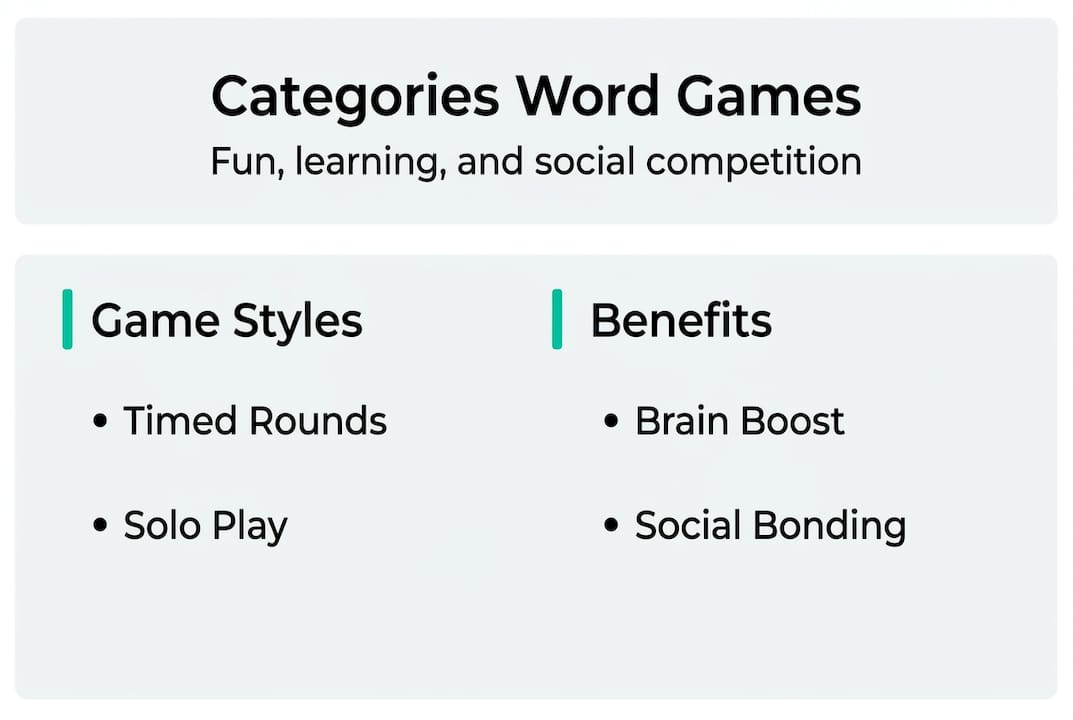
Modern categories games come in many forms. Some of the most popular word games for casual mobile gamers, families, and educators include Words with Friends 2, Scrabble GO, Wordscapes, Wordle, Boggle With Friends, and Elevate. Each one takes a slightly different approach, but they all share the core idea of working with words under some kind of constraint or theme.
There are also many types of word games that fit different settings. Some are best for solo practice. Others are built for group play. A good categories game for kids can work beautifully in a classroom without any screens at all.
Here’s a quick look at how the most common formats compare:
| Game type | Core mechanic | Best for |
|---|---|---|
| Scattergories-style | List words per category with a letter | Groups, families |
| Scrabble-style | Place words on a board for points | Strategy lovers |
| Wordle-style | Guess a hidden word with feedback | Solo daily play |
| Boggle-style | Find words in a letter grid | Speed and pattern thinkers |
| App-based categories | Theme-based challenges with timers | Mobile gamers, classrooms |
The variety is part of what makes categories games so accessible. You can pick a format that fits your group, your time, and your goals.
Key benefits players notice right away:
- Vocabulary growth through repeated word retrieval
- Faster thinking under timed pressure
- Category thinking that transfers to reading and writing
- Social connection through shared play
- Adaptability for different ages and skill levels
Core mechanics and gameplay styles
With the basics established, it’s time to dig into how categories games really work and what makes them different from classic solo word puzzles.
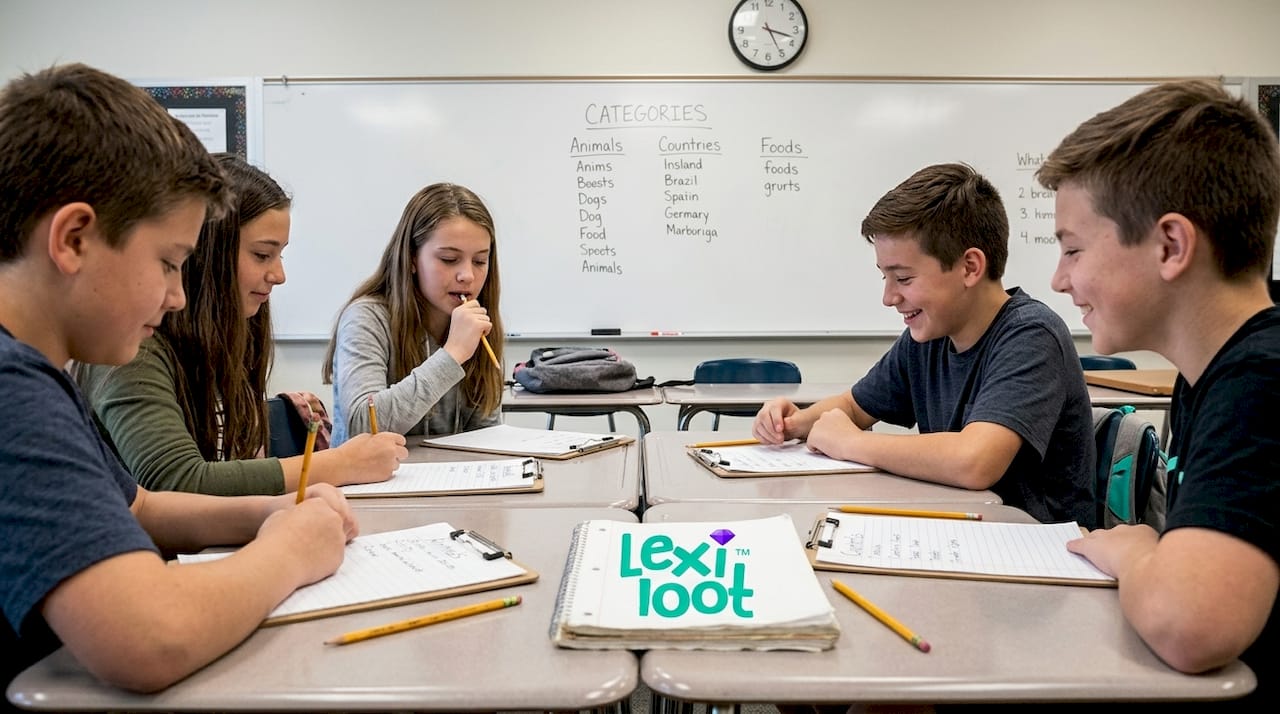
At their core, most categories games follow one of a few mechanical frameworks. Understanding these helps you choose the right game and get better at it faster.
Core mechanics in popular word games include word formation from letter sets, crossword-style placement on boards with score multipliers, daily puzzles with color-coded feedback, and multiplayer turns that don’t require both players to be online at the same time. That last feature, called asynchronous play, is one reason mobile word games have become so popular with busy families and adults.
Here’s how the main gameplay styles break down:
- Timed rounds. Players list as many words as possible within a set time. This format rewards quick vocabulary recall and works well for energetic groups.
- Turn-based play. Each player takes a turn placing or guessing a word. This suits strategic thinkers and works for asynchronous mobile play.
- Points-based scoring. Words earn points based on letter values, board position, or category difficulty. Multipliers and bonus squares add a layer of strategy.
- Speed rounds. Short bursts of rapid-fire category naming. These are great for warming up a classroom or keeping family game night moving.
- Daily puzzle formats. One challenge per day with feedback on your performance. These build a habit of play and give players something to discuss with others.
For educators, adapting these mechanics to a classroom is straightforward. You can run a timed round as a warm-up activity, use turn-based formats for small group work, or set up a daily word challenge on a shared screen. Learning how to play categories in different formats gives you flexibility for any setting.
Pro Tip: If you’re new to categories games, start with a timed format using familiar topics. Categories like “foods you can eat cold” or “things in a backpack” lower the barrier to entry and let players focus on the fun before the strategy.
The connection between gameplay and word games and brainpower is well established. When you play regularly, your brain gets faster at retrieving and organizing language, which pays off in reading, writing, and everyday conversation.
Social competition and engagement features
Understanding the mechanics is just the start. Next, discover how categories games build social bonds and motivation, making wordplay a group experience rather than a solo one.
Most categories games today are built with social features at their center. Social competition through asynchronous multiplayer, leaderboards, leagues, and group challenges enhances engagement for casual gamers and families in ways that solo play simply cannot match.
Leaderboards create friendly rivalry. Badges reward consistent play. Group challenges give families or classrooms a shared goal to work toward. These features don’t just make the game more fun. They keep players coming back, which means more practice and more learning over time.
Here’s how social features impact different groups:
| Audience | Key social feature | Benefit |
|---|---|---|
| Families | Shared leaderboards | Friendly competition at home |
| Students | Class challenges | Motivation and peer accountability |
| Casual gamers | Asynchronous multiplayer | Play on your own schedule |
| Teachers | Progress tracking | Easy record-keeping and feedback |
Educators have found particular value in gamification in vocabulary games. When students compete on a class leaderboard or earn badges for completing word challenges, they engage more deeply with the material. The competitive element feels like play, but the learning is real.
Research backs this up. Gamification elements like points, badges, leaderboards, and challenges can boost vocabulary retention by 23% and support cognitive skill development through neuroscientist-designed exercises. That’s a meaningful gain from something that feels like a game.
“The best word game experiences are the ones where players forget they’re learning. Social competition is the engine that makes that possible.”
The social layer also supports vocabulary and cognition boost in ways that solo study cannot. When you discuss a word with a friend or defend your answer to a teammate, you process language more deeply. That deeper processing leads to stronger retention.
Features that drive social engagement in categories games:
- Real-time or async multiplayer for flexible group play
- Leaderboards that update after every game
- Friend invites to start private matches
- Group leagues for classrooms or families
- Badges and streaks that reward consistency
Educational impact and expert strategies
Social and gamified play are engaging, but how do categories games actually benefit your brain and learning? Let’s look at the research and expert approaches.
Categories games are more than entertaining. They are a proven tool for building vocabulary, improving memory, and training the brain to think more flexibly. Gamification elements like points, badges, leaderboards, and challenges boost vocabulary retention by 23% and support cognitive skills through neuroscientist-designed exercises. That result holds for kids and adults alike.
For teachers, embedding categories games into a lesson plan is easier than it sounds. A five-minute warm-up round before a reading lesson activates vocabulary. A post-lesson category challenge reinforces new words in context. These small additions add up to significant learning gains over a semester.
For families, a weekly game night built around categories play gives kids consistent vocabulary practice without the feel of homework. Parents who play alongside their children model language use and make the activity feel shared rather than instructional.
Expert strategies can also help you play smarter. Optimal starting words like SALET and CRANE in Wordle maximize early information. In Scrabble-style games, bingo bonuses worth 40 extra points reward players who use all their letters. Defensive blocking, where you place words to cut off high-value board spaces, adds a strategic layer that rewards planning.
Here are expert-backed strategies to apply right away:
- Start with high-frequency letters. Words using common letters give you more flexibility and more scoring options.
- Think in clusters. Group related words in your mind before your turn. This speeds up recall under pressure.
- Use the board strategically. In placement games, position words to access multiplier squares while blocking your opponent.
- Practice with harder categories. Advanced puzzle strategies often involve pushing past easy answers to find less obvious words that score higher.
- Adapt to the format. Word game cube design research shows that random board layouts require adaptive strategies. Rigid approaches fail when the game changes around you.
Pro Tip: When teaching word games to younger players, start with broad categories and narrow them as confidence grows. Moving from “animals” to “animals with four legs” to “animals with four legs that live in Africa” builds category thinking step by step.
The cognitive benefits go beyond vocabulary. Regular play improves attention, working memory, and mental flexibility. These are skills that support learning across every subject, not just language arts. Explore more on boosting learning with word games to see how consistent play builds lasting cognitive habits.
Why categories games are more than just play: Our perspective
Research and expert strategies shine a light, but real-world experience tells us something even more important about categories word games.
Conventional wisdom treats word games as a side activity, something you do to pass time. We think that framing undersells what these games actually do. Categories games place language at the center of social interaction. When a family sits down to play, they’re not just having fun. They’re building a shared vocabulary, practicing flexible thinking, and reinforcing the idea that words matter.
Rote study sessions rarely produce the same results. You can memorize a word list and forget it by Friday. But a word you argued about during a game, one you defended or discovered in competition, tends to stick. The emotional context of social play creates a memory anchor that repetition alone cannot replicate.
We also believe the best results come when players feel safe to take creative risks. Guessing an unusual word, trying a category stretch, or defending an unconventional answer builds confidence alongside vocabulary. That confidence transfers directly to reading, writing, and classroom participation.
If you want to see this in action, start teaching word games in your home or classroom and watch how quickly the conversation around language changes. It’s not just about winning. It’s about thinking out loud together.
Level up your wordplay with Lexiloot: Play, learn, and connect
If you’re inspired to bring categories games into your family routine, classroom, or personal brain training practice, Lexiloot is built for exactly that.
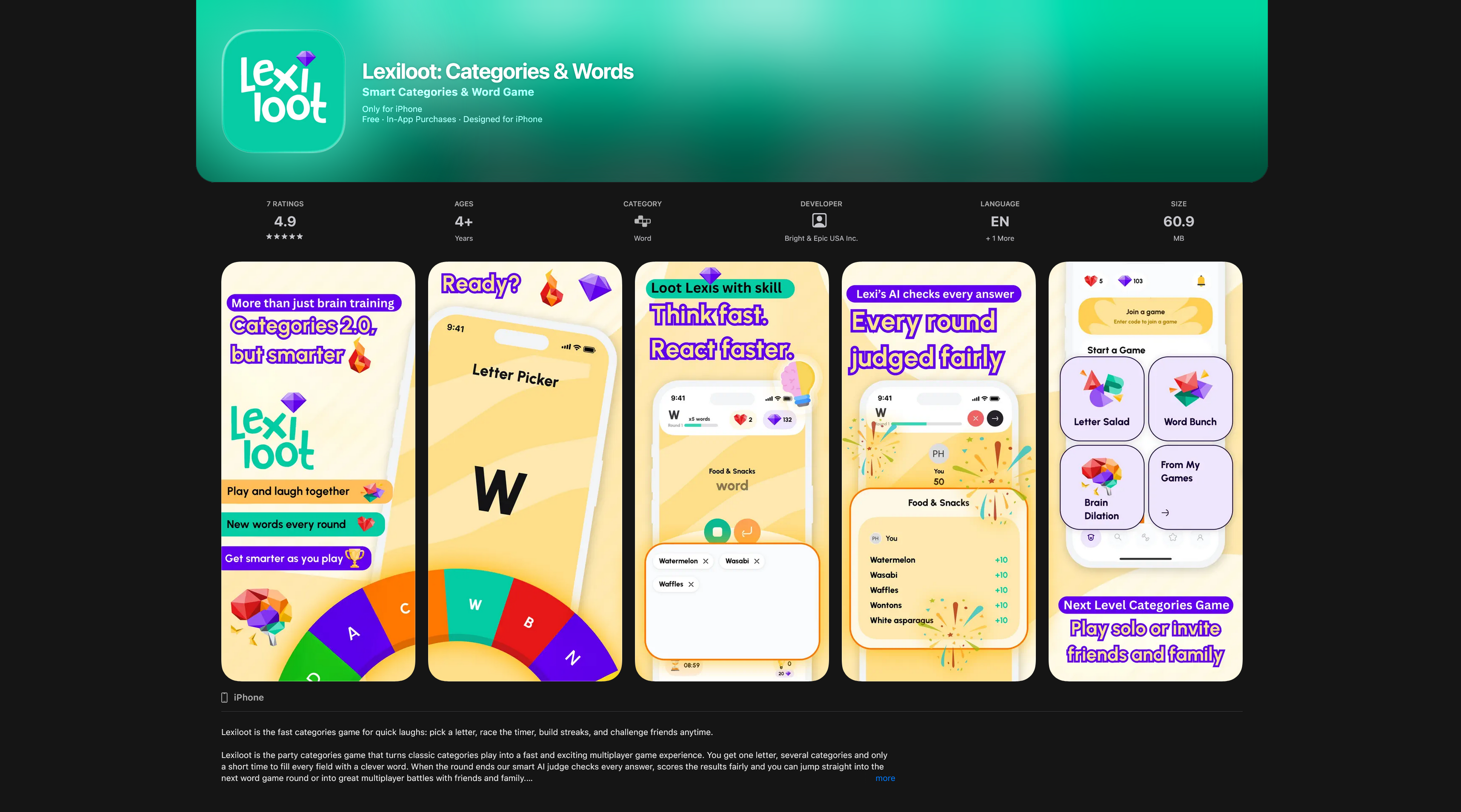
Lexiloot combines categories challenges, vocabulary building, and social competition in one mobile app designed for all ages. Whether you want a categories game for kids and classrooms, a way to master category games online with friends, or a collection of vocabulary games for kids that make learning stick, Lexiloot has a mode for you. With a pay-once model and no subscriptions, you get full access to brain-boosting gameplay without ongoing costs. Jump in and see how much fun learning can be.
Frequently asked questions
What makes categories games different from traditional word games?
Categories games challenge you to brainstorm words that fit specific themes, encouraging creativity and flexible thinking beyond simple word recall. This active retrieval process strengthens vocabulary in a way that passive word searches or crosswords do not.
Can categories games really improve vocabulary for kids and adults?
Yes. Research shows that gamified word play can boost vocabulary retention by 23% and support cognitive skill development for all ages. The combination of competition, repetition, and social context makes the learning stick.
What are some examples of popular categories games for mobile devices?
Words with Friends 2, Scrabble GO, Wordscapes, Wordle, Boggle With Friends, and Elevate are all top choices for mobile categories gameplay across different skill levels and age groups.
How do multiplayer and social features work in categories games?
Players connect asynchronously through multiplayer, compete in group leagues, and climb leaderboards that update in real time, keeping gameplay engaging and interactive without requiring everyone to be online at once.
Are there strategies to maximize scores in categories word games?
Yes. Using optimal starting words like SALET or CRANE, targeting bingo bonuses, blocking opponent scoring lanes, and adapting to random board layouts are all proven ways to improve your results.

