


TL;DR:
- Casual family gaming is a low-commitment, flexible activity that promotes vocabulary and category skills through shared play. These games emphasize quick participation, easy re-entry, and feedback to enhance learning without stressing players of all ages. Designing or selecting such games with support features and avoiding manipulative elements ensures accessible, engaging, and effective family language development.
Most parents assume that screen time and skill-building sit on opposite ends of a spectrum. The reality is quite different. When families play word and category games together, they activate vocabulary recall, category thinking, and memory in ways that passive entertainment simply cannot. Casual family gaming is designed to be low-commitment and flexible, making it easy to fit real learning into real life, whether you have ten minutes before dinner or a full afternoon to share.
Table of Contents
- What is casual family gaming?
- How word and category games boost vocabulary
- Supporting diverse learners: Ramp difficulty and encourage success
- Risks and best practices: Spotting behavioral traps
- Our perspective: What most family guides miss about casual gaming
- Explore games that build skills and connection
- Frequently asked questions
Key Takeaways
| Point | Details |
|---|---|
| Casual gaming is flexible | Family gaming can work in short, interruptible sessions and include all ages without pressure. |
| Word games build vocabulary | Interactive, feedback-driven word games are proven to improve vocabulary retention and acquisition. |
| Support all learners | Features like ramping difficulty, visuals, and extra hints help young or emergent readers succeed. |
| Watch for manipulative designs | Not all casual games are educational; beware of monetization and behavioral traps. |
| Quality beats gamification | Focus on design features—social play, adaptive levels, feedback—rather than marketing buzzwords. |
What is casual family gaming?
Casual family gaming is not just a looser version of gaming. It is a distinct style of play with specific features that make it accessible and enjoyable for everyone at the table, regardless of age or skill level.
The core definition comes from how these games are structured. Low-commitment, interruptible play designed for mixed-age participation sets casual gaming apart from progression-heavy games that demand hours of uninterrupted focus. In practical terms, this means a parent can jump in mid-round, a younger sibling can catch up quickly, and nobody feels lost when they set the game down and return to it later.
Here is a clear comparison between casual games and progression-heavy games:
| Feature | Casual games | Progression-heavy games |
|---|---|---|
| Time commitment | Short sessions, any length | Long sessions, structured chapters |
| Learning curve | Gentle, fast onboarding | Steep, requires tutorials |
| Mixed-age play | Yes, designed for it | Often limited by complexity |
| Pause and resume | Easy, no penalty | Often disrupts progress |
| Educational hooks | Vocabulary, categories, memory | Strategy, reflex, narrative |
| Parental control fit | High compatibility | Variable |
The features that make casual games flexible are the same features that make them powerful for learning. When kids can drop in without stress, they stay curious rather than defensive. When parents can participate without mastering complicated rules, the experience becomes genuinely shared.
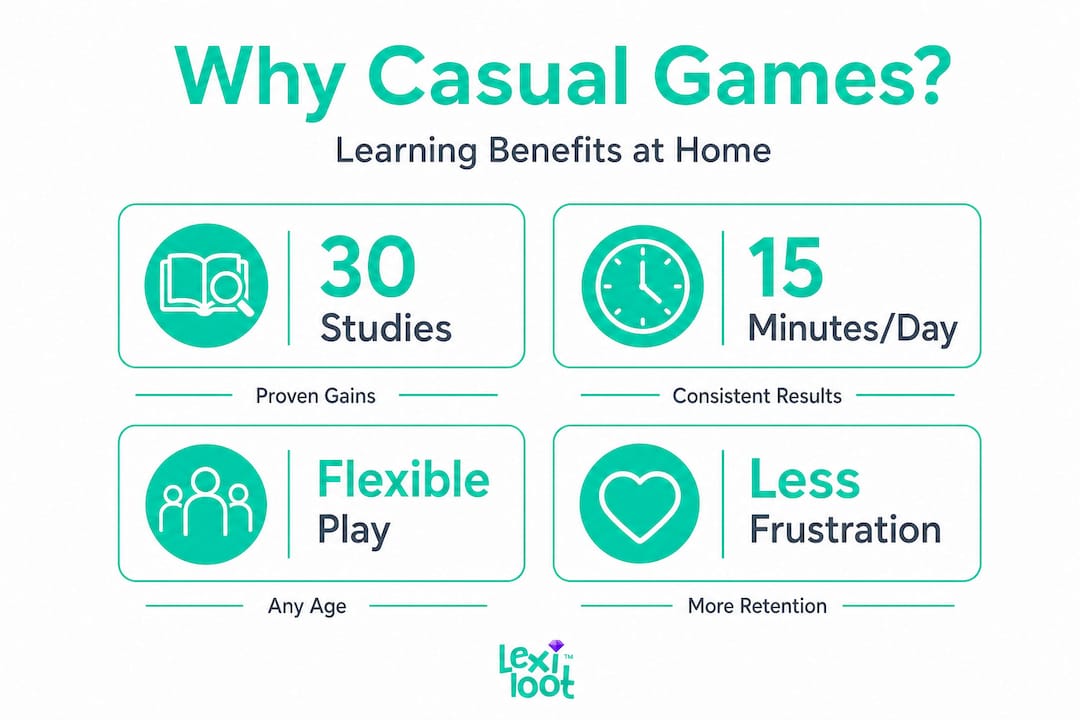
Good family-friendly word games consistently demonstrate these traits. They use simple rule sets, short rounds, and clear feedback so players of all ages feel capable and motivated rather than frustrated.
A few key benefits of casual family gaming include:
- Shared local and multiplayer formats that encourage conversation and teamwork
- Easy re-entry after breaks, meals, or interruptions
- Low-pressure stakes that let kids take vocabulary risks without fear of failure
- ESRB and parental control compatibility, since most casual games carry E or E10+ ratings
The family word games workflow also matters. Families who build a short, consistent gaming habit, even just 15 minutes three times a week, report stronger vocabulary gains than those who play longer but irregular sessions.
How word and category games boost vocabulary
Understanding what counts as casual family gaming sets the stage to explore how these games impact vocabulary and learning at a meaningful level.
The research here is genuinely encouraging. A systematic review covering 30 studies from 2020 to 2024 found that gamification in language learning consistently produced positive results for vocabulary acquisition and retention. The key ingredient was not just making learning “fun.” It was the combination of interactive exposure, immediate corrective feedback, and structured practice that moved the needle.
Here is what the data shows in a focused summary:
| Learning component | Effect on vocabulary |
|---|---|
| Repeated exposure in context | Builds word recognition and fluency |
| Immediate corrective feedback | Reduces errors, reinforces correct usage |
| Semantic categorization tasks | Strengthens conceptual connections |
| Reward systems with clear goals | Increases time-on-task and motivation |
| Adaptive difficulty | Keeps players in a productive challenge zone |
Effect sizes in these studies ranged from 0.36 to 0.48, which researchers consider a meaningful positive impact. Memory retention statistics from the same body of work showed that players who received feedback during gameplay retained significantly more vocabulary after a week compared to passive learners.
What the research tells us clearly: Educational effects align with interactive exposure plus feedback and structured practice. Effect sizes of 0.36 to 0.48 represent real, measurable vocabulary gains. Memory retention is higher when feedback is immediate and rewards feel earned rather than random.
So how does this play out in a real game? Think about a category challenge where a child must name five animals that live in the ocean within 30 seconds. The brain scans what it already knows, retrieves words under mild pressure, and receives instant feedback when a word is correct or incorrect. That entire sequence, which takes under a minute, is a complete vocabulary exercise.
Here are the steps that make gamifying vocabulary learning effective when the game is designed well:
- Exposure. The player encounters a word or category in context, often more than once across rounds.
- Attempt. The player guesses, sorts, or recalls the word under mild time or challenge pressure.
- Feedback. The game immediately signals whether the answer was correct, with a clear visual or audio cue.
- Repetition. The word or category reappears in future rounds, reinforcing the neural pathway.
- Reward. Points, badges, or level progression provide a sense of achievement that encourages the next session.
Pro Tip: Look for vocabulary trainer games that adapt difficulty as a player improves. Static difficulty can cause boredom in strong players and frustration in beginners. Adaptive games keep everyone in that productive middle zone where learning happens fastest.
The vocabulary game examples that perform best in research settings are not the ones with the flashiest graphics. They are the ones that prioritize feedback loops and category-based thinking, skills that transfer directly to reading comprehension and writing.

Supporting diverse learners: Ramp difficulty and encourage success
With the basics of vocabulary gains covered, it is important to talk about how games support the full spectrum of family participants, because not every player starts from the same place.
Some of the most common edge cases families encounter include:
- Young readers who recognize pictures but struggle with spelling
- English learners who have strong concept knowledge but limited word retrieval in English
- Kids with smaller vocabularies who may feel defeated quickly in competitive word games
- Players with attention differences who need shorter, clearer rounds to stay engaged
The challenge is real. As difficulty ramping and support affordances become more important to researchers, game designers are paying closer attention to features like extra time settings, visual cues, and simplified task modes that let emerging learners participate without feeling left behind.
Here is a practical list of features to look for when choosing a game for diverse learners:
- Visual supports: Images alongside text help early readers and English learners connect meaning to words
- Level-based challenges: Beginners get shorter words and simpler categories while advanced players face tougher rounds
- Extra time modes: Reducing time pressure immediately lowers anxiety and improves performance for many kids
- Hint systems: A one-tap hint option lets a stuck player continue rather than shut down
- Simplified task options: Matching tasks instead of spelling tasks open the game to a wider age range
- Audio pronunciation: Hearing a word spoken aloud helps players who learn better through listening
These features matter because frustration is the enemy of learning. When a child hits a wall in a game and cannot find a way through, they disengage, and that disengagement is hard to reverse. Good supportive game design prevents that moment by offering a path forward.
Knowing how to teach word games for different ability levels is a skill in itself. Start by letting the youngest or least-experienced player set the initial difficulty. Then allow other players to choose a harder mode so everyone feels appropriately challenged.
It is also worth noting that scaffolded difficulty benefits older learners too. Adults who encounter unfamiliar vocabulary in a structured, low-pressure format tend to retain those words just as effectively as younger players. Age does not limit the benefit. It just changes which entry point works best.
Pro Tip: If a child refuses to play a word game after one frustrating session, try a version that uses pictures or spoken words instead of written ones. You will often find that the vocabulary knowledge is there. The barrier was the format, not the learning. Explore options for boosting vocabulary with games that offer multiple input types.
Risks and best practices: Spotting behavioral traps
Just as accessible design is essential for learning, families also need to know what to avoid and how to choose games wisely. Not every game labeled “casual” or “educational” actually earns those descriptions.
Some mobile gaming experiences are built primarily around monetization and behavioral pressure rather than skill development. The key issue is that parents should look beyond rating labels to design features and spending pressure patterns, because ratings do not capture everything about how a game is designed to hold attention and extract money.
A critical design concern: Classification gaps can hide predatory patterns even within an E10+ rating. Displacement is a central concern when families assume a rating means a game is safe for open-ended play. The actual experience of the game, its reward loops, spending mechanics, and ad frequency, tells a more complete story than any label.
Watch for these warning signs when evaluating a new game:
- Aggressive interstitial ads that appear between every round or interrupt gameplay without warning
- Forced in-app purchases to unlock features that were previously free or that block progress without payment
- Confusing reward systems that make it unclear whether a reward was earned through skill or triggered a purchase
- Artificial scarcity such as limited “lives” that reset on a timer and encourage spending to continue
- Social pressure mechanics that push players to spend money to keep up with friends on leaderboards
- Vague pricing where the cost of in-game currency is deliberately hard to convert to real dollars
The good news is that genuinely educational games tend to look quite different. They reward consistent play over spending, offer clear and fair pricing, and focus energy on the game mechanics rather than on pulling you toward a purchase screen.
When you evaluate a potential game, look at how mobile games for vocabulary learning are structured before you download. Check user reviews specifically for mentions of ads or unexpected charges. Look at whether the developer offers a pay-once model rather than a subscription or a freemium structure built around constant spending decisions.
Practical best practices for choosing family games include: reading parent reviews on app stores, watching a short gameplay video before installing, checking whether the premium version is a flat fee, and testing the free version yourself before sharing it with kids.
Our perspective: What most family guides miss about casual gaming
After exploring risks, let us step back and share a practical perspective on what actually works for families over time, because we see a pattern that most guides overlook.
Most recommendations focus on features. People want to know which games have the best content, the most vocabulary words, or the highest ratings. Those things matter, but they are not what keeps families playing together for months or even years.
What actually sustains the habit is interruptibility and shared play. A game your family can pick up after a week away, without re-reading instructions or losing progress, is more valuable than a richer game that requires everyone to be fully rested, fully focused, and playing on the same schedule. The best educational game is the one your family actually uses.
We also think the “gamification” label has become less meaningful than it used to be. Many apps slap points and badges onto flat content and call it gamified learning. Real learning comes from design quality: feedback that is clear, categories that stretch thinking, and social formats that make playing together genuinely enjoyable rather than competitive in a discouraging way.
Social and cooperative play formats deserve far more attention than they typically get. When kids play word games alongside a parent or sibling rather than against them, they use language differently. They explain their thinking, ask questions, and take more vocabulary risks because the stakes feel supportive rather than threatening. That kind of interaction deepens cognitive gains in a way solo play simply cannot replicate.
Our honest recommendation is this: do not chase the most feature-rich game. Follow the real workflow guide and prioritize games your family can drop into and out of without stress. Start short, stay consistent, and let the social connection drive the habit.
Explore games that build skills and connection
Having established what works and what to avoid, here is how to find games your family can trust and actually enjoy together.
If you are ready to explore evidence-based options, we have built a set of resources to help you make smart choices quickly.
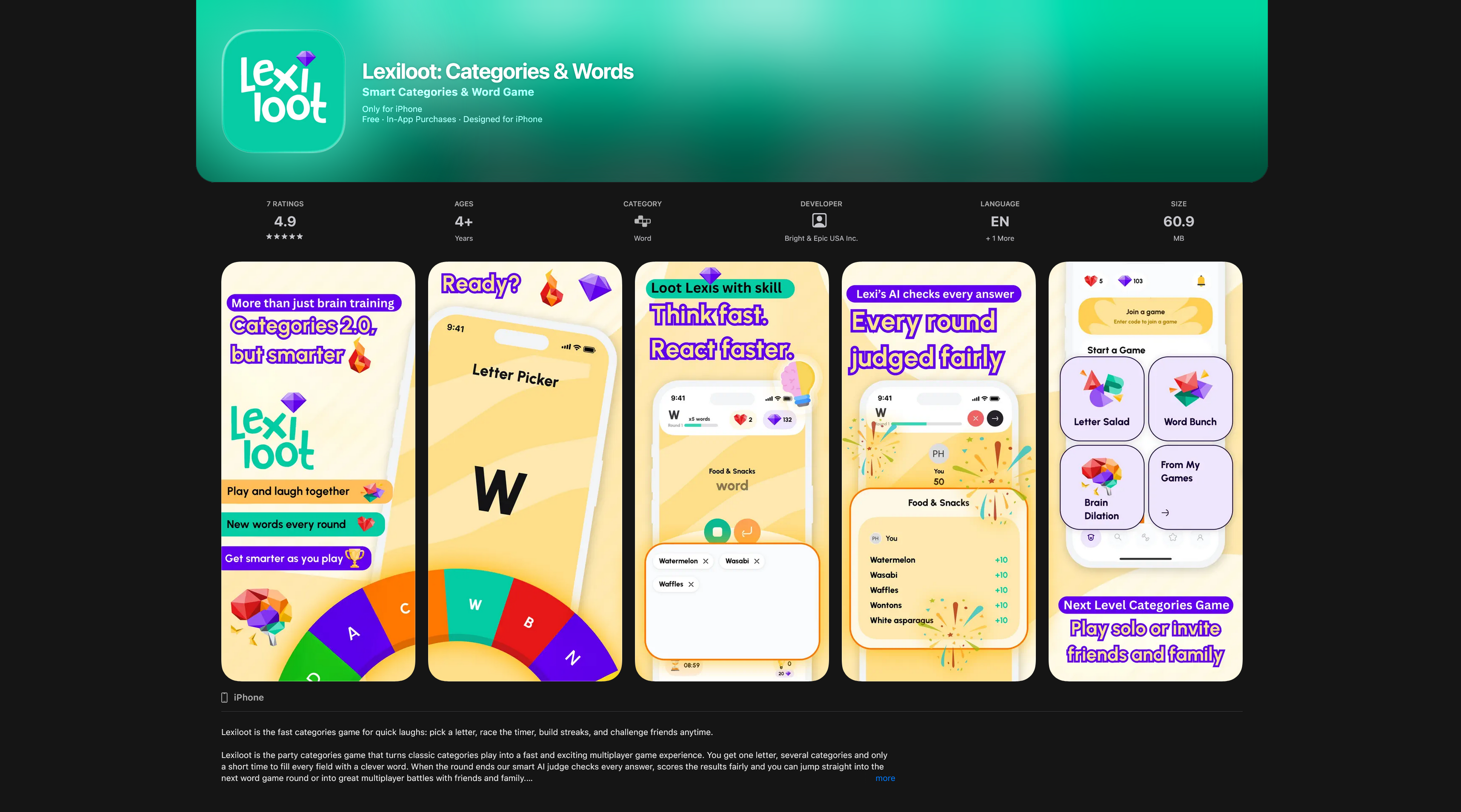
Start with the games in education guide for a research-backed overview of what makes educational games genuinely effective. If you want something ready to play right now with kids, the categories game for kids is a great place to start, whether you are at home or in a classroom. And if your family enjoys creative challenges and wordplay, check out creative word games for formats that build vocabulary while keeping everyone laughing. Lexiloot brings all of this together in one place, with no subscriptions and no manipulative ad loops, just focused, social word play your whole family can enjoy.
Frequently asked questions
What makes a game truly “casual” for families?
Casual family games are flexible, easy to pause and resume, and suitable for different ages playing together. The defining trait is low-commitment, interruptible play that does not penalize players for stepping away.
Do word games really improve vocabulary for kids?
Yes, structured vocabulary games with feedback and repetition are shown to significantly boost word skills and retention. A review of gamification in English language learning covering 30 studies found consistent positive impacts on vocabulary acquisition.
How can I make sure a game isn’t manipulative or risky for my child?
Check for aggressive ads, forced purchases, and confusing reward systems, and read beyond ESRB or app-store ratings to review actual design features. Parents should look beyond rating labels to spending pressure patterns before trusting a game with children.
How can young or beginner readers enjoy word games without frustration?
Choose games with level-based challenges, visual supports, extra hints, and simplified tasks to keep learning enjoyable and accessible. Difficulty ramping and support affordances are especially important for emergent or low-vocabulary learners who need a path forward rather than a wall.

