


Brain training can boost working memory by up to 30%, making it a powerful tool for families and educators seeking vocabulary and cognitive development. Yet many struggle to decode terms like neuroplasticity and executive function when choosing educational word games. This guide clarifies essential brain training concepts, linking them to practical game selection for classrooms and home use, so you can confidently choose tools that deliver measurable learning outcomes.
Table of Contents
- Understanding Brain Training Terms In Educational Word Games
- Key Vocabulary And Cognitive Skills Related To Brain Training
- The Role Of Social Environment In Brain Training Games
- Common Misconceptions About Brain Training Terms
- Comparison Framework Of Brain Training Concepts In Word Games
- Bridging Terminology To Practical Game Use In Families And Education
- Explore Lexiloot For Effective Brain Training Vocabulary Games
- Frequently Asked Questions About Brain Training Terms
Key takeaways
| Point | Details |
|---|---|
| Understanding brain training terms boosts vocabulary and cognitive skill development | Clarifying concepts like working memory and semantic processing helps you select games that target specific learning goals. |
| Social interaction enhances motivation and retention in brain training games | Group play activates neural reward pathways, leading to 15% higher vocabulary retention compared to solo practice. |
| Common misconceptions can hinder effective game use | Many assume all word games offer equal cognitive benefits, but only targeted, sustained practice drives neuroplastic change. |
| Comparison framework helps align terms with game mechanics | Matching cognitive skills to game features lets you evaluate educational apps systematically before adoption. |
| Practical tips guide educators and families in applying knowledge | Real-world strategies for integrating vocabulary games into learning routines maximize cognitive and engagement outcomes. |
Introduction to brain training in educational word games
Brain training refers to targeted cognitive exercises designed to enhance skills vital for language learning. Attention, memory, processing speed, and executive function form the foundation for vocabulary acquisition and verbal fluency. When you engage in educational word games, you’re not just memorizing definitions; you’re strengthening neural pathways that support comprehension, recall, and flexible language use.
Vocabulary development relies on cognitive skills working together. Semantic memory stores word meanings, while working memory holds information during complex tasks like sentence construction. Executive function coordinates these processes, letting you switch between categories, inhibit incorrect responses, and plan strategic word choices. Educational word games that challenge multiple cognitive domains simultaneously deliver the strongest learning outcomes.
Social game elements amplify these benefits by adding motivation and engagement. When families or classrooms play together, competition and collaboration activate reward systems in the brain. This emotional investment strengthens memory consolidation, making vocabulary stick. Apps like categories games for kids and classrooms harness these mechanisms by combining cognitive challenges with multiplayer modes, creating an environment where learning feels natural and fun.
Key cognitive domains targeted by educational word games:
- Attention networks that filter distractions and maintain focus during timed challenges
- Memory systems that encode, store, and retrieve word meanings and associations
- Processing speed that determines how quickly you recognize patterns and generate responses
- Executive functions that manage strategy, inhibition, and cognitive flexibility during gameplay
Understanding brain training terms in educational word games
Cognitive engagement describes the active mental effort required to process information and solve problems. High-engagement word games demand more than passive recognition; they force you to manipulate language actively, compare options, and make strategic decisions. This sustained mental effort drives the neural changes that improve vocabulary and cognitive performance over time.
Executive function serves as your brain’s control center, managing goal-directed behavior and self-regulation. In word games, executive skills help you plan category responses, switch between semantic networks, and inhibit obvious but incorrect answers. Strengthening these abilities through gameplay transfers to academic tasks like essay writing and reading comprehension, where similar cognitive control is essential.
Working memory holds information temporarily while you manipulate it. During category challenges, you must keep the prompt in mind, access relevant vocabulary, evaluate options for validity, and select the best response. Games that tax working memory capacity with time pressure or multiple constraints build this crucial cognitive resource, which correlates strongly with academic achievement across subjects.
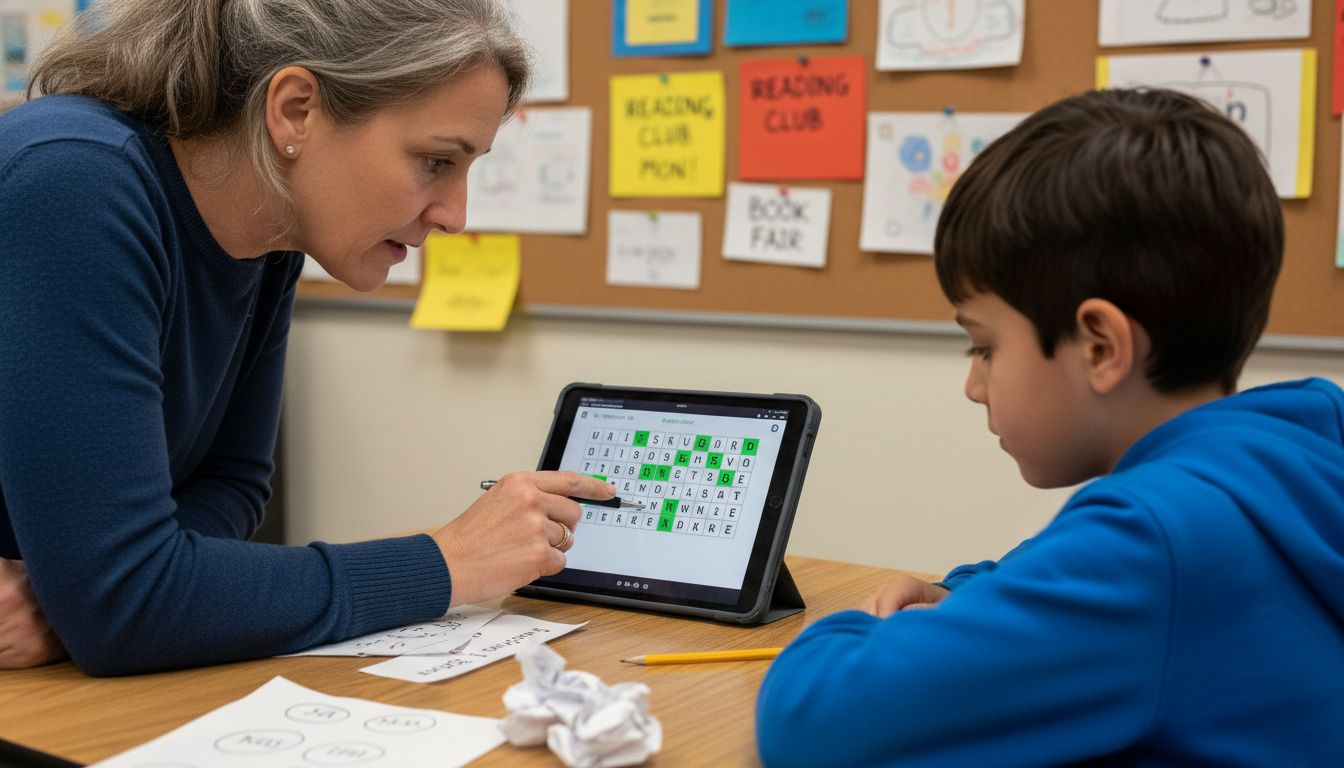
Semantic memory stores your knowledge of word meanings, concepts, and relationships between ideas. Educational word games expand semantic networks by exposing you to new vocabulary in context, creating multiple retrieval pathways. The more connections you build between related words and categories, the easier it becomes to access and use that vocabulary flexibly in different situations.
Neuroplasticity refers to the brain’s ability to reorganize and form new neural connections throughout life. Intensive brain training induces measurable neuroplastic changes in language processing areas within 6 to 8 weeks. This means sustained practice with challenging word games doesn’t just teach vocabulary; it physically reshapes the brain regions responsible for language processing, leading to lasting cognitive improvements.
Essential terms for evaluating brain training games:
- Cognitive load: the mental effort required during a task, with optimal learning occurring at moderate challenge levels
- Transfer effects: improvements in untrained tasks that result from brain training in a related domain
- Adaptive difficulty: games that adjust challenge level based on performance to maintain optimal engagement
- Spaced repetition: revisiting vocabulary at increasing intervals to strengthen long-term memory consolidation
Understanding these concepts helps you evaluate whether a categories game app delivers genuine cognitive benefits or just entertainment value. Look for games that progressively challenge multiple cognitive domains while providing feedback and adaptation to your skill level.
Key vocabulary and cognitive skills related to brain training
Vocabulary enhancement through word games relies on semantic memory expansion. When you encounter words in varied category contexts, you build richer mental representations that include multiple associations and usage examples. Research shows vocabulary size can increase 20 to 25% after sustained word game training over 8 weeks, particularly when games present words in meaningful semantic clusters rather than isolated lists.
Cognitive flexibility develops as you switch between different category frameworks and word associations. A single word might fit multiple categories depending on context, requiring you to inhibit dominant responses and consider alternative classifications. This mental agility transfers to academic tasks requiring perspective-taking, creative problem-solving, and adaptable thinking across subject domains.
Executive skills get a workout during timed category challenges that demand rapid retrieval, evaluation, and decision-making under pressure. You must maintain the category rule in working memory, search semantic networks efficiently, and monitor your responses for accuracy. Games that combine time pressure with category complexity create an ideal training ground for executive function development, which supports academic success across all subjects.
Language processing speed improves through repeated practice accessing and producing words quickly. Faster processing doesn’t mean sacrificing accuracy; it reflects more efficient neural pathways and stronger semantic networks. As you play vocabulary games regularly, you’ll notice quicker word recall in conversation and writing, along with improved reading fluency and comprehension speed.
Pro Tip: Choose games offering diverse category types to target different semantic networks. A mix of concrete categories (animals, foods), abstract categories (emotions, qualities), and function-based categories (things that fly, items in a kitchen) builds broader cognitive flexibility and vocabulary depth than games focusing on a single category type.
Critical vocabulary skills developed through brain training games:
- Semantic retrieval: accessing word meanings and associations quickly from long-term memory
- Categorical thinking: organizing knowledge into hierarchical structures and recognizing relationships
- Phonological processing: manipulating sound patterns in words to identify rhymes, syllables, and letter patterns
- Orthographic knowledge: understanding spelling patterns and written word forms to support reading and writing
Apps like the Valentines special word game demonstrate how thematic categories can make vocabulary practice more engaging while still targeting essential cognitive skills. Themed challenges add emotional relevance, which enhances memory encoding and makes learning feel purposeful rather than drill-based.
The role of social environment in brain training games
Social interaction transforms brain training from solitary practice into a motivating, emotionally engaging experience. When you play word games with family or classmates, competition activates dopamine pathways associated with reward and motivation. This neurochemical response strengthens memory consolidation, making vocabulary learned during social play more likely to stick in long-term memory than words encountered in isolated study.
Group play introduces accountability and social pressure that sustain engagement over time. You’re more likely to maintain regular practice when friends or family members expect you to participate in game sessions. This consistency is crucial because cognitive benefits from brain training require sustained practice over weeks or months, not sporadic attempts that fail to drive neuroplastic change.
Friendly competition provides immediate feedback on your performance relative to peers, helping you identify strengths and areas needing improvement. This social comparison motivates continued practice and creates natural scaffolding as you observe strategies used by more skilled players. The collaborative element in team-based word games adds another dimension, requiring communication and joint problem-solving that deepen engagement.
Research confirms that socially interactive brain training games produce 15% higher vocabulary retention than non-social games over three months. The emotional arousal and social bonding during group play create stronger memory traces, while the variety of opponents and teammates prevents boredom by introducing unpredictability into each session.
Pro Tip: Schedule regular family or classroom word game sessions rather than relying on spontaneous play. Consistent practice at the same time each week builds habit strength and ensures the sustained engagement necessary for measurable cognitive gains. Even 15 to 20 minutes per session delivers benefits when maintained over time.
Social gaming benefits that amplify brain training effects:
- Increased intrinsic motivation through enjoyment and social connection rather than external rewards
- Emotional arousal during competition that enhances memory encoding and consolidation
- Observational learning from watching others’ strategies and vocabulary choices
- Social accountability that maintains engagement when individual motivation wanes
Platforms offering free categories games online make social play accessible for families and classrooms without financial barriers. The low-stakes environment of free modes lets beginners build confidence before progressing to more challenging premium options that offer deeper vocabulary practice and advanced cognitive training.
Common misconceptions about brain training terms
Many people assume brain training games serve only as entertainment, dismissing scientific evidence supporting cognitive improvement. While enjoyment matters for sustained engagement, research shows properly designed vocabulary games produce measurable gains in working memory, processing speed, and language skills. However, only 35% of brain training apps on app stores meet established scientific criteria for cognitive improvement, so skepticism about generic word puzzles is warranted.
Common misunderstandings that confuse families and educators:
-
All word games offer equal brain training benefits: Not all games target cognitive skills systematically. Effective brain training requires progressive difficulty, multiple cognitive domains engaged simultaneously, and sustained practice over weeks. Casual word games lacking these features provide entertainment but minimal cognitive development.
-
Neuroplasticity means any mental activity reshapes the brain: While the brain remains plastic throughout life, meaningful neuroplastic changes require targeted, challenging practice that pushes cognitive limits. Passive activities or games below your skill level won’t drive the neural reorganization needed for lasting improvement.
-
Social interaction distracts from serious learning: This misconception treats learning as a solitary, effortful process. In reality, social engagement enhances motivation, activates reward pathways, and strengthens memory consolidation. The emotional investment during group play makes vocabulary stick better than isolated memorization.
-
Brain training effects don’t transfer to real-world skills: Well-designed games targeting executive function and semantic memory do show transfer effects to academic tasks. The key is choosing games that challenge cognitive skills broadly applicable beyond the game context, such as category switching and strategic planning.
-
Immediate results indicate effective brain training: Genuine cognitive change requires sustained practice over 6 to 8 weeks minimum. Apps promising instant brain boosts likely deliver temporary performance improvements through practice effects rather than lasting neuroplastic changes.
Understanding these misconceptions helps you avoid ineffective apps and set realistic expectations. Brain training vocabulary games work best when integrated into a broader learning strategy that includes reading, conversation, and varied language experiences beyond gameplay.
Comparison framework of brain training concepts in word games
A systematic framework helps you evaluate how brain training terms map to actual game features and learning outcomes. Organize concepts into three domains: cognitive skills targeted, vocabulary development mechanisms, and engagement systems. This structure lets you assess whether a word game delivers on its educational claims or merely packages entertainment as learning.
Cognitive skills domain includes working memory challenges (time limits, multiple constraints), executive function demands (strategy, inhibition, switching), and processing speed requirements (rapid retrieval, quick decisions). Games that combine these elements create cognitive load without overwhelming players, maintaining the moderate difficulty level where learning occurs most efficiently.
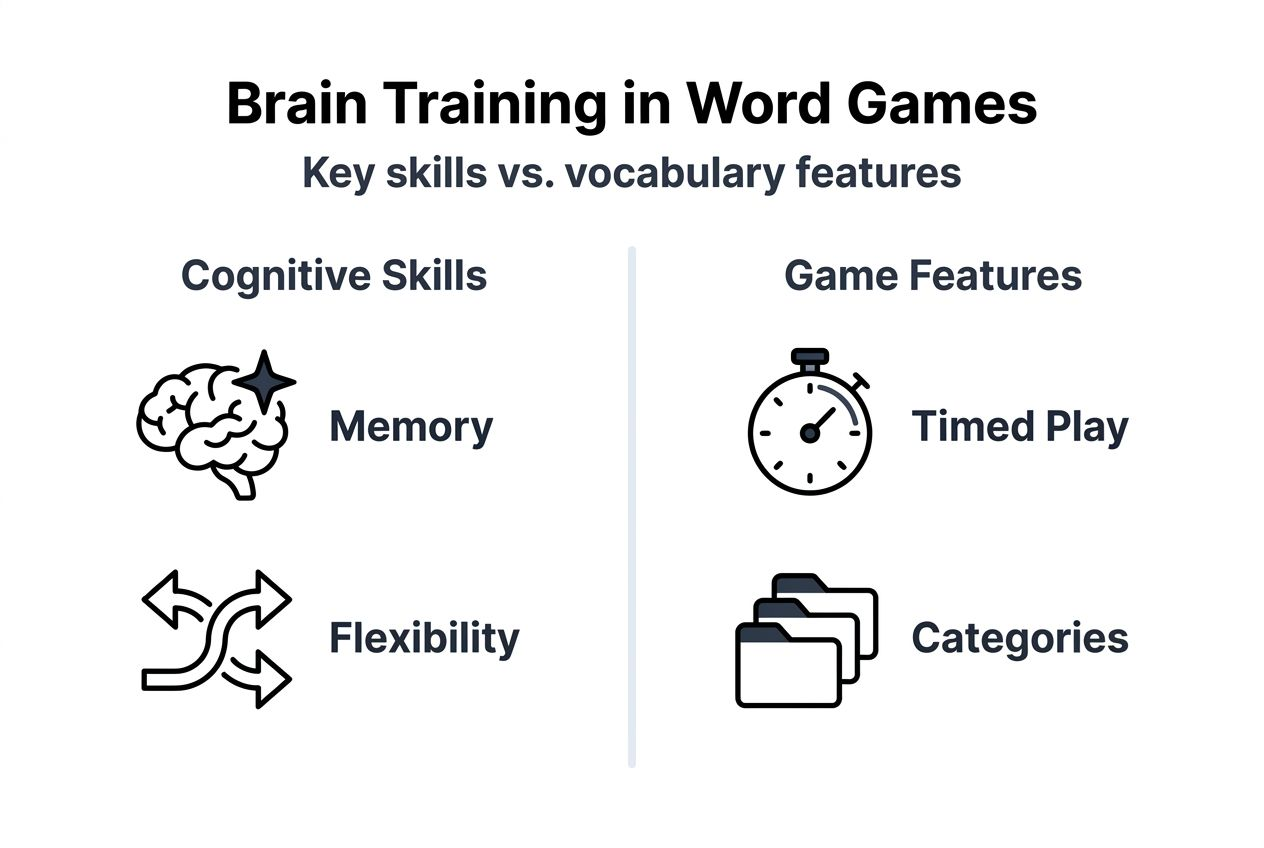
Vocabulary development mechanisms encompass semantic network expansion (varied category types, word relationships), contextual learning (words presented in meaningful situations), and spaced retrieval (revisiting vocabulary at intervals). Effective games don’t just expose you to new words; they create multiple retrieval opportunities and force you to use words flexibly across contexts.
Engagement mechanisms determine whether players stick with games long enough to experience cognitive benefits. Social features (multiplayer modes, leaderboards, friend challenges) and reward systems (progression tracking, achievement unlocking) maintain motivation. Adaptive difficulty keeps challenges appropriate to skill level, preventing frustration or boredom that kill engagement.
| Brain Training Term | Game Mechanic | Cognitive Outcome |
|---|---|---|
| Working Memory | Timed category responses with multiple constraints | Improved capacity to hold and manipulate information during complex tasks |
| Executive Function | Strategic word selection requiring inhibition and planning | Enhanced self-regulation and goal-directed behavior in academic contexts |
| Neuroplasticity | Progressive difficulty with sustained practice over weeks | Lasting neural changes in language processing areas of the brain |
| Semantic Memory | Varied category types building word associations | Expanded vocabulary with richer mental representations and flexible usage |
| Cognitive Flexibility | Category switching requiring alternative classifications | Better perspective-taking and creative problem-solving across subject domains |
| Social Cognition | Multiplayer competition and collaboration | Increased motivation and 15% higher retention through emotional engagement |
Pro Tip: Use this framework to evaluate new word games before adopting them in classroom or family settings. Ask whether the game explicitly targets multiple cognitive domains, how it builds vocabulary systematically, and what keeps players engaged beyond novelty. Games meeting criteria across all three domains deliver the strongest educational value.
The Scattergories alternative game approach demonstrates how classic category mechanics can be enhanced with modern brain training principles. By adding adaptive difficulty, social features, and systematic vocabulary building to familiar gameplay, apps create engaging experiences that deliver measurable cognitive benefits families and teachers can trust.
Bridging terminology to practical game use in families and education
Translating brain training concepts into action means selecting and using educational word games strategically. Look for apps offering both casual and competitive modes so players can build skills in low-pressure environments before tackling challenges requiring peak cognitive performance. Premium features like ad-free gameplay and advanced vocabulary modes justify investment when they deliver sustained engagement and measurable learning outcomes.
The pay-once model benefits families and teachers by eliminating subscription pressure while providing long-term access to brain training tools. Unlike subscription apps requiring monthly justification, pay-once options encourage experimental play and gradual skill building without financial anxiety. This pricing structure aligns better with educational settings where budgets are tight and long-term value matters more than constant new content.
Integrating gameplay into learning routines requires intention and structure. Schedule specific game times rather than treating vocabulary apps as time-fillers. Use category games as warm-ups before reading or writing tasks to activate semantic networks. Follow gameplay with brief discussions about new words encountered, reinforcing vocabulary through conversation and multiple exposures in varied contexts.
Practical recommendations for choosing effective vocabulary games:
- Verify the app targets multiple cognitive domains simultaneously, not just vocabulary memorization
- Check whether difficulty adapts to player skill level, maintaining optimal challenge
- Ensure social features support both competitive and collaborative play for varied engagement
- Look for progress tracking that shows vocabulary growth and cognitive skill development over time
- Confirm the app provides varied category types to build broad semantic networks and cognitive flexibility
Apps like Lexiloot exemplify these principles by combining categories games for kids and classrooms with multiplayer battles and systematic vocabulary building. The platform’s focus on cognitive training within an engaging social gaming environment makes it suitable for both casual family fun and serious educational use in classroom settings.
When planning game night with category challenges, mix difficulty levels and category types to keep all players engaged. Beginners benefit from concrete categories with obvious examples, while advanced players need abstract categories requiring deeper semantic processing. This differentiation lets families and mixed-ability classrooms play together productively, with each participant working at an appropriate challenge level.
Explore Lexiloot for effective brain training vocabulary games
Ready to apply these brain training insights? Lexiloot combines scientifically backed cognitive training with engaging social gameplay designed for families, students, and teachers. The app offers diverse game modes targeting vocabulary expansion, executive function, and working memory within a modern multiplayer platform. Whether you’re seeking casual family fun or serious classroom vocabulary practice, Lexiloot’s adaptive challenges and social features deliver measurable learning outcomes.
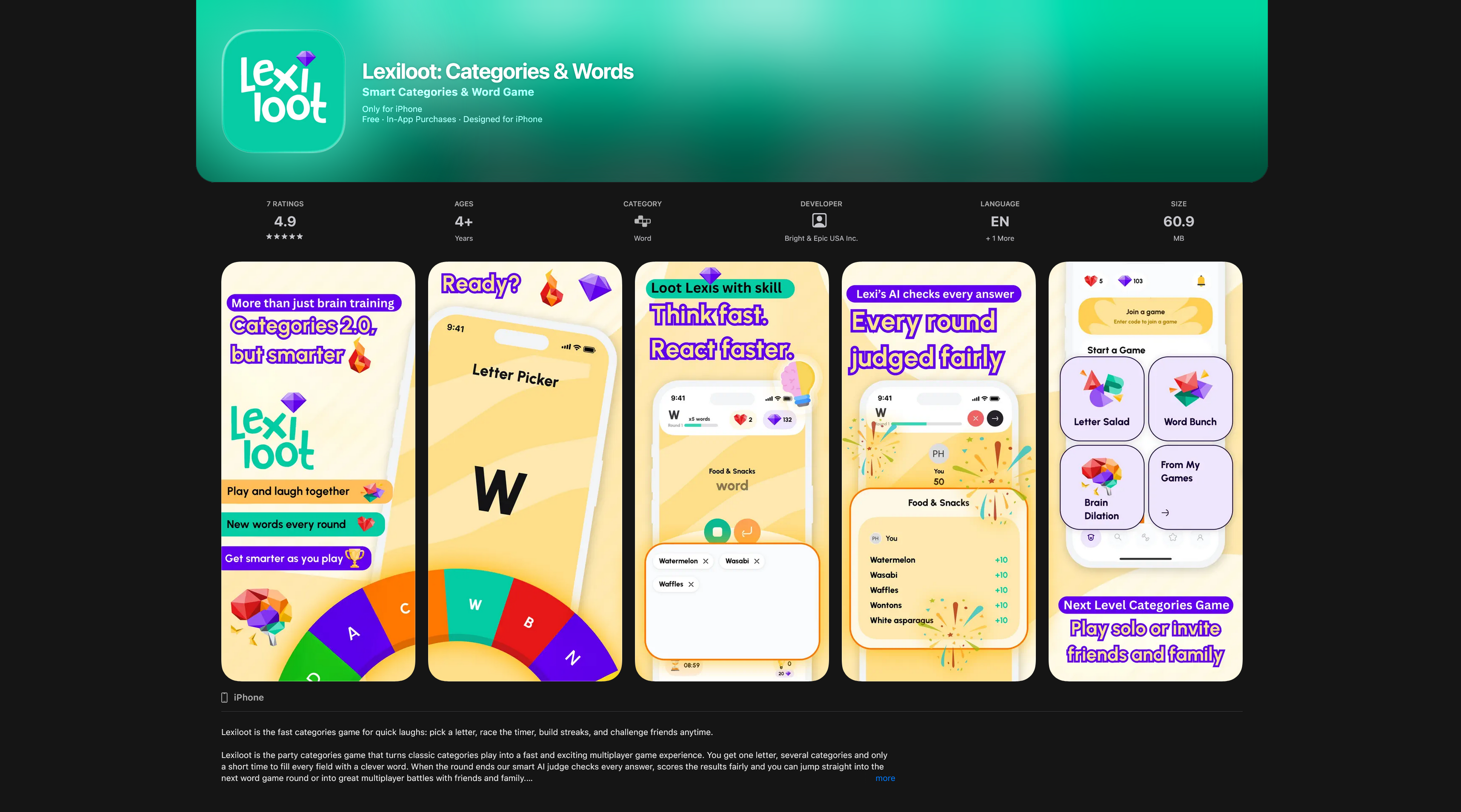
Start with free categories games online to experience the platform’s cognitive training approach without commitment. When you’re ready for deeper practice, premium modes provide ad-free gameplay, advanced vocabulary challenges, and brain training exercises targeting specific cognitive domains. The pay-once model means no subscription pressure, just long-term access to tools supporting vocabulary development and cognitive growth. Explore the categories game app today and discover how understanding brain training terms translates into real learning results for your family or classroom.
Frequently asked questions about brain training terms
What is neuroplasticity in brain training?
Neuroplasticity refers to the brain’s ability to form new neural connections and reorganize existing pathways throughout life. In brain training, sustained practice with challenging vocabulary games drives neuroplastic changes in language processing areas, typically requiring 6 to 8 weeks of consistent engagement to produce measurable cognitive improvements.
How does social play improve vocabulary retention?
Social interaction during gameplay activates dopamine reward pathways and creates emotional arousal that strengthens memory consolidation. Competition and collaboration add motivational elements that sustain engagement, resulting in 15% higher vocabulary retention compared to solo practice over three-month periods.
Which cognitive skills do word games target?
Effective word games challenge working memory through timed responses, executive function via strategic planning and inhibition, processing speed during rapid retrieval tasks, and semantic memory by building vocabulary associations. Games engaging multiple cognitive domains simultaneously deliver the strongest transfer effects to academic tasks.
Can all word games improve brain function?
No, only properly designed games targeting cognitive skills systematically produce measurable improvements. Generic word puzzles lacking progressive difficulty, adaptive challenges, and sustained practice requirements provide entertainment but minimal cognitive development. Research shows only 35% of brain training apps meet scientific criteria for effectiveness.
How do you choose effective brain training games?
Evaluate games across three domains: cognitive skills targeted (working memory, executive function, processing speed), vocabulary development mechanisms (semantic network building, contextual learning, spaced retrieval), and engagement systems (social features, adaptive difficulty, progress tracking). Games strong in all three areas deliver the best educational outcomes for families and classrooms.

