


Playing word games isn’t just a fun way to pass time. Recent research reveals that frequent word game play in middle and older age predicts significantly better global cognition 14 years later, with measurable improvements in memory, processing speed, and reasoning. Whether you’re a casual player looking to sharpen your mind or a competitive gamer aiming to expand your vocabulary, word games deliver real cognitive benefits across all ages. This guide explores the science behind these benefits, highlights popular games proven to enhance vocabulary, and shares strategies to maximize your learning while having fun.
Table of Contents
- Key takeaways
- How word games enhance cognitive skills and vocabulary
- Popular word games and their unique learning benefits
- The role of word game mechanics in effective vocabulary building
- Strategies to maximize benefits when playing word games
- Try Lexiloot’s engaging word games for all ages
- Frequently asked questions
Key Takeaways
| Point | Details |
|---|---|
| Long term cognition benefits | Frequent word game play in midlife and older age predicts better global cognition 14 years later with improvements in memory processing speed and reasoning. |
| Vocabulary gains across ages | Word games consistently improve vocabulary and language skills across diverse age groups through repetition practice and exposure. |
| Learning through challenge | The learning mechanism combines repetition challenging levels and social interaction to reinforce word knowledge and strategic thinking. |
| Immediate feedback training | Casual word puzzles offer scalable cognitive training with immediate feedback that reinforces effective strategies and metacognition. |
How word games enhance cognitive skills and vocabulary
Scientific evidence confirms that word games provide genuine cognitive training benefits. Research tracking middle-aged and older adults over 14 years found that frequent word game play predicts better global cognition, with players showing improved memory, faster processing speeds, and stronger reasoning abilities. These benefits persist long after the games are played, suggesting that regular engagement creates lasting neural pathways.
Word games work by challenging your brain to recall, recognize, and manipulate language patterns under time pressure or competitive conditions. This cognitive load strengthens neural connections related to language processing, pattern recognition, and problem solving. Studies demonstrate vocabulary improvements across diverse age groups, from young learners building foundational word knowledge to aging adults maintaining linguistic abilities.
The learning mechanism combines several powerful elements. Repetition reinforces word recognition and spelling patterns. Challenge levels push players beyond their comfort zones, forcing them to stretch their vocabulary and cognitive resources. Social interaction adds motivation and introduces new strategies through observation and competition. Together, these factors create an engaging environment where learning feels natural rather than forced.
Casual brain gaming through word puzzles offers scalable cognitive training that adapts to individual skill levels. Unlike passive vocabulary learning methods, word games provide immediate feedback and reward systems that reinforce successful strategies. Players develop metacognitive skills as they learn which approaches work best, building both vocabulary and strategic thinking simultaneously.
Pro Tip: Track your progress over weeks rather than days to notice meaningful vocabulary and cognitive improvements, as benefits accumulate gradually through consistent play.
Popular word games and their unique learning benefits
Different word games target vocabulary and cognitive skills through distinct mechanics, each offering unique learning advantages. Research on specific games reveals how their design elements translate into measurable educational outcomes.

Digital versions of Snakes and Ladders significantly improve vocabulary scores in young learners by combining movement-based gameplay with word recognition challenges. The game’s familiar board structure reduces cognitive load for learning mechanics, allowing children to focus mental resources on vocabulary acquisition. Visual cues and immediate feedback help reinforce correct word usage and spelling patterns.
The Deal or No Deal game enhances English vocabulary in grade 9 students by embedding word challenges within a high-stakes decision-making framework. The pressure of choosing cases creates emotional engagement that strengthens memory formation. Students must process vocabulary quickly while managing risk, building both language skills and cognitive flexibility.
Wordle gamification improves vocabulary proficiency in eighth-grade students through daily five-letter word puzzles. The game’s constraint of six guesses forces strategic thinking about letter frequency, word patterns, and phonetic relationships. Limited attempts create productive struggle that enhances retention compared to unlimited practice sessions.
| Game Type | Primary Mechanic | Best For | Key Benefit |
|---|---|---|---|
| Wordle | Guessing with feedback | Pattern recognition | Builds strategic vocabulary through constrained attempts |
| Snakes and Ladders | Movement with word tasks | Young learners | Combines familiar gameplay with vocabulary reinforcement |
| Deal or No Deal | Decision-making with words | Middle schoolers | Enhances vocabulary under pressure and time constraints |
| Cube-based games | Letter combination | All ages | Maximizes word exposure through extensive letter coverage |
Exploring different types of word games helps you identify which mechanics align with your learning goals. Guessing games like Wordle develop deductive reasoning and pattern analysis. Unscrambling challenges strengthen spelling and phonetic awareness. Cube-based models expose players to diverse letter combinations, expanding vocabulary breadth.
Pro Tip: Rotate between game types weekly to target different cognitive skills and prevent your brain from adapting too specifically to one mechanic, which maximizes overall vocabulary growth.
Applying proven word game strategies enhances both performance and learning outcomes. Start with common letter combinations, use process of elimination systematically, and analyze failed attempts to identify knowledge gaps.
The role of word game mechanics in effective vocabulary building
Word game mechanics create structured learning environments that optimize vocabulary acquisition through specific design elements. Understanding how these mechanics work helps you choose games that align with your learning objectives.
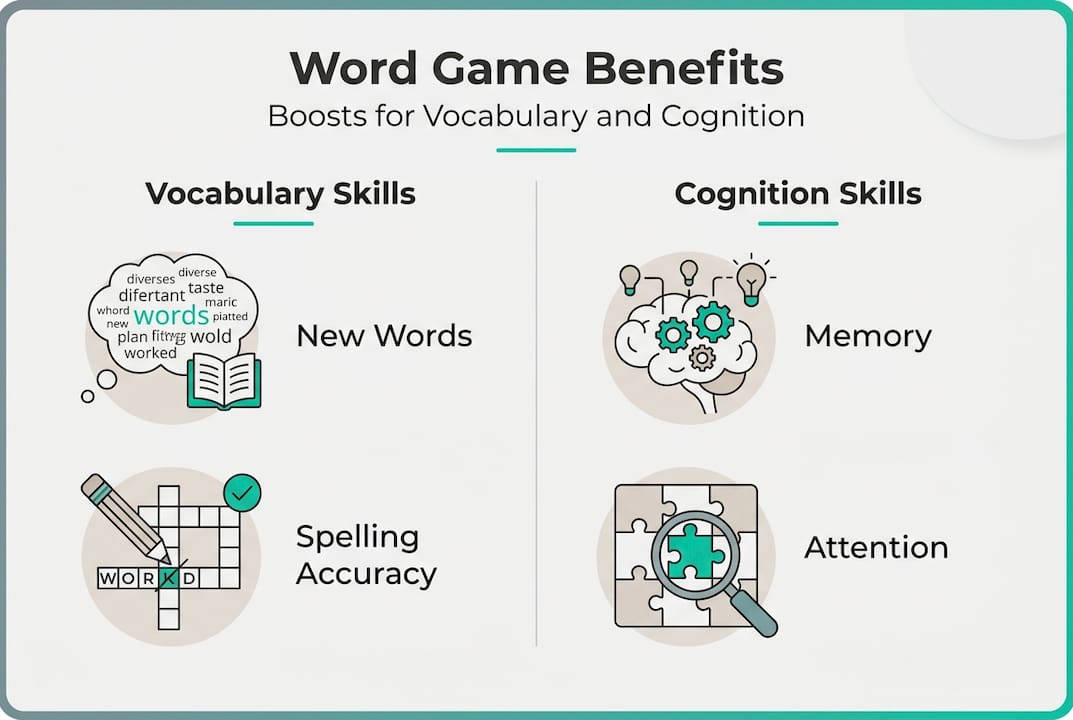
Unscrambling mechanics require players to recognize valid word patterns from jumbled letters. This process activates multiple cognitive pathways simultaneously, including visual pattern recognition, phonetic processing, and semantic memory. Players must mentally manipulate letter sequences, testing combinations against their vocabulary knowledge until they identify valid words. This trial-and-error approach strengthens neural connections between spelling patterns and word meanings.
Guessing mechanics, exemplified by Wordle-style games, provide graduated feedback that guides players toward correct answers. Each guess reveals which letters are correct and properly positioned, which are correct but misplaced, and which are absent entirely. This information structure teaches players to think strategically about letter frequency, common word patterns, and phonetic rules. The limited number of attempts creates productive cognitive load that enhances memory formation.
Cube-based models represent an advanced approach to word game design. The Advanced Cubic Game model achieves 89.5% coverage for three to five letter words using just eight cubes across multiple languages. This extensive coverage ensures players encounter a broad vocabulary range within compact gameplay sessions. The cubic structure allows for millions of possible combinations while maintaining accessibility through familiar letter arrangements.
Vocabulary retention improves when games provide repeated exposure within varied contexts. Each encounter with a word reinforces its spelling, meaning, and usage patterns. Context clues from surrounding letters or game scenarios help players infer meanings of unfamiliar words, expanding vocabulary through natural discovery rather than rote memorization.
The step-by-step process of vocabulary building through game mechanics:
- Initial exposure introduces new words within gameplay context, creating first impressions that link spelling patterns to meanings.
- Pattern recognition develops as players notice common letter combinations, prefixes, suffixes, and word structures across multiple encounters.
- Strategic application emerges when players consciously use learned vocabulary to solve new puzzles, reinforcing memory through active recall.
- Mastery occurs through repeated successful application, moving words from active vocabulary practice into automatic recognition and usage.
| Mechanic Type | Cognitive Process | Vocabulary Skill Developed | Learning Efficiency |
|---|---|---|---|
| Unscrambling | Pattern manipulation | Spelling and phonetics | High for visual learners |
| Guessing with feedback | Deductive reasoning | Strategic word selection | High for analytical thinkers |
| Cube combinations | Spatial reasoning | Broad vocabulary exposure | Excellent for extensive coverage |
| Timed challenges | Processing speed | Rapid word recall | Moderate but builds fluency |
Different mechanics target distinct language skills. Unscrambling strengthens spelling accuracy and phonetic awareness. Guessing games develop strategic thinking about word structure and letter frequency. Cube-based challenges maximize vocabulary breadth through extensive word exposure. Timed formats build processing speed and automatic word recognition.
Pro Tip: Combine games with different mechanics throughout your week to develop well-rounded vocabulary skills, as each mechanic strengthens different aspects of language processing and retention.
Exploring word puzzle varieties reveals additional mechanical approaches, from crossword-style intersections to category-based word association challenges, each offering unique cognitive benefits.
Strategies to maximize benefits when playing word games
Applying strategic approaches to word game play amplifies cognitive and vocabulary benefits. These evidence-based strategies help you extract maximum learning value from your gaming sessions.
Play word games regularly to maintain and build cognitive benefits over time. Research shows that frequent players demonstrate stronger cognition years later, suggesting that consistent engagement creates cumulative advantages. Aim for daily or near-daily sessions rather than sporadic marathon gaming. Short, regular practice sessions of 15 to 20 minutes prove more effective than occasional hour-long binges because distributed practice enhances long-term retention.
Gradually increase difficulty levels as your skills improve. Starting with games that match your current vocabulary level builds confidence and establishes baseline strategies. Once you achieve consistent success, step up to more challenging variants that introduce less common words, stricter time limits, or more complex mechanics. This progressive challenge keeps your brain engaged in active learning rather than automatic pattern execution.
Engage socially through multiplayer modes and competitive variants. Playing against friends or online opponents introduces new vocabulary and strategies through observation and interaction. You’ll encounter words you might not discover in solo play, expanding your vocabulary organically. Social elements also boost motivation and accountability, increasing the likelihood you’ll maintain regular play habits.
Avoid burnout by balancing challenge with enjoyment. If word games start feeling like tedious work rather than engaging entertainment, you risk abandoning them entirely. Mix competitive high-stakes games with casual relaxing puzzles. Celebrate progress and learning rather than fixating exclusively on winning. Remember that even unsuccessful attempts teach you new words and strategies.
Pro Tip: Alternate between casual and competitive modes each session to optimize learning gains while maintaining long-term motivation, as this balance prevents mental fatigue while maximizing vocabulary exposure.
Research on competitive word gaming found no major risks in competitive variants, with strategy emphasis adding positive challenge without identified downsides. This evidence supports the value of competitive play as a safe, effective learning tool.
Implement these specific tactics during gameplay:
- Analyze failed attempts to identify vocabulary gaps, then actively learn those missed words through context research or dictionary lookups.
- Keep a word journal documenting new vocabulary discovered during play, reviewing it weekly to reinforce learning.
- Challenge yourself with word games in topics outside your expertise to force vocabulary expansion beyond comfortable domains.
- Use practice modes without time pressure to experiment with different strategic approaches and learn from mistakes without stress.
Applying proven word game strategies systematically transforms casual play into structured learning. Focus on high-frequency letters first, use elimination strategies to narrow possibilities, and develop pattern recognition skills through conscious attention to successful word structures.
Try Lexiloot’s engaging word games for all ages
Ready to put these insights into practice? Lexiloot offers diverse word games designed to build vocabulary and cognitive skills through fun, engaging gameplay. Whether you’re introducing categories games to kids in classrooms or sharpening your competitive edge, Lexiloot provides game modes for every skill level and learning goal.
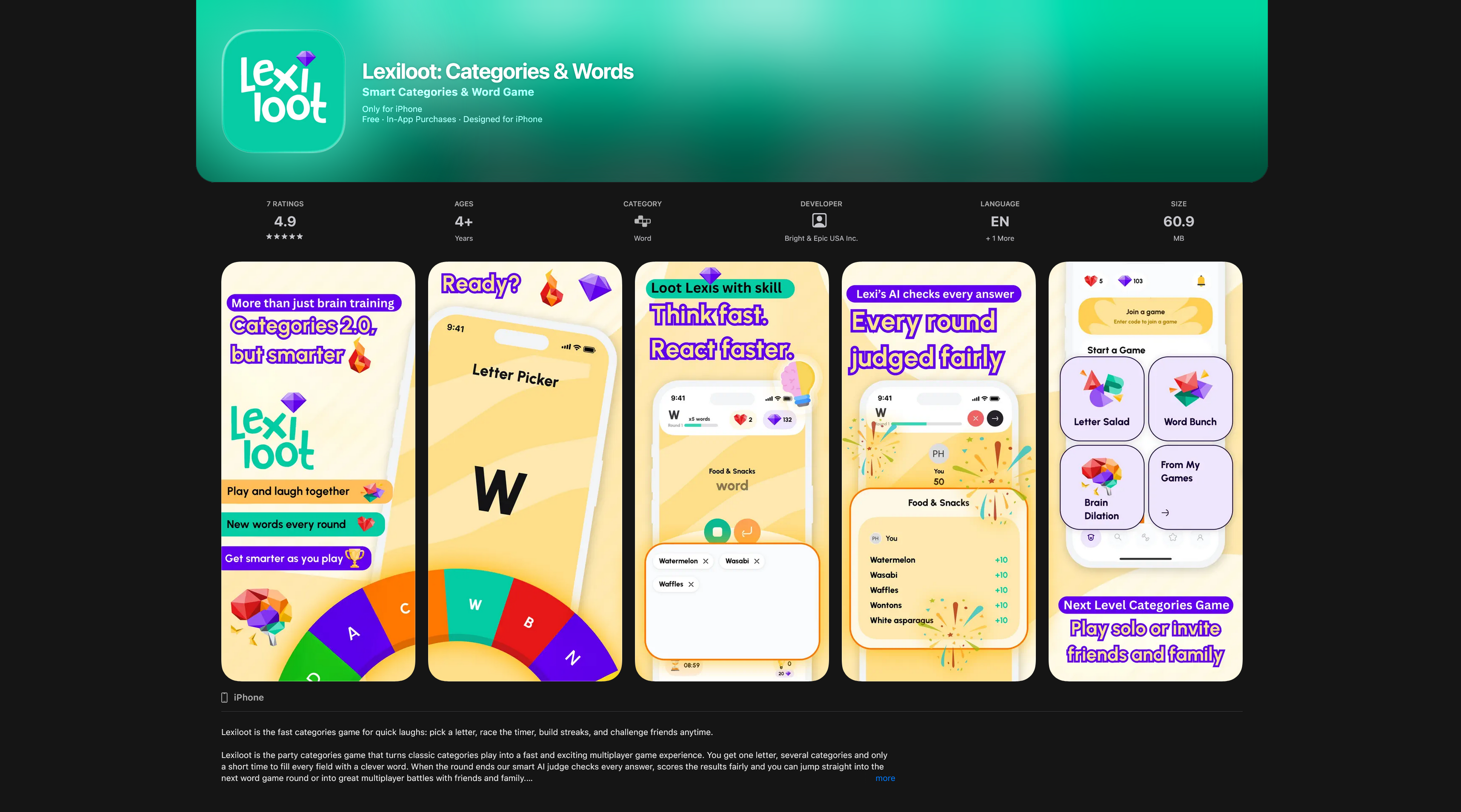
The platform combines casual word puzzles with competitive multiplayer challenges, letting you practice vocabulary building at your own pace or test your skills against friends and global players. Premium features unlock advanced brain training modes and ad-free gameplay through a simple pay-once model. Explore proven word game strategies to boost scores and brainpower, or dive into brain training terms and vocabulary games to understand the cognitive science behind your gameplay. Start building stronger vocabulary and sharper cognition today.
Frequently asked questions
What are the main cognitive benefits of playing word games?
Word games improve global cognition including memory, processing speed, and reasoning abilities. Research tracking players over 14 years shows that frequent word game engagement predicts better cognitive performance long-term. These benefits extend across age groups, from young learners building foundational skills to older adults maintaining mental sharpness.
How often should I play word games to see benefits?
Consistent, frequent play delivers the strongest long-term cognitive and vocabulary benefits. Daily or near-daily sessions of 15 to 20 minutes prove more effective than sporadic longer sessions because distributed practice enhances retention. Even casual, repeated play aids vocabulary growth and cognitive maintenance when sustained over weeks and months.
Are there any downsides to competitive word games?
No major risks have been identified in competitive word gaming research. Strategy emphasis in competitive variants adds positive cognitive challenge without noted downsides. The pressure of competition can actually enhance memory formation and engagement, making competitive play a valuable learning tool when balanced with casual gameplay to prevent burnout.
What types of word games boost vocabulary best?
Games featuring guessing mechanics, unscrambling challenges, and cube-based letter combinations prove most effective for vocabulary building. Popular games like Wordle, Deal or No Deal, and digital Snakes and Ladders show clear vocabulary benefits in research studies. The best choice depends on your learning style, with guessing games favoring analytical thinkers and unscrambling games benefiting visual learners.

