


TL;DR:
- Advanced vocabulary practice focuses on active use, retrieval, repetition, and contextual application.
- Combining retrieval, spaced repetition, and meaningful context leads to long-term vocabulary mastery.
- Using games and social activities enhances motivation and solidifies advanced word knowledge effectively.
Most people assume that advancing your vocabulary simply means tackling longer, harder word lists. The truth is more interesting. Effective advanced vocabulary practice mechanically combines active retrieval, spaced repetition, and learning in context to produce lasting retention and real-world usage. This article walks you through what advanced vocabulary practice actually means, breaks down the core strategies backed by research, explains how to measure your progress, and shows you why purposeful word games in a social setting deliver results that flashcard drills simply cannot match.
Table of Contents
- What does advanced vocabulary practice really mean?
- Core components: Retrieval, repetition, and context
- Benchmarks and measuring progress: What should you track?
- How advanced word games supercharge vocabulary growth
- What most experts miss about advanced vocabulary in practice
- Boost your vocabulary with games built for real learning
- Frequently asked questions
Key Takeaways
| Point | Details |
|---|---|
| Context beats rote memory | Meaning-rich, game-based approaches outperform memorizing lists for advanced vocabulary growth. |
| Combine retrieval and repetition | Practice recalling words over time for real retention—don’t rely on single exposures. |
| Benchmark your progress | Track receptive and productive vocabulary for a full picture of growth. |
| Games multiply motivation | Social, engaging word games keep practice fun and effective for all ages. |
What does advanced vocabulary practice really mean?
With the misconception of vocabulary learning shaken, let’s clarify what advanced practice actually involves. Most learners picture advanced vocabulary as a bigger, harder version of what they did in school: longer lists, tougher definitions, and stricter spelling tests. That picture is incomplete, and it holds a lot of people back.
Advanced vocabulary practice is really about moving words from passive recognition to active, flexible use. It means you can recall a word when you need it, use it correctly in a sentence, and understand its nuance when you encounter it in a different context. That takes more than memory work. It requires strategy.
The three pillars of truly advanced practice are:
- Active retrieval: Pulling words out of your memory on demand, rather than simply reading or re-reading a list.
- Spaced repetition: Revisiting words at increasing intervals, which moves them from short-term memory into long-term storage.
- Context-rich application: Using words in real sentences, category challenges, and meaning-driven activities rather than studying them in isolation.
These strategies apply to everyone. A curious seven-year-old playing a word game with engaging vocabulary challenges and a graduate student prepping for a high-stakes exam both benefit from the same evidence-based framework. The format may differ, but the underlying cognitive process is the same.
Research backs this up clearly. A 2025 quasi-experimental study found that meaning-first instruction outperformed form-first methods in vocabulary acquisition and sentence-level usage with an effect size of Cohen’s d = 1.37 after just 12 weeks, measured across 57 Grade-4 bilingual learners. That is a very large effect. It tells us that how a word is taught matters enormously, not just which words are chosen.
“Advanced vocabulary practice is not about memorizing harder words. It is about building deeper, more flexible connections between words and their meanings.”
For parents, teachers, and learners looking at teaching advanced word games as a classroom or home strategy, understanding this distinction changes everything. Instead of asking “how many words did you learn today,” the better question becomes “did you use those words in a sentence, a story, or a game challenge today?” That shift in thinking produces far better outcomes.
You can also explore how brain training vocabulary terms connect to cognitive development for a fuller picture of what is happening inside the brain when someone truly learns a word at an advanced level.
Core components: Retrieval, repetition, and context
Now that advanced vocabulary practice is defined, let’s unpack the strategies that make it work. Each element contributes something unique, and combining all three creates a learning loop that is significantly more powerful than any single strategy used alone.
Here is a clear breakdown of each component:
-
Active retrieval: This is the process of consciously recalling a word from memory rather than recognizing it on a page. Think of flashcard-style quizzes, fill-in-the-blank sentences, or oral recall challenges. Every time your brain searches for and retrieves a word, the neural pathway connected to that word gets stronger. Retrieval practice is sometimes called the “testing effect,” and it consistently outperforms passive re-reading in studies across age groups.
-
Spaced repetition: This method schedules reviews of words at carefully timed intervals, starting close together and spreading further apart as confidence grows. The idea is simple. If you review a word today, then again tomorrow, then in three days, then in a week, it gradually moves into long-term memory. If you cram all reviews into one session, the word fades quickly. Spaced repetition systems, whether in an app or on a structured card deck, do this scheduling automatically for you.
-
Context-rich application: This means encountering and using words inside meaningful situations. Sentences, stories, category groupings, and word association games all count. When a word is tied to a real meaning, a category, or a sentence you built yourself, your brain stores it with more “hooks,” making it easier to retrieve later. This is why cloze exercises (fill-in-the-blank sentences) and games that enhance vocabulary and cognition outperform simple definition matching.
The research reinforces exactly this combination. Advanced vocabulary practice consistently benefits from pairing active retrieval, spaced repetition, and sentence-level context to build long-term retention. Using one of these strategies is helpful. Using all three together is transformative.

| Strategy | What it does | Best format |
|---|---|---|
| Active retrieval | Strengthens word recall pathways | Quizzes, recall games, oral drills |
| Spaced repetition | Moves words to long-term memory | App-based review, scheduled revisits |
| Context application | Creates meaning connections | Sentence building, category games |
| All three combined | Maximizes retention and flexible use | Game-based learning platforms |
Pro Tip: When introducing a new word, do not just define it. Use it in a sentence, then challenge yourself to place it in a second, different sentence 24 hours later. This two-step habit is a mini-spaced repetition and context loop in action.
For learners and educators exploring modern word puzzles, understanding these components helps you choose formats that genuinely work, rather than activities that merely feel productive.
Benchmarks and measuring progress: What should you track?
Equipped with key practice methods, let’s look at the ways your progress can and should be measured. Progress in vocabulary is not always visible, and without some kind of benchmark, it is easy to feel like you are working hard without getting anywhere.
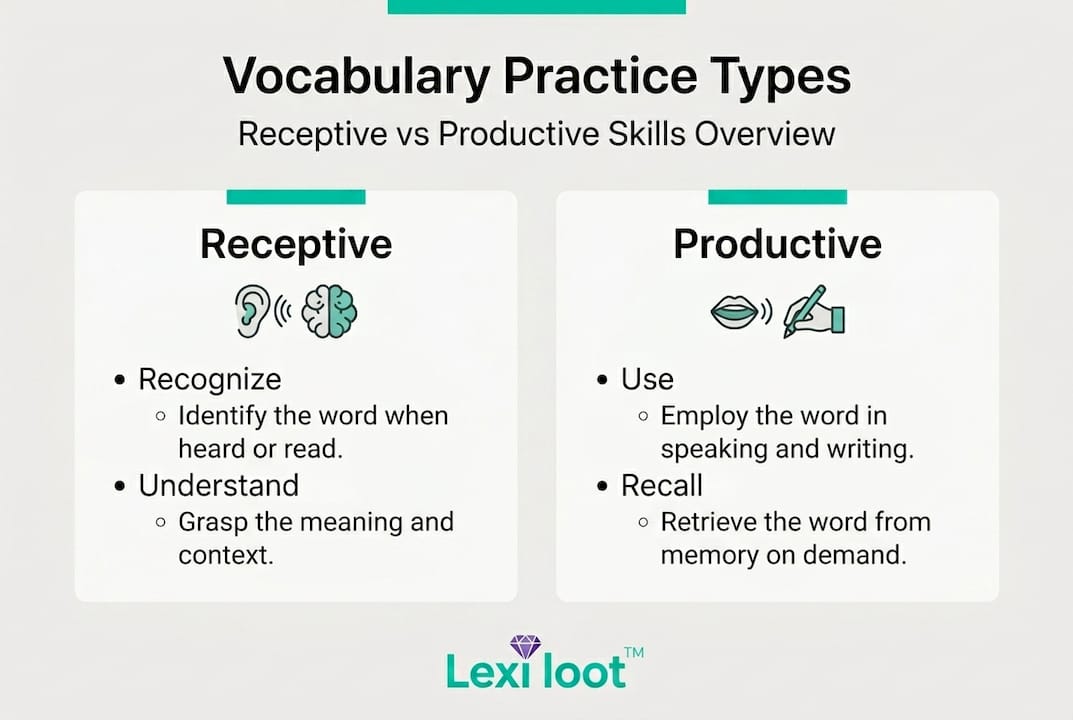
The first important concept to understand is the difference between receptive vocabulary and productive vocabulary. Receptive vocabulary refers to all the words you can recognize and understand when you read or hear them. Productive vocabulary is the smaller, harder-won set of words you can use correctly in speech or writing. Most people’s receptive vocabulary is much larger than their productive vocabulary, and advanced practice specifically aims to close that gap.
Here is a quick comparison:
| Vocabulary type | Definition | Measured by | Practice focus |
|---|---|---|---|
| Receptive | Words you recognize | Reading tests, recognition tasks | Exposure, wide reading |
| Productive | Words you actively use | Writing samples, oral output | Retrieval, sentence use |
| Contextual | Words you use accurately in context | Sentence-level assessments | Meaning-first practice |
Tracking both types matters because they tell different stories. Strong receptive scores with weak productive performance signal that your practice leans too heavily on recognition. You need more retrieval and context exercises to close the gap.
Research on assessment methods also highlights an important nuance. Vocabulary size and knowledge can be measured very differently, including by receptive versus productive tests and by fixed paper tests versus computerized adaptive assessments, all of which affects how success should be benchmarked. Computerized adaptive tests adjust difficulty in real time based on your responses, giving a faster and more accurate measure of true vocabulary knowledge compared to fixed, one-size-fits-all formats.
Practical benchmarks to track include:
- Word count growth: How many words can you use confidently in new sentences each week?
- Category breadth: Can you name 10 or more words in increasingly specific categories (not just “animals” but “nocturnal mammals”)?
- Sentence accuracy: When you use a new word in a sentence, is it grammatically and semantically correct?
- Retrieval speed: Are you recalling practiced words faster over time, with less effort?
Statistic to note: Studies comparing fixed versus adaptive computerized vocabulary tests found meaningful differences in accuracy of measurement, with adaptive formats often better reflecting true individual progress, especially for advanced learners.
Setting small, trackable goals like “use three new words correctly in conversation this week” makes advanced practice feel achievable and keeps motivation strong.
How advanced word games supercharge vocabulary growth
Once you understand how to measure your progress, you will want methods that keep motivation high. This is where purposeful games and social play excel.
Games are not a shortcut or a compromise on rigor. When designed well, they are one of the most efficient delivery systems for combining retrieval, repetition, and contextual learning in a format that people actually want to keep doing. That last part matters enormously. Consistency is the engine of vocabulary growth, and games solve the consistency problem by making practice enjoyable.
Here is how games build each of the three core components:
- Retrieval in real time: Every round of a word game requires you to pull words from memory under mild pressure. Category challenges, rapid-recall games, and timed puzzles all trigger active retrieval repeatedly in a single session.
- Natural spaced repetition: Good game platforms revisit words over multiple sessions, creating automatic spacing without the learner having to plan it. You encounter a word today, see it again in a different challenge tomorrow, and consolidate it next week.
- Meaning and category context: Category-based games specifically build what researchers call “semantic networks,” which are webs of meaning connecting related words. When you group words by theme, usage, or context, your brain stores them with richer connections, making retrieval faster and more accurate.
Research confirms that meaning-rich, contextual approaches yield stronger vocabulary gains than practice that focuses only on form, spelling, or isolated definitions. Games that ask you to build sentences, sort words into categories, or match words to their usage in a phrase are doing exactly what the evidence recommends.
Pro Tip: Play word games with others whenever possible. Social play adds a layer of motivation that solo drilling cannot replicate. When a friend challenges you on a word choice, or you compete on a leaderboard, your brain engages more deeply and retains more.
You can explore language game examples to see specific formats that blend retrieval and context effectively. For a broader look at the cognitive benefits beyond just vocabulary, the vocabulary and cognition boost resource walks you through the research in an accessible way.
Group play also supports learners of all ages. Families playing together around a shared vocabulary game, students competing in classroom leaderboards, and adult learners joining online word battles all experience the same motivational boost. The social element creates accountability and positive emotional associations with learning, both of which improve retention significantly.
What most experts miss about advanced vocabulary in practice
Most vocabulary guides focus on technique. They tell you to use spaced repetition, to learn in context, and to practice retrieval. That advice is correct. But there is something deeper that often gets left out: the mindset shift required to make those techniques actually stick in daily life.
We have seen this pattern repeatedly. A learner picks up a new method, uses it diligently for a few weeks, then quietly drifts back to re-reading word lists because lists feel familiar and controllable. The technique was never the problem. The underlying belief was. If you still privately believe that vocabulary growth comes from recognizing words rather than using them, your practice will keep defaulting to passive modes.
The evidence is clear on this point. Meaning-first vocabulary instruction significantly outperformed form-first approaches in both acquisition and sentence-level usage in recent research. This is not a minor difference. It is a fundamental argument for rethinking what “studying vocabulary” actually means in practice.
Building meaning pathways is the work. That means using new words in varied contexts, playing with word categories, making up unusual sentences, and getting corrected when you use a word wrong. It means treating every word game session as a small laboratory, not just entertainment. The game is the context. The social challenge is the retrieval. The combination is the repetition.
For educators especially, this matters when choosing tools and activities. A drill that tests spelling is testing something real, but it is not testing the word knowledge that builds reading comprehension and flexible communication. The most effective vocabulary instruction weaves meaning into every interaction with a word, from the first introduction to the hundredth encounter.
Do not skip the context step. It is not a bonus activity after the “real” learning is done. It is the real learning.
Boost your vocabulary with games built for real learning
If you are ready to apply what works best, here is a quick way to get started and where to find tools that do the heavy lifting for you.
The strategies covered in this article, retrieval, spaced repetition, and context-rich practice, are exactly what well-designed vocabulary games deliver every session. You do not need to build a study plan from scratch. You need a platform that bakes these methods into the gameplay itself.
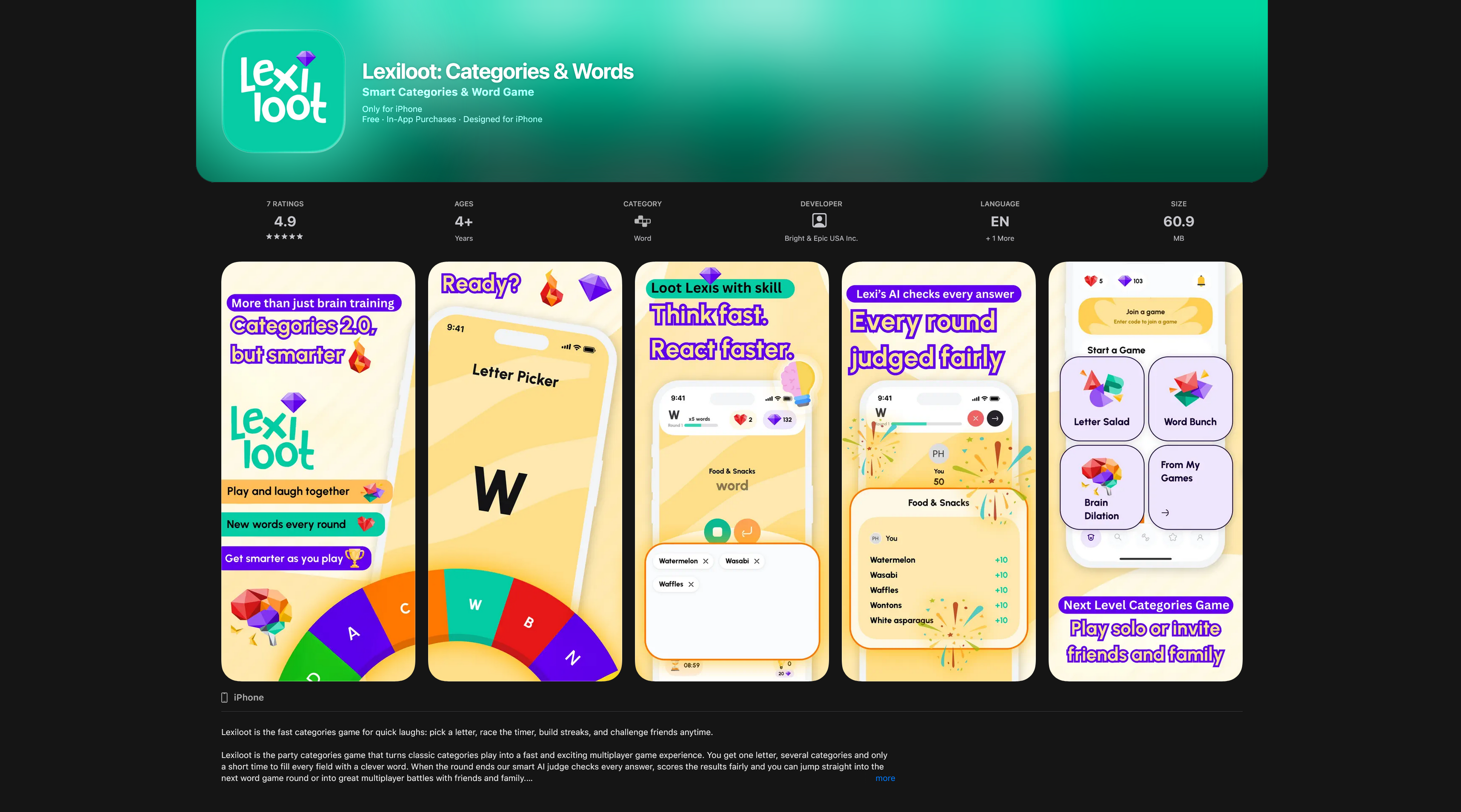
Lexiloot is built on this principle. Every game mode, from casual word puzzles to category battles and multiplayer leaderboard challenges, is designed to create genuine learning, not just entertainment. You can explore creative word game examples to see the variety available, and check out word game strategies to get more out of every session. For families, students, and serious language learners alike, Lexiloot’s focus on vocabulary and comprehension skills makes it a tool worth picking up today.
Frequently asked questions
What’s the difference between receptive and productive vocabulary?
Receptive vocabulary refers to words you recognize and understand when you read or hear them, while productive vocabulary includes words you can actively use in speaking or writing. Advanced practice specifically targets the gap between these two types.
Why do context and games help vocabulary stick?
Contextual learning and games trigger frequent, meaningful retrieval and application, which is why advanced vocabulary practice that combines retrieval, spaced repetition, and context consistently produces stronger, longer-lasting gains than passive study methods.
How long until advanced practice shows real results?
Evidence shows that 12 weeks of meaning-focused contextual practice can produce significantly improved vocabulary acquisition and sentence-level usage, as demonstrated in a 2025 study with a large effect size of Cohen’s d = 1.37.
Can adults and kids use the same advanced vocabulary methods?
Yes, strategies like retrieval practice, spaced repetition, and context-rich games are evidence-based and effective for learners of all ages, though the format and complexity of activities can be adjusted to fit each age group’s needs and interests.

