


TL;DR:
- Ads in mobile games disrupt flow, reducing cognitive engagement and learning benefits.
- Uninterrupted gameplay enhances memory, attention control, and vocabulary recall.
- Ad-free environments are especially vital for educational, therapeutic, and focused learning contexts.
Ads in mobile games feel like a minor inconvenience. But here’s what most players don’t realize: every time an ad pops up mid-puzzle, your brain doesn’t just pause. It actively resets. That reset costs you more than a few seconds of annoyance. It interrupts the mental state that makes word games and educational play so effective for building vocabulary, sharpening focus, and growing cognitive skills. Psychological research backs this up, and the findings are clearer than most casual gamers expect. This article walks you through exactly what happens in your brain during those interruptions, and why choosing ad-free gameplay can genuinely improve how much you learn and retain.
Table of Contents
- How ads disrupt flow and focus
- The science: Why uninterrupted gameplay boosts your brain
- Not all ads (or gamers) are the same: The nuanced reality
- Ad-free games in education and lifelong learning
- A fresh perspective: What most gamers and educators miss about ad-free design
- Discover ad-free word games for real learning gains
- Frequently asked questions
Key Takeaways
| Point | Details |
|---|---|
| Ad interruptions disrupt learning | Even short ads can break focus and make cognitive gains from games harder to achieve. |
| Uninterrupted play boosts brainpower | Sustained, ad-free gameplay supports better memory, attention, and problem-solving. |
| Ad-free matters most for focused players | Word game enthusiasts and learners benefit most from a distraction-free experience. |
| Optimize for education | Families and educators should choose ad-free games to maximize vocabulary and cognitive growth. |
How ads disrupt flow and focus
Let’s begin by looking at what really happens in your brain when an in-game ad appears.
In psychology, flow is a state of complete mental absorption in a task. When you’re in flow during a word game, your brain is actively retrieving vocabulary, pattern-matching, and problem-solving all at once. You’re not thinking about thinking. You’re just playing, and learning happens almost automatically. This is the sweet spot that makes brain gaming and puzzles so effective for cognitive development.
An ad breaks that state instantly. The moment a pop-up appears, your brain shifts from focused task processing to environmental scanning. It registers the new stimulus, decides it’s irrelevant, and then has to reload the mental context you were just in. That reload takes effort and time, even if you don’t consciously notice it.
“Interruptions are most disruptive when they are complex or similar to your current task, pulling more cognitive resources away from what you were doing.”
Research confirms that interruptions disrupt performance especially when the interrupting content is mentally demanding or resembles the task at hand. A video ad with words and voiceover is particularly costly during a word puzzle because both compete for the same language-processing resources in your brain.
The more cognitively rich the ad, the bigger the disruption. A simple banner at the edge of the screen is far less harmful than a full-screen video with narration. But even simple interruptions add up over a long play session.
Here are the most common ways ads interrupt casual gamers and word game players:
- Forced full-screen video ads between levels break problem-solving momentum completely
- Audio ads compete directly with internal language processing during vocabulary tasks
- Pop-up banners mid-puzzle redirect visual attention away from the game board
- Countdown timers on ads create urgency and stress that lingers into the next round
- Reward prompts (“Watch an ad to continue!”) introduce a decision point that disrupts focus
For anyone using games to build word games and cognition, these interruptions are more than frustrating. They actively reduce how much benefit you get from each session.
The science: Why uninterrupted gameplay boosts your brain
Understanding the disruption is only part of the story. Let’s see what happens in the brain when gameplay remains uninterrupted.
A landmark randomized clinical trial on cognitive improvements found that sustained mobile gameplay produced measurable gains in working memory, attention control, and problem-solving ability. Participants who played without interruption showed stronger results than those whose sessions were fragmented. The key word here is sustained. The brain needs time in focused engagement to build the neural pathways that support lasting cognitive skills.
Here’s how interrupted and uninterrupted gaming sessions compare across key cognitive outcomes:
| Cognitive skill | Uninterrupted gameplay | Ad-interrupted gameplay |
|---|---|---|
| Working memory | Significant improvement | Moderate or reduced gains |
| Attention control | Strengthened over time | Frequently reset by interruptions |
| Vocabulary recall | Builds progressively | Disrupted encoding mid-session |
| Problem-solving speed | Increases with flow | Slows after each ad break |
The three cognitive skills that benefit most from ad-free play are:
- Working memory. Word games require you to hold letters, words, and category rules in your mind at once. Uninterrupted play lets working memory stretch and strengthen without being wiped mid-task.
- Attention control. Staying focused on a complex puzzle trains your brain’s ability to filter distractions. Ads do the opposite. They train your brain to shift attention reactively.
- Vocabulary recall. When you stay in flow during a word game, your brain reinforces language pathways naturally. Interruptions break the encoding process before it completes, reducing how much vocabulary sticks.
Exploring word games and learning in a focused, uninterrupted environment is genuinely more effective. It’s not just a preference. It’s what the science supports.
For modern puzzles for vocabulary, the format matters just as much as the content.
Pro Tip: Set aside focused 15 to 20 minute sessions for word games without picking up your phone for anything else. Even a single uninterrupted stretch can produce noticeably better vocabulary recall compared to a scattered, ad-heavy hour of play.
Not all ads (or gamers) are the same: The nuanced reality
While ad-free gaming offers clear cognitive benefits, real-world gaming is a bit more complex.
You might assume that experienced gamers are better at tuning out ads. But ad avoidance is driven more by a player’s attitudes toward ads and games than by their level of gaming experience. In other words, how you feel about ads matters more than how many hours you’ve logged.
Some players are far more sensitive to interruptions than others. Here’s how ad impact tends to vary by gamer type:
| Gamer type | Ad sensitivity | Impact on gameplay |
|---|---|---|
| Casual word puzzle players | High | Strong disruption to focus and flow |
| Educational or classroom users | Very high | Cognitive and behavioral disruption |
| Competitive gamers | Moderate | Frustration, but faster recovery |
| Habitual mobile gamers | Lower | Adapted but still performance-affected |
Ad formats also matter. Rewarded ads (where you choose to watch in exchange for in-game benefits) are significantly less disruptive than forced pop-ups because the player retains a sense of control. Banners are the least harmful. Full-screen video ads with sound are the most damaging to flow and learning.
So who benefits most from going ad-free? Players seeking cognitive flow get the clearest gains. Word game enthusiasts working on vocabulary and spelling fluency see better session outcomes. Educators using games in classrooms need ad-free environments to keep students focused and to meet professional standards for screen time use. Puzzles for all-age training work best when the experience is seamless.
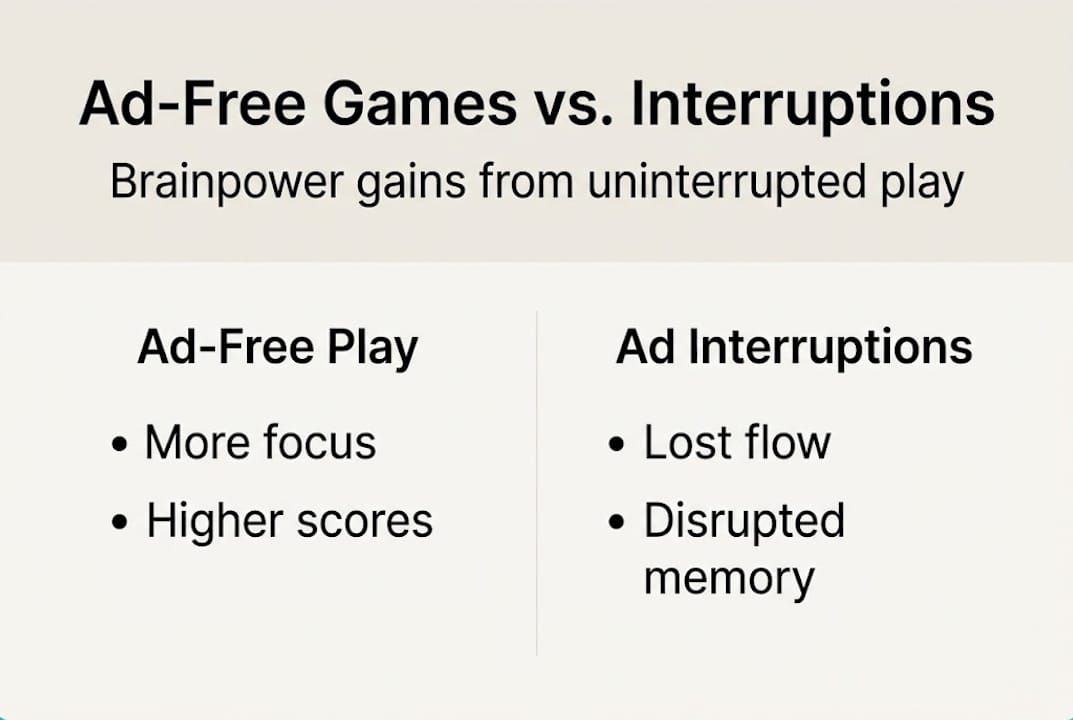
Pro Tip: Pay attention to how you feel after an ad-heavy session compared to an uninterrupted one. If you notice fatigue or lower scores, that’s your brain telling you the interruptions are taking a real toll.
Ad-free games in education and lifelong learning
This nuance matters even more when games are used for learning and skill development.
In classrooms, interruptions from ads don’t just distract one student. They break group momentum, raise questions from kids about inappropriate ad content, and reduce the educational value of the session. Teachers who use word games as part of vocabulary instruction need clean, predictable gameplay. An ad appearing mid-activity can derail an entire lesson.
At home, family vocabulary games benefit from the same uninterrupted structure. When parents and kids play together, ads create friction and pull attention in different directions. Ad-free games keep everyone in the same mental space, which supports shared learning and family bonding.
In cognitive rehabilitation and therapy settings, uninterrupted gameplay is even more critical. Patients retraining attention or language skills after injury or illness need consistent, controlled environments. An unexpected ad could undo minutes of careful cognitive work.
Key use cases where ad-free games make the biggest difference:
- School classrooms: Keeps lessons on track and avoids inappropriate or distracting ad content
- Home learning: Supports parent-child co-play and focused skill-building sessions
- Cognitive rehabilitation: Provides the predictable environment needed for structured brain training
- Senior cognitive training: Reduces confusion and frustration for older users building memory skills
- Competitive word game practice: Lets serious players build vocabulary fluency without performance interruptions
Clinical evidence supports this approach. Ad-free, sustained gameplay may be essential for maximizing cognitive development in educational settings, particularly when players need repeated, focused exposure to language tasks to build lasting skills.

When selecting games for educational use, look for apps with clear ad-free upgrade options, no autoplay video ads, and content that aligns with your learning goals. Exploring word game strategies alongside clean gameplay tools gives learners the best possible combination.
A fresh perspective: What most gamers and educators miss about ad-free design
Stepping back from the facts, here’s what most guides on ad-free gaming get wrong.
People frame the ad-free upgrade as a comfort purchase. No more annoying interruptions. That framing undersells it completely. Ad-free gameplay isn’t just about a smoother experience. It’s about creating the conditions where real learning can happen.
Most casual gamers significantly underestimate how much cognitive performance they lose to interruptions. The losses aren’t dramatic in any single moment. They accumulate quietly, session after session. Over time, that adds up to noticeably less vocabulary growth, weaker attention control, and a lower return on the time you invest in playing.
Educators have an even bigger opportunity here. If you’ve been using educational games in your classroom and feeling like the results are inconsistent, ad interruptions may be a larger factor than you’ve considered. Switching to word game trends in 2026 shows a clear move toward premium, uninterrupted formats precisely because the research supports their effectiveness. The real value of ad-free design is not what it removes. It’s what it protects: the cognitive flow that makes learning stick.
Discover ad-free word games for real learning gains
Ready for a truly brain-boosting, ad-free gaming experience?
Lexiloot offers a focused, distraction-free environment built specifically for word game enthusiasts, families, and educators who want real cognitive results. With creative word game examples across multiple formats, you get vocabulary building, category thinking challenges, and spelling fluency practice without a single pop-up breaking your focus.
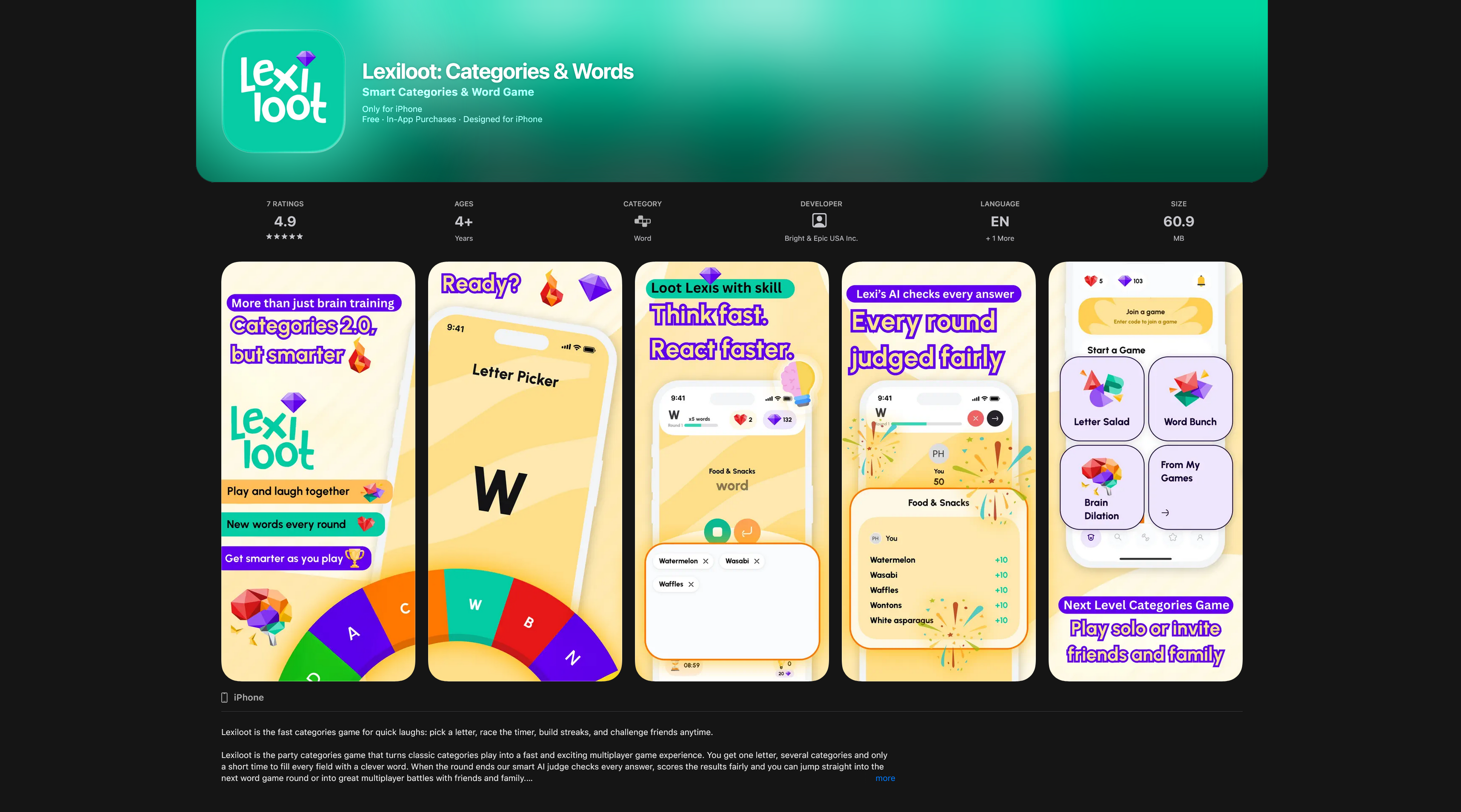
Whether you’re a teacher looking for categories game for classrooms or a parent wanting to boost vocabulary with games at home, Lexiloot’s pay-once premium model means no subscriptions and no interruptions. Just clean, effective, engaging play that supports genuine learning gains every session.
Frequently asked questions
How do in-game ads actually affect my performance in word games?
Ads disrupt your working memory and pull you out of the focused flow state your brain needs to solve puzzles efficiently. Even brief interruptions cause measurable disruption in cognitive tasks like vocabulary recall and pattern recognition.
Are ad-free games proven to boost cognitive function more than ad-supported ones?
Yes. Sustained mobile gameplay improved cognitive scores in a clinical trial, and uninterrupted sessions consistently show stronger gains in memory and attention than fragmented, ad-supported play.
Who gets the most benefit from ad-free word games?
Word game enthusiasts, learners in classroom settings, and anyone who finds interruptions particularly distracting see the greatest gains. Research shows that player attitudes toward ads strongly influence how disruptive those ads feel and how much they affect performance.
Can ad-supported games ever be as effective for learning?
They can, if ad placements are minimal and well-timed, but the overall evidence favors ad-free for deep cognitive learning. Designing less disruptive monetization helps preserve engagement, but it remains a case-by-case situation depending on format and player sensitivity.
Recommended
- Top types of brain games to boost skills and fun in 2026
- Word game trends 2026: fun learning with 25% boost
- Brain training games: 5 fun picks for sharper skills
- Premium brain training: boost skills with fun social games
- Schwimmen fürs Gehirn – Kognitive Vorteile für Kinder
- Educatief speelgoed trends 2026: slimme keuzes voor groei

